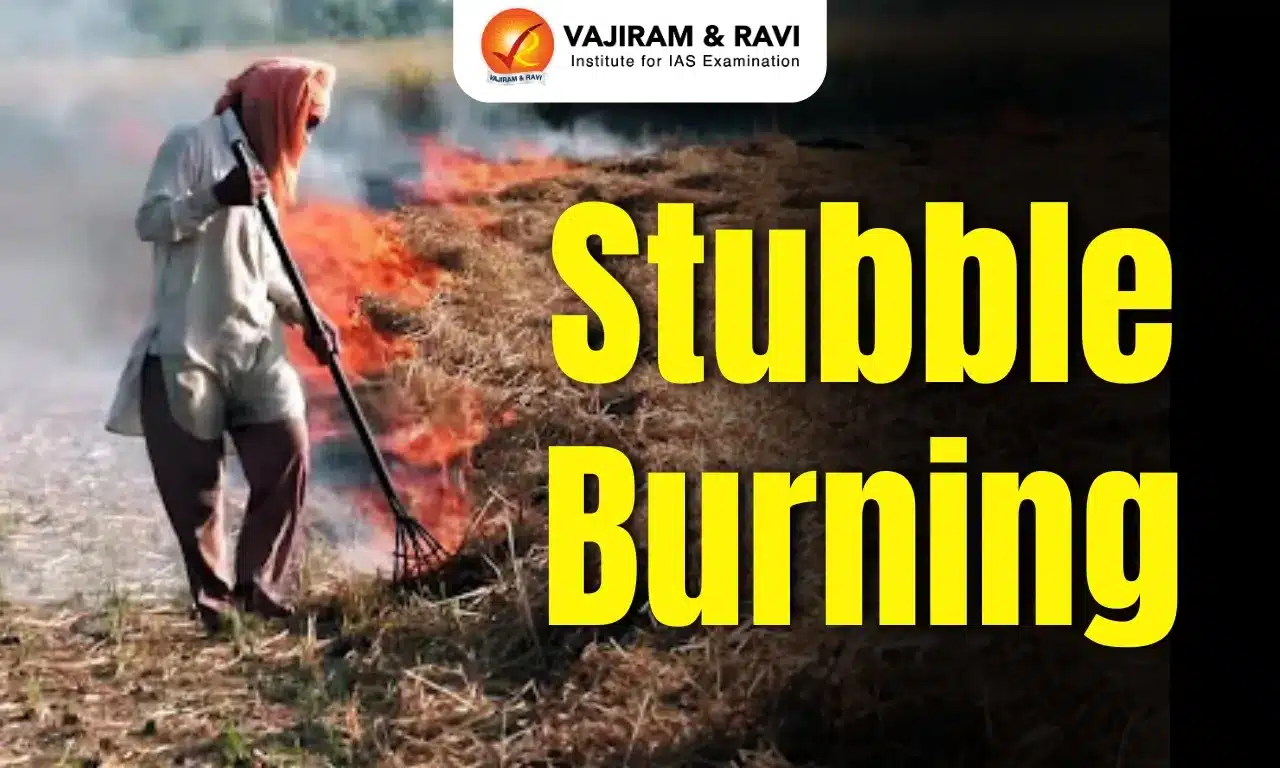
Stubble Burning Latest News
- The latest satellite-based data shows that while Punjab’s stubble burning incidents have reportedly declined by 70% in 2024, the total burnt farmland area remains almost unchanged.
Stubble Burning in Punjab: An Evolving Challenge
- Every autumn, vast swathes of north India are engulfed in haze as farmers burn paddy residue to clear fields for the next wheat crop.
- This annual cycle, especially prevalent in Punjab and Haryana, contributes significantly to air pollution across northern India, including the National Capital Region (NCR).
- The practice of stubble burning remains one of India’s most persistent environmental challenges, despite several years of government intervention, technological support, and public awareness campaigns.


The Problem of Crop Residue Burning
- Punjab, a leading rice and wheat-producing state, relies heavily on mechanised harvesting using combine harvesters.
- These machines leave behind paddy stubble that is difficult to remove manually. Given the short three-week window between paddy harvesting and wheat sowing, farmers find burning the residue the most cost-effective and time-efficient option.
- While the method helps prepare the fields quickly, it leads to massive emissions of particulate matter (PM2.5 and PM10), nitrogen oxides, and greenhouse gases.
- The smoke drifts toward neighbouring states, worsening air quality across Delhi-NCR and beyond.
Trends and Statistics: Is the Problem Really Declining?
- Recent data indicate a complex picture. According to the Punjab government’s satellite-based estimates, the state recorded 10,909 cases of stubble burning in 2024, a sharp 70% decline from 36,663 cases in 2023.
- This drop has been attributed to a mix of factors, including widespread flooding in mid-2024, which left large stretches of farmland inundated, and government-led initiatives promoting crop residue management.
- However, while the number of incidents has declined, the total burnt area has not shown a corresponding reduction.
- Data from the Punjab Remote Sensing Centre (PRSC) and the Punjab Pollution Control Board (PPCB) reveal that in 2024, nearly 19.17 lakh hectares of farmland were affected by stubble burning, almost identical to 19.14 lakh hectares in 2023.
- This suggests that although fewer fire incidents are being recorded, the fires that do occur are covering larger areas or are being underreported by existing detection systems.
Understanding the Data Discrepancy
- Experts point out that the apparent contradiction arises from technical and observational limitations in the way fire incidents are recorded.
- Satellite systems such as MODIS (Moderate Resolution Imaging Spectroradiometer) and VIIRS (Visible Infrared Imaging Radiometer Suite) detect fires based on thermal infrared imaging, essentially identifying heat anomalies on the Earth’s surface.
- However, these satellites pass over Punjab only a few times a day, often missing short-lived or smaller fires that occur in the late afternoon or evening, which are common in Punjab’s fragmented landholdings.
- A study by the Indian Institute of Science Education and Research (IISER), Mohali, found that cloud cover, haze, and the short duration of many farm fires lead to significant underreporting.
- Additionally, as farmers become aware of satellite monitoring, some have started covering up burnt patches or conducting burns strategically to avoid detection.
Advances in Monitoring and the Role of New Technologies
- Despite these limitations, advances in optical satellite imaging are improving accuracy.
- According to experts, optical sensors like Sentinel-2 can detect post-fire discolouration and burn scars, providing a more precise estimate of the total burnt area even when thermal sensors miss direct fire events.
- They emphasise that future assessments must integrate thermal and optical satellite observations, supported by ground-based verification, to accurately capture both the number of incidents and the extent of damage.
Policy Interventions and Way Forward
- The Central and Punjab governments have undertaken several initiatives over the years to tackle the stubble burning problem. These include:
- Subsidised Crop Residue Management (CRM) Machines: Distribution of happy seeders, super straw management systems, and mulchers to promote in-situ residue management.
- Ex-situ Biomass Utilisation: Encouraging biomass-based power plants and ethanol production to use paddy straw.
- Financial Incentives: Direct benefit transfers to farmers adopting non-burning methods.
- Monitoring and Enforcement: Deployment of real-time monitoring via satellites and drones, coupled with local enforcement by district administrations.
- However, experts argue that these measures need long-term economic incentives, not just penalties or machinery subsidies.
- Shifting to short-duration paddy varieties, promoting crop diversification, and ensuring timely procurement and financial compensation for alternative practices are crucial for sustainable change.
Rethinking Metrics of Success
- While the declining number of recorded fires is encouraging, it is not a complete measure of progress. Thus, future assessments must focus not just on the number of incidents but also on fire intensity, duration, and emission load to accurately gauge environmental impact.
- In the long term, the fight against stubble burning will depend on integrated policies combining technology, economics, and behavioural change, ensuring that sustainable practices are both viable and profitable for Punjab’s farmers.
Source: TH

 Last updated on Oct, 2026
→ UPSC 2027 Notification will be released on 13 January 2027 at upsconline.nic.in.
→ Asian Games 2026 are being held in Aichi-Nagoya, Japan, from 19 September to 4 October.
→ Check out the latest UPSC Syllabus here.
→ Download UPSC Model Answers for Mains 2026
→ UPSC Mains Question Paper 2026 is out now for Essay & GS Paper 1, 2, 3 & 4.
→ UPSC Calendar 2027 has been released.
→ Enroll in Vajiram & Ravi’s UPSC Mains Test Series 2027 for structured answer writing practice, expert evaluation, and exam-oriented feedback.
→ Join Vajiram & Ravi’s UPSC Mentorship Program 2027 for personalized guidance, strategy planning, and one-to-one support from experienced mentors.
→ Go through the UPSC Mains Previous Year Papers to enhance your preparation.
→ UPSC has released UPSC Toppers List 2025 with the Civil Services final result on its official website.
→ Download PIB PRiSM Monthly Magazine 2026 here.
→ Also check Best UPSC Coaching in India
Stubble Burning FAQs
Q1. Why do farmers in Punjab resort to stubble burning?+
Q2. Has stubble burning in Punjab declined recently?+
Q3. Why do satellite data and ground realities differ?+
Q4. What technologies are improving stubble burn monitoring?+
Q5. What long-term solutions are proposed to reduce stubble burning?+
Tags: mains articles stubble burning upsc current affairs upsc mains current affairs