Gyan Bharatam Mission Latest News
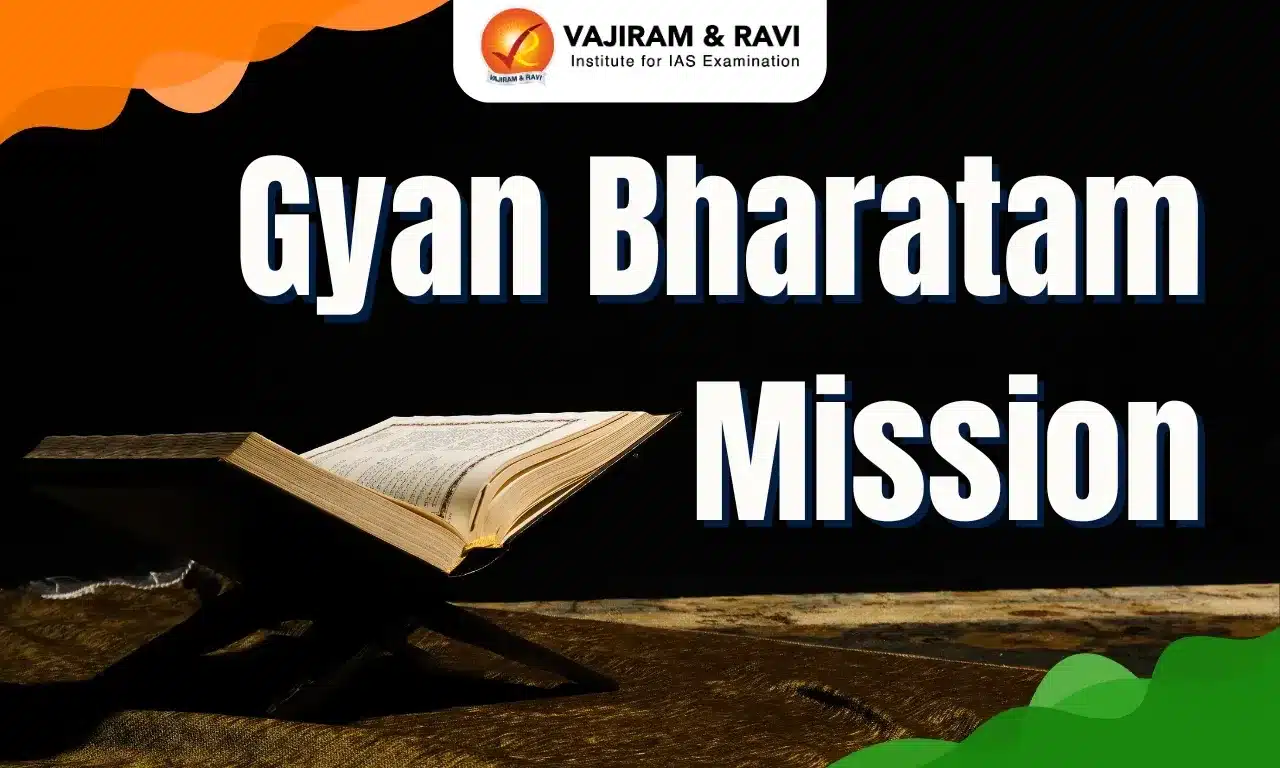
- The Gyan Bharatam Mission, launched by the Ministry of Culture, is set to sign MoUs with around 50 institutions across India to conserve, digitise, and promote the country’s vast repository of ancient manuscripts.
Background
- India is home to one of the richest manuscript traditions in the world, with millions of ancient documents in diverse languages such as Sanskrit, Pali, Prakrit, Tamil, Persian, and Arabic.
- These manuscripts embody the intellectual and spiritual heritage of India’s civilisational history, spanning literature, philosophy, medicine, astronomy, mathematics, law, and governance.
- However, many of these invaluable records remain scattered across libraries, monasteries, and private collections, facing the constant threat of decay due to environmental and preservation challenges.
- Recognising the need for a coordinated national effort to conserve and digitise this vast legacy, the Government of India launched the Gyan Bharatam Mission, a flagship initiative of the Ministry of Culture.


About the Gyan Bharatam Mission
- The Gyan Bharatam Mission aims to identify, document, conserve, digitise, and promote India’s manuscript heritage through a systematic and technology-driven approach.
- The mission’s core mandate is to create a National Digital Repository (NDR), a centralised digital platform to make manuscripts accessible to scholars and the public across the world.
- The NDR will serve as India’s largest knowledge archive, hosting digital copies of manuscripts sourced from universities, monasteries, libraries, and research institutes.
- It also seeks to connect India’s rich knowledge traditions with contemporary academic research, encouraging comparative studies and interdisciplinary collaborations.
Institutional Collaboration and MoUs
- The Gyan Bharatam Mission will sign Memorandums of Understanding (MoUs) with around 20 institutes on October 25, 2025, for the conservation, upkeep, and digitisation of manuscripts.
- According to the Ministry of Culture, 30 more institutes will sign similar agreements in the following days.
- These partnerships reflect the mission’s pan-India reach, covering both regional and national repositories.
Cluster and Independent Centre Framework
- To streamline execution, the participating institutions have been categorised as Cluster Centres and Independent Centres:
- Cluster Centres: These institutions will manage manuscript-related activities for themselves and up to 20 partner centres, ensuring collaboration and uniform standards of preservation and documentation.
- Independent Centres: These will focus exclusively on their own collections, handling conservation, digitisation, and cataloguing independently.
- The Gyan Bharatam Mission will provide technical guidance, funding, and monitoring, ensuring adherence to standard protocols for conservation and digitisation.
- Each centre will establish a dedicated “Gyan Bharatam Cell”, comprising experts in linguistics, conservation, digitisation, and research. These cells will act as the nodal communication and implementation teams within their respective institutions.
Funding and Financial Oversight
- The mission’s financial structure is designed for transparency and accountability. Funds will be released in two instalments:
- First Instalment (70%) – Disbursed after approval of the annual budget and work plan.
- Second Instalment (30%) – Released upon submission of progress reports, utilisation certificates, quality verification, and approval by third-party auditors.
- This phased funding ensures that each participating institution meets its conservation and digitisation milestones with measurable results.
Focus Areas and Key Activities
- The Gyan Bharatam Mission has identified six thematic verticals for its partner institutions:
- Survey and Cataloguing – Identifying and recording manuscript holdings across India.
- Conservation and Capacity Building – Training personnel in manuscript restoration and preventive care.
- Technology and Digitisation – Using high-resolution scanners and AI-assisted tools to preserve texts digitally.
- Linguistics and Translation – Promoting the study and translation of rare texts into contemporary languages.
- Research and Publication – Facilitating academic work based on digitised materials.
- Outreach and Public Awareness – Encouraging public participation in preserving India’s intellectual legacy.
- By integrating these verticals, the mission aims to balance preservation with access, ensuring that ancient knowledge systems are not lost to time but revived for modern scholarship.
Broader Significance and Global Context
- The Gyan Bharatam Mission aligns with India’s broader goal of “Reclaiming India’s Knowledge Legacy”, as highlighted during the first-ever international conference on manuscripts held by the Culture Ministry in 2025.
- Globally, the initiative reflects India’s commitment to protecting intangible cultural heritage in line with UNESCO’s Memory of the World Programme.
- It also strengthens India’s soft power by showcasing its civilisational wisdom and promoting cross-cultural academic collaboration.
- Moreover, the creation of the National Digital Repository will complement the government’s Digital India initiative, bridging technology with culture and scholarship.
Source: TH

 Last updated on Oct, 2026
→ UPSC 2027 Notification will be released on 13 January 2027 at upsconline.nic.in.
→ Asian Games 2026 are being held in Aichi-Nagoya, Japan, from 19 September to 4 October.
→ Check Nobel Prize 2026 Winners List here.
→ Download PIB PRiSM Monthly Magazine 2026 here.
→ Check UPSC Monthly Current Affairs Magazine The Recitals here.
→ Check out the latest UPSC Syllabus here.
→ Download UPSC Model Answers for Mains 2026
→ UPSC Mains Question Paper 2026 is out now for Essay & GS Paper 1, 2, 3 & 4.
→ UPSC Calendar 2027 has been released.
→ Enroll in Vajiram & Ravi’s UPSC Mains Test Series 2027 for structured answer writing practice, expert evaluation, and exam-oriented feedback.
→ Join Vajiram & Ravi’s UPSC Mentorship Program 2027 for personalized guidance, strategy planning, and one-to-one support from experienced mentors.
→ Go through the UPSC Mains Previous Year Papers to enhance your preparation.
→ UPSC has released UPSC Toppers List 2025 with the Civil Services final result on its official website.
→ Also check Best UPSC Coaching in India
Gyan Bharatam Mission FAQs
Q1. What is the Gyan Bharatam Mission?+
Q2. How many institutes are signing MoUs under the mission?+
Q3. What is the National Digital Repository (NDR)?+
Q4. How will funds be released to partner institutes?+
Q5. What are the key focus areas of the mission?+
Tags: gyan bharatam mission mains articles upsc current affairs upsc mains current affairs