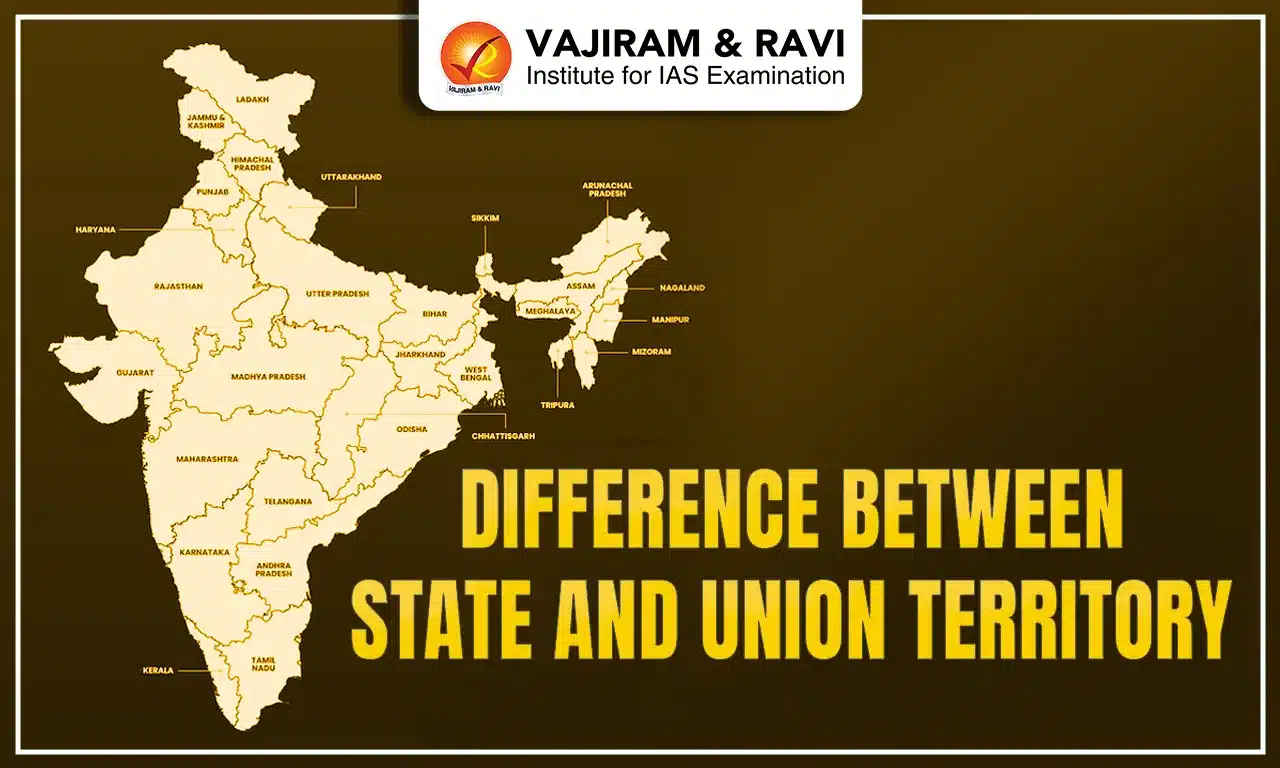
The section on States and Union Territories in the Indian Constitution lays out the organizational structure of India’s political subdivisions. It defines the division of the country into states and union territories, their modes of governance, and the constitutional mechanisms through which new states or union territories can be created, altered, or administered. India is explicitly described as a “Union of States”, highlighting its federal character, while retaining a strong central authority. Parliament possesses the exclusive power to establish new states, admit territories into the Union, or alter existing state boundaries, names, or territories.
Difference Between State and Union Territories
The Constitution of India provides a robust framework for the organization and administration of its states and union territories. By describing India as a “Union of States”, it balances federal principles with central supremacy. Articles 1-4, along with the First and Fourth Schedules, outline the powers of Parliament to admit, form, or reorganize states and territories without requiring constitutional amendments.
India’s federal character is unique in that it allows Parliament to alter state boundaries or create new states independently, unlike federations such as the USA, where state consent is necessary. Over time, a series of commissions and legislative actions, from the Dhar Commission to the Fazl Ali Commission and the States Reorganization Act (1956), have shaped India’s modern administrative map, responding to administrative efficiency, linguistic diversity, and regional demands. The distinction between states and union territories reflects the degree of autonomy, legislative powers, and administrative control, highlighting the adaptive and dynamic nature of India’s territorial and political structure. Post-1956, India has witnessed significant transformations in its political map, reflecting its commitment to administrative efficiency, linguistic recognition, and democratic governance. Thus, India continues to function as “an indestructible union of destructible states”, with a system that allows for flexibility in territorial administration, while ensuring unity and sovereignty of the Union.
States and Union Territories Governing Constitutional Provisions
- Article 1: Name and Territory of the Union
- Article 1 declares India, also known as Bharat, to be a Union of States. It further classifies the territory of India into three categories:
- Territories of the States – As of 2020, India has 28 states.
- Union Territories specified in the First Schedule – India has 8 UTs as of 2020.
- Acquired territories – Areas that may be acquired by the Union in the future.
- Administration:
- States: Members of the federal system, sharing power with the Union.
- Union Territories (UTs): Administered directly by the Central Government.
- Acquired Territories: Also under direct administration by the Centre.
- Article 2: Admission or Establishment of New States
- Article 2 empowers Parliament to undertake two distinct actions:
- Admission of existing states into the Union.
- Establishment of new states that did not previously exist.
- This provision primarily concerns states not already part of the Union of India.
- Schedule 1 lists all states and their territorial jurisdictions, serving as a reference for India’s official administrative divisions.
- Article 3: Formation of New States and Alteration of Boundaries
- Article 3 empowers Parliament to undertake internal territorial adjustments, including:
- Forming a new state by separating a territory from an existing state, uniting parts of two or more states, or merging territories with parts of states.
- Increasing or decreasing the area of a state.
- Altering the name or boundaries of a state.
- Conditions under Article 3:
- Prior Sanction of the President: Any bill proposing such changes must first receive the President’s recommendation.
- Consultation with the State Legislature: The President must seek the views of the affected state legislature within a specified timeframe. However, Parliament may disregard the views of the state legislature and proceed with the changes.
- For union territories, Parliament can act without consulting the legislature.
- Thus, the Constitution does not guarantee the territorial integrity of states, making India an “indestructible union of destructible states”, in contrast to the United States, described as “an indestructible union of indestructible states.”
- Article 4: Amendment of Schedules
- Laws passed under Articles 2 and 3 for admitting, forming, or altering states do not require a constitutional amendment under Article 368. They can be passed through a simple majority in Parliament.


States and Union Territories Important Concepts
- Union of States vs. Federation of States:
- India is a Union of States, not a federation formed by agreement among the states, unlike the USA.
- States cannot secede from the Union.
- Territorial Integrity:
- Parliament may alter state boundaries or form new states without the consent of the states involved.
- This emphasizes the supremacy of the Union.
- Cession of Territory:
- The Supreme Court clarified that Parliament’s powers under Article 3 do not extend to ceding Indian territory to foreign nations.
- Such a cession requires a constitutional amendment under Article 368.
- Example: The 100th Constitutional Amendment (2015) dealt with the transfer of enclaves between India and Bangladesh.
- Boundary Disputes:
- Disputes with foreign countries not involving cession can be resolved through executive action without a constitutional amendment.
- Example: The 1969 settlement of a boundary dispute with a neighboring country.
- Territory of India:
- A broader term including states, union territories, and any future acquired territories.
- The Union of India includes only the states.
Committees on State Reorganization
- Dhar Commission (1948):
- Set up by President Rajendra Prasad in June 1948 as the Linguistic Provinces Commission.
- Members: SK Dhar, Jagat Narain Lal, and Panna Lall.
- Report submitted in December 1948.
- Recommended reorganization based on administrative convenience rather than linguistic lines.
- Focused on Madras, Bombay, Central Provinces, and Berar, prioritizing geographical, financial, and administrative factors.
- JVP Committee (1948–49):
- Members: Jawaharlal Nehru, Vallabhbhai Patel, Pattabhi Sitaramayya.
- Tasked to examine Dhar Commission proposals.
- Report submitted in April 1949.
- Rejected language as a criterion for reorganization.
- Andhra State (1953):
- First linguistic state in India.
- Formed by separating Telugu-speaking areas from Madras State.
- Fazl Ali Commission (1953–55):
- Members: Fazl Ali (Chairman), K.M. Panikkar, H.N. Kunzru.
- Accepted language as a basis for reorganization, but rejected the one-language-one-state principle.
- Recommendations implemented via the States Reorganization Act (1956) and the 7th Constitutional Amendment, creating 14 states and 6 UTs on 1 November 1956.
Difference Between States and Union Territories
States and Union Territories have the following differences:
| Feature | States | Union Territories |
|
Autonomy |
High; share powers with the Centre |
Low; under direct control of the Centre |
|
Administrative Setup |
Relatively uniform |
Varied, no uniformity |
|
Head |
Governor |
Administrator/Lt. Governor/Chief Commissioner |
|
Lawmaking |
Parliament cannot legislate on state subjects except in extraordinary circumstances |
Parliament can legislate on any subject, including state list subjects |
Formation of States and UTs Post-1956
States and Territories in 1956:
- States: Andhra Pradesh, Assam, Bihar, Bombay, Jammu & Kashmir, Kerala, Madhya Pradesh, Madras, Mysore, Orissa, Punjab, Rajasthan, Uttar Pradesh, West Bengal.
- UTs: Andaman & Nicobar Islands, Delhi, Himachal Pradesh, Laccadive, Minicoy & Amindivi Islands, Manipur, Tripura.
States and UTs Created After 1956:
| Year | States / UTs Created |
|
1960 |
Maharashtra and Gujarat (bifurcation) |
|
1961 |
Dadra & Nagar Haveli (10th Amendment) |
|
1962 |
Goa, Daman & Diu (12th Amendment); Puducherry (French transfer) |
|
1963 |
Nagaland |
|
1966 |
Chandigarh, Punjab, Haryana |
|
1971 |
Himachal Pradesh |
|
1987 |
Mizoram, Arunachal Pradesh, Goa |
|
2000 |
Chhattisgarh, Uttarakhand, Jharkhand |
|
2014 |
Telangana |
|
2019 |
2 UTs: Jammu & Kashmir and Ladakh |
|
2020 |
Merger of Dadra & Nagar Haveli and Daman & Diu |

 Last updated on Oct, 2026
→ UPSC 2027 Notification will be released on 13 January 2027 at upsconline.nic.in.
→ Check Nobel Prize 2026 Winners List here.
→ Download PIB PRiSM Monthly Magazine 2026 here.
→ Check UPSC Monthly Current Affairs Magazine The Recitals here.
→ Check out the latest UPSC Syllabus here.
→ Download UPSC Model Answers for Mains 2026
→ UPSC Mains Question Paper 2026 is out now for Essay & GS Paper 1, 2, 3 & 4.
→ UPSC Calendar 2027 has been released.
→ Enroll in Vajiram & Ravi’s UPSC Mains Test Series 2027 for structured answer writing practice, expert evaluation, and exam-oriented feedback.
→ Join Vajiram & Ravi’s UPSC Mentorship Program 2027 for personalized guidance, strategy planning, and one-to-one support from experienced mentors.
→ Go through the UPSC Mains Previous Year Papers to enhance your preparation.
→ UPSC has released UPSC Toppers List 2025 with the Civil Services final result on its official website.
→ Also check Best UPSC Coaching in India
Difference Between State and Union Territory FAQs
Q1. What is the difference between a Union Territory and a State?+
Q2. Why is Delhi a Union Territory and not a State?+
Q3. What is the difference between Union and State?+
Q4. Why is a territory called a Union Territory?+
Q5. Why is India divided into States and Union Territories?+
Tags: difference between state and union territory