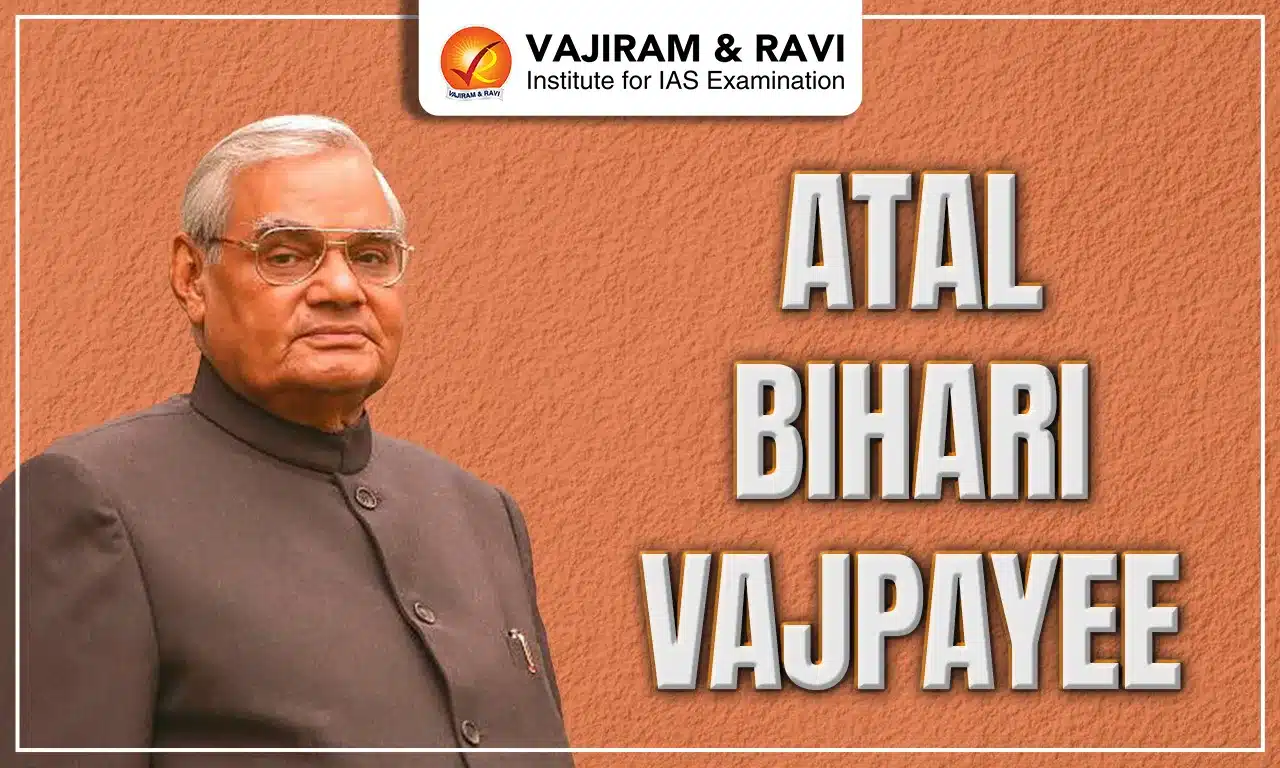
Atal Bihari Vajpayee was one of India’s most respected leaders, known for his vision, eloquence, and statesmanship. A freedom fighter turned parliamentarian, he played a pivotal role in shaping modern India through his policies of development, diplomacy, and national security. Serving three times as Prime Minister, Vajpayee’s leadership marked a new era of governance, combining economic reforms with national pride and inclusive growth.
Atal Bihari Vajpayee
Atal Bihari Vajpayee was a visionary leader, poet, and statesman who shaped modern Indian politics with integrity and inclusiveness. Born on 25 December 1924 in Gwalior, he began as a freedom activist and later co-founded the Bharatiya Jana Sangh and Bharatiya Janata Party (BJP). Known for his eloquence and moderate politics, he served thrice as India’s Prime Minister, emphasizing economic reforms, diplomacy, and national unity. His poetic works reflected his deep love for India and human values.
Atal Bihari Vajpayee Early Life
Atal Bihari Vajpayee was born on December 25, 1924, in Gwalior, Madhya Pradesh. His father, Krishna Bihari Vajpayee, was a school teacher, and his mother, Krishna Devi, was a homemaker. He attended Saraswati Shishu Mandir and later completed his post-graduation in Political Science from DAV College, Kanpur. During his student life, he was deeply influenced by nationalist ideas and joined the Rashtriya Swayamsevak Sangh (RSS) in 1939, marking the beginning of his political journey.
Read About: Mahatma Gandhi


Atal Bihari Vajpayee Political Journey
Vajpayee’s political career began with his association with the Bharatiya Jana Sangh (BJS), the predecessor of today’s Bharatiya Janata Party (BJP). He entered the Indian Parliament for the first time in 1957 from Balrampur, Uttar Pradesh. Known for his oratory, Vajpayee soon became one of the most respected opposition leaders.
In 1980, after the dissolution of the Janata Party, he co-founded the Bharatiya Janata Party (BJP) and became its first president. Under his guidance, BJP adopted the slogan “Gandhian Socialism,” emphasizing both economic progress and cultural integrity.
Atal Bihari Vajpayee as Prime Minister of India
Atal Bihari Vajpayee served as the Prime Minister of India three times- briefly in 1996, and later from 1998 to 2004. His government introduced several landmark reforms and policies that transformed India’s economic and strategic standing globally.
His governance was marked by stability, inclusive development, and visionary leadership. Vajpayee’s tenure was also significant for strengthening democratic institutions, promoting coalition politics, and ensuring India’s place in the global community. His government was the first non-Congress government to complete a full five-year term (1999-2004).
Atal Bihari Vajpayee Policies and Reforms
Vajpayee’s leadership was known for his focus on infrastructure, economic liberalization, and strategic independence. Some key initiatives include:
- Golden Quadrilateral Project: Launched in 2001 under the National Highways Development Project, connecting Delhi, Mumbai, Chennai, and Kolkata to boost trade and transport.
- Sarva Shiksha Abhiyan (SSA): A flagship programme to ensure universal elementary education.
- Pradhan Mantri Gram Sadak Yojana (PMGSY): Initiated in 2000 to improve rural road connectivity.
- Telecom Revolution: Liberalization of the telecom sector led to rapid expansion of mobile networks and internet access.
- Nuclear Tests at Pokhran (1998): Demonstrated India’s nuclear capability, making the country a recognized nuclear power.
- Economic Reforms: Continued liberalization policies to attract foreign investment and promote privatization of public enterprises.
Atal Bihari Vajpayee Diplomacy
Vajpayee was a strong advocate of peace and diplomacy. His foreign policy combined strength with dialogue.
- Pokhran-II Nuclear Tests (1998): Despite international criticism, Vajpayee maintained India’s sovereign right to security while initiating peaceful relations with world powers.
- Lahore Summit (1999): In a historic move, he traveled by bus to Pakistan to meet Prime Minister Nawaz Sharif, promoting peace between the two nations.
- Kargil War (1999): After Pakistan’s betrayal, he led India to victory with restraint and strategic planning, earning global respect.
- Strengthening Ties: His tenure improved relations with the United States, Russia, and neighboring countries, enhancing India’s global stature.
Atal Bihari Vajpayee Role in Economic Development
Vajpayee’s economic vision emphasized sustainable and inclusive growth. He encouraged private investment, infrastructure development, and balanced fiscal management. His policies led to GDP growth averaging around 6% per annum during his tenure.
The Fiscal Responsibility and Budget Management (FRBM) Act, 2003 was a key reform that promoted transparency in government expenditure and reduced fiscal deficits. His balanced approach helped India maintain macroeconomic stability and build investor confidence.
Atal Bihari Vajpayee Social Vision
Atal Bihari Vajpayee believed in the idea of “India First”- promoting unity in diversity. His government focused on cultural revival while maintaining secular values. Initiatives such as the celebration of Good Governance Day on his birthday reflect his vision for transparent, citizen-centered administration.
He was also a poet, philosopher, and writer, whose works inspired millions. His poetry often reflected deep patriotism and empathy for humanity.
Challenges Faced by Atal Bihari Vajpayee During Tenure
Despite his success, Vajpayee faced several challenges.
- Kargil Conflict (1999): Tested his leadership during wartime.
- Parliament Attack (2001): Exposed India’s internal security vulnerabilities.
- Coalition Politics: Managing alliances under the National Democratic Alliance (NDA) required constant negotiation and compromise.
- Economic Slowdown: Global recession in early 2000s affected India’s growth temporarily.
Vajpayee handled these challenges with maturity and diplomatic skill, maintaining stability and progress.
Atal Bihari Vajpayee Philosophy
Atal Bihari Vajpayee’s literary works reveal his emotional depth and philosophical insight. His poetry collections, such as “Meri Ekyavan Kavitayein”, express patriotism, spirituality, and human compassion. He viewed politics as a moral duty guided by service and harmony, not power. Vajpayee’s philosophy combined cultural nationalism with democratic values, emphasizing dialogue over conflict. His poetic voice continues to inspire Indians toward courage, peace, and optimism in public life.
Atal Bihari Vajpayee Awards and Honours
Atal Bihari Vajpayee received several national and international honors in recognition of his leadership, diplomacy, and contributions to India’s development. His awards not only reflect his political achievements but also his stature as a statesman respected across the globe.
- National Awards:
- Bharat Ratna (2015): India’s highest civilian award, conferred for his lifelong service to the nation, contributions to democratic governance, and vision for India’s progress.
- Padma Vibhushan (1992): Awarded for exceptional and distinguished service in the field of public affairs.
- Best Parliamentarian Award (1994): Presented by the Indian Parliament to honor his exemplary conduct, oratory, and commitment to democratic values.
- Lokmanya Tilak Award (1994): Recognized his leadership during a period of political and economic reform in India.
- Pt. Govind Ballabh Pant Award (1992): Given for his literary contribution and efforts in strengthening parliamentary democracy.
- International Recognition:
- Bangladesh Liberation Honour (2021, posthumously): Awarded by the Government of Bangladesh for Vajpayee’s decisive role in supporting Bangladesh’s independence in 1971 as India’s Foreign Minister under Prime Minister Indira Gandhi.
- International Recognition at the United Nations (1977): As India’s External Affairs Minister, Vajpayee delivered India’s first speech in Hindi at the UN General Assembly, a milestone moment in Indian diplomacy.
- Asian Statesman of the Year Award (2001): Presented by the Harvard University’s India Caucus for his role in strengthening Indo-US relations and promoting South Asian peace and stability.
- Honorary Doctorate (Doctor of Laws) by Kanpur University: For his contributions to politics, literature, and the strengthening of India’s democratic foundations.
- Political and Literary Achievements:
- UN Hindi Speech (1977): His historic use of Hindi at the United Nations General Assembly strengthened India’s linguistic identity on the global stage.
- Golden Jubilee Speech (1997): His address during India’s 50th Independence anniversary in Parliament highlighted his vision for a strong, united, and prosperous India.
- Literary Works: His collections of poems such as “Meri Ekyavan Kavitayein” express deep patriotism, moral reflection, and compassion- showcasing the emotional depth behind his political persona.
- Leadership of the NDA (1998-2004): As head of the National Democratic Alliance, he managed a coalition of over 20 parties- a testament to his diplomatic skill and inclusive approach.
- Legacy Honours:
- Statues and Memorials: His statue was unveiled in the Parliament House (2018) and Lucknow’s Hazratganj (2020), symbolizing his enduring influence on Indian politics.
- Film: A biographical film titled “Main Atal Hoon” (2024) was released to honor Atal Bihari Vajpayee’s life, ideals, and political journey.
- Schemes Named After Him:
- Atal Pension Yojana (2015): Social security scheme for unorganized sector workers.
- Atal Mission for Rejuvenation and Urban Transformation (AMRUT): Focused on improving urban infrastructure.
- Atal Innovation Mission (AIM): Launched to promote innovation and entrepreneurship among youth.
- Atal Setu (Goa) and Atal Tunnel (Himachal Pradesh): Infrastructure projects named in his memory celebrating his development-oriented leadership.
Atal Bihari Vajpayee UPSC
After his passing in August 2018, world leaders including the United States, Japan, Russia, and Bangladesh paid tribute to his statesmanship. The United Nations observed a moment of silence in his honor, reflecting his global stature. In India, December 25 is celebrated as Good Governance Day every year, marking his commitment to transparency, accountability, and citizen-centric governance.
Atal Bihari Vajpayee’s legacy transcends party politics. He symbolized moderation, humanity, and political maturity. His vision for “India as a developed nation by 2020” inspired future leaders and policy makers. His ability to balance economic reform with social welfare made him one of India’s most beloved leaders. Today, projects like Pradhan Mantri Gram Sadak Yojana and Golden Quadrilateral continue to impact millions. His leadership laid the foundation for India’s modern political and economic landscape.

 Last updated on Oct, 2026
→ UPSC 2027 Notification will be released on 13 January 2027 at upsconline.nic.in.
→ Check Nobel Prize 2026 Winners List here.
→ Download PIB PRiSM Monthly Magazine 2026 here.
→ Check UPSC Monthly Current Affairs Magazine The Recitals here.
→ Check out the latest UPSC Syllabus here.
→ Download UPSC Model Answers for Mains 2026
→ UPSC Mains Question Paper 2026 is out now for Essay & GS Paper 1, 2, 3 & 4.
→ UPSC Calendar 2027 has been released.
→ Enroll in Vajiram & Ravi’s UPSC Mains Test Series 2027 for structured answer writing practice, expert evaluation, and exam-oriented feedback.
→ Join Vajiram & Ravi’s UPSC Mentorship Program 2027 for personalized guidance, strategy planning, and one-to-one support from experienced mentors.
→ Go through the UPSC Mains Previous Year Papers to enhance your preparation.
→ UPSC has released UPSC Toppers List 2025 with the Civil Services final result on its official website.
→ Also check Best UPSC Coaching in India
Atal Bihari Vajpayee FAQs
Q1. Who was Atal Bihari Vajpayee? +
Q2. When was Atal Bihari Vajpayee born? +
Q3. What are Atal Bihari Vajpayee’s major achievements? +
Q4. Which award was given to Atal Bihari Vajpayee? +
Q5. What is the film based on Atal Bihari Vajpayee’s life? +
Tags: Atal Bihari Vajpayee