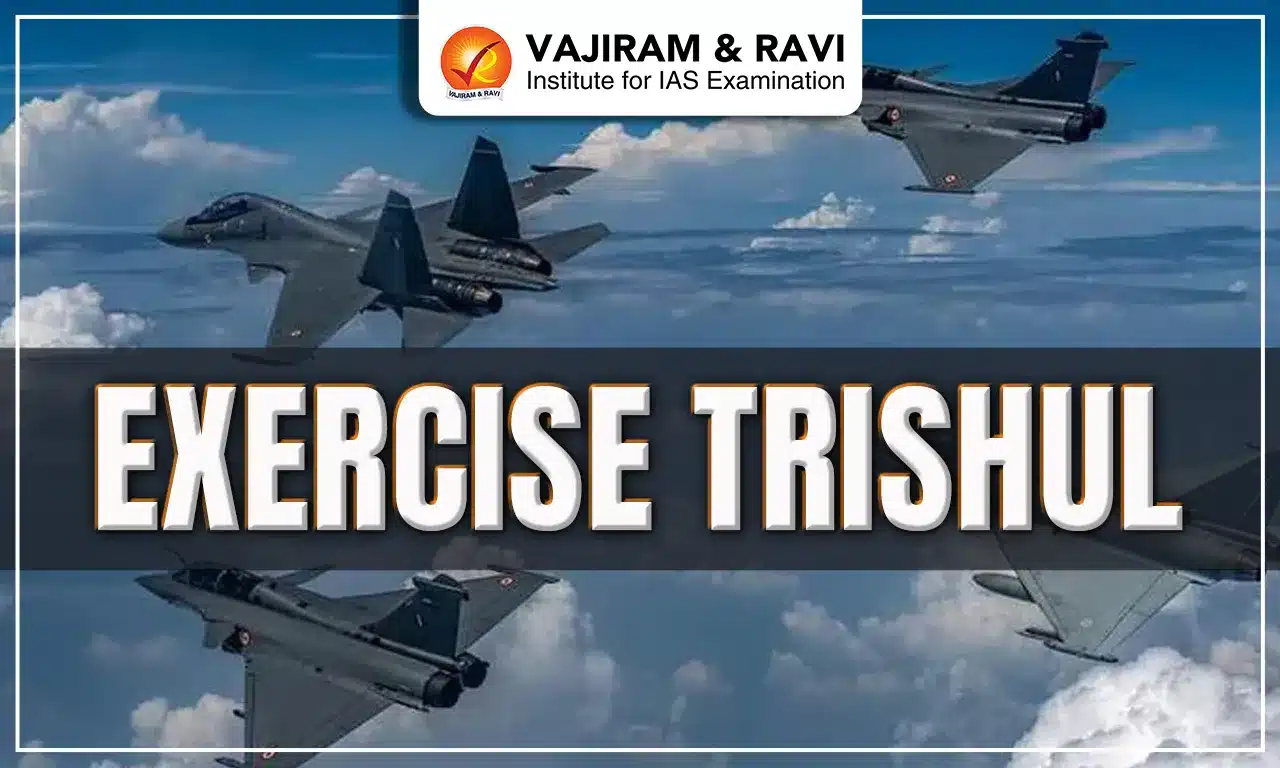
Exercise Trishul is a major tri-services military drill conducted by the Indian Armed Forces to test and validate inter-service coordination between the Army, Navy and Air Force across land, air, sea and cyber domains. It reflects India’s strategic posture of “JAI”, i.e., ‘Jointness, Atmanirbharta (self-reliance) and Innovation’. Recent versions of the exercise have included network-centric warfare, amphibious operations and high-altitude preparedness.
Exercise Trishul
Exercise Trishul, also referred to by the internal codename “Mahagurjar”, is conducted by the tri-services of India (Army, Navy, Air Force) under the aegis of the Ministry of Defence. Its purpose is to enhance jointness, validate theatre logistics, and reinforce multi-domain combat readiness. Methods include network-centric warfare, amphibious landings, desert & creek manoeuvres, ISR & EW integration. Notable sub-exercises include “Agni Drishti” (network-centric sensor-to-shooter integration) and “Trinetra” (spectrum dominance, counter-drone & multi-domain coordination). The exercise is currently underway, scheduled from October 30 to November 10, 2025.
Exercise Trishul Purpose
The exercise is being held as a major readiness drill to test India’s tri-services coordination across land, air, sea, cyber and space domains under realistic threat scenarios. It also serves as a clear deterrence signal to adversaries along the western border and demonstrates India’s shift toward integrated theatre operations.


Exercise Trishul Location
The drill spans multiple terrains: the marshy Sir Creek sector in Gujarat, the Rann of Kutch, desert zones in Rajasthan, and the Saurashtra coast for amphibious operations. It integrates land manoeuvres, air operations and naval assets across west-coast and creek sectors, thereby mapping a multi-domain theatre of operations.
Exercise Trishul Participation
This Exercise is a Tri-Service Military Exercise, i.e., it involves the participation of the Army, Navy and Airforce together. Under this exercise, the Indian Army has deployed over 20,000 personnel along with T-90S/ Arjun tanks and howitzers. The Air Force is fielding Rafale and Su-30MKI fighters, transport/ refuellers such as IL-78, and UAVs. The Navy has positioned frigates and destroyers along the Saurashtra/ Gujarat coast to conduct amphibious and maritime drills.
Sir Creek Dispute
The Sir Creek Dispute involves a 96-kilometre tidal estuary between India’s Gujarat (Rann of Kutch) and Pakistan’s Sindh province, critical for determining maritime boundaries and Exclusive Economic Zones in the Arabian Sea. Its unresolved status makes the region strategically sensitive. Exercise Trishul, conducted near this area, reinforces India’s operational readiness and coastal defence capabilities, signaling deterrence while ensuring protection of maritime interests and oil exploration rights in adjoining waters. It also enhances tri-service coordination in disputed border terrains.
NOTAM
Ahead of the exercise, India issued a Notice to Airmen (NOTAM) restricting civil flights over large parts of Rajasthan and Gujarat during 30 Oct-10 Nov 2025, while Pakistan also issued airspace restrictions over its central and southern routes (28-29 Oct 2025) in response. This reflects aerial domain coordination and signalling associated with the drill.
Exercise Trishul Objectives
The main aims of Exercise Trishul include:
- Testing tri-services synergy: how well the Army, Navy and Air Force work in concert under theatre command structures.
- Validating theatre logistics: the supply, movement, maintenance and sustainment of forces across vast geographic zones including deserts, maritime and air.
- Exercising multi-domain operations: linking land, sea, air, space, cyber and electromagnetic spectrum operations into a unified combat grid.
- Demonstrating Atmanirbharta: usage of indigenously developed weapons, platforms and systems in operational exercises.
- Projecting strategic deterrence: by conducting operations in sensitive border zones like Sir Creek and alerting adversaries to India’s operational readiness.
Exercise Trishul Drills
Some specific drills and modules within Trishul include below mentioned lists. These components reflect the evolving needs of modern warfare, where domain integration, speed, information dominance and logistics resilience matter as much as weapons and numbers.
- Agni Drishti: A network-centric warfare drill integrating land, air, space and unmanned ISR assets into a “sensor-to-shooter” grid.
- Trinetra: Focused on electromagnetic spectrum dominance, counter-UAV kill-chains and multi-domain sensing and strike.
- Amphibious landings off the Saurashtra coast and amphibious manoeuvres in creek zones to test operational flexibility in maritime environment.
- Logistics testing: The exercise puts emphasis on moving large quantities of supplies, fuel, electronic assets and integrating them across services without delays.
Exercise Trishul Pakistan’s Response
Pakistan responded to India’s Exercise Trishul by issuing multiple air-traffic route restrictions (NOTAMs) across its central and southern airspace on 28 to 29 October 2025, signalling heightened vigilance in reaction to India’s tri-services drill near the western border. Pakistani military sources also placed the Bahawalpur Strike Corps and Karachi Corps on high alert, and naval patrols in the Arabian Sea were reinforced as Islamabad viewed the exercise near the disputed Sir Creek sector as a strategic signal of pressure on its maritime and land-frontiers.
Exercise Trishul Significance
The strategic importance of Exercise Trishul lies in several aspects:
- Location: Conducted near Pakistan’s western border (Sir Creek / Gujarat) it signals India’s readiness to operate in contested border zones.
- Deterrence: Pakistan’s issuance of airspace restrictions (NOTAM) ahead of Trishul underscores the drill’s perception by adversaries.
- Integration with border operations: Coming after operations like “Operation Sindoor”, the drill connects with India’s active operational posture rather than just training.
- Reflects force structure evolution: The emphasis on theatre commands, joint logistics and multi-domain warfare underlines India’s transition to future-ready force structures.
- Self-Reliance: By using indigenous platforms and emphasising Atmanirbharta, the exercise aligns with the broader national defence strategy.
In essence, Exercise Trishul is both a preparedness exercise and a strategic communication tool.
Exercise Trishul Outcomes
Though the final after-action reports are classified, several implications can be discerned:
- The drills will likely refine doctrines for joint forces in India’s upcoming theatre command structure.
- Gaps in logistics, information fusion and service interoperability will emerge and drive reforms in supply chains and command architecture.
- The exercise will validate the readiness of newly raised or restructured formations (e.g., the Southern Command’s “Agnibaaz” Division) to conduct multi-domain operations.
- Operational readiness on the western frontier will receive boost; adversary eyewear (Pakistan/ China) will monitor and adjust their own posture accordingly.
- The visibility of the exercise underscores India’s military diplomacy – conveying to neighbours and partners that India’s joint force capability is advancing.
Exercise Trishul Challenges
Despite its strategic success, several challenges remain in the execution and outcome of Exercise Trishul:
- Inter-Service Coordination Gaps: Though the exercise focuses on jointness, operational differences between services persist, particularly in command hierarchy and information sharing.
- Logistical Complexity: Conducting large-scale tri-service operations across diverse terrains requires massive logistical coordination, which still faces time and resource bottlenecks.
- Technology Integration: Integrating indigenously developed systems with legacy imported equipment creates technical compatibility issues during real-time operations.
- Cybersecurity Risks: As the exercise relies heavily on digital networks and communication systems, there is a rising vulnerability to cyber intrusions.
- Budgetary and Infrastructure Constraints: Advanced exercises demand extensive funding, fuel, and infrastructure upgrades, which may be limited in certain sectors.
- Environmental Impact: Large-scale military operations in sensitive areas like Sir Creek raise ecological concerns that require mitigation.
Way Forward:
To strengthen future editions of Exercise Trishul and India’s tri-service capability, several measures are recommended:
- Institutionalize Theatre Commands: The government should fast-track the creation of integrated theatre commands with unified control structures for seamless coordination.
- Enhance Indigenous R&D: Continued investment in Indian defense technologies will ensure better system compatibility and strategic autonomy.
- Develop Advanced Logistics Corridors: Establishing military logistics hubs and AI-based supply tracking can ensure faster movement of men and materials.
- Cyber and EW Preparedness: Specialized training programs on cyber warfare and electronic dominance are needed to address digital threats during operations.
- Joint Training Doctrine: Regular tri-service drills under shared tactical doctrines will bridge operational gaps and improve readiness.
- Eco-friendly Operations: Sustainable planning with environmental assessments should accompany exercises in ecologically fragile zones.
Exercise Trishul UPSC
Exercise Trishul is a large scale operational exercise scheduled by the Ministry of Defence to integrate multiple services in complex scenarios. Trishul serves as both a readiness drill and a deterrent signal in India’s strategic neighbourhood. According to official sources and the defence commentary:
- The 2025 edition is being conducted by the Southern Command of the Indian Army from around 30 October to 10 November near the western border and offshore Saurashtra region.
- It covers challenging terrains like deserts, creeks (notably the strategic Sir Creek marshland along the India-Pakistan border) and coastal amphibious zones.
- The exercise integrates modern capabilities: unmanned aerial vehicles (UAVs), electronic warfare (EW) assets, cyber operations, space-based ISR (Intelligence, Surveillance and Reconnaissance), and full spectrum theatre logistics.
- A Notice to Airmen (NOTAM) for airspace up to 28,000 feet has been issued, underscoring the altitude and scale of operations.

 Last updated on Oct, 2026
→ UPSC 2027 Notification will be released on 13 January 2027 at upsconline.nic.in.
→ Check Nobel Prize 2026 Winners List here.
→ Download PIB PRiSM Monthly Magazine 2026 here.
→ Check UPSC Monthly Current Affairs Magazine The Recitals here.
→ Check out the latest UPSC Syllabus here.
→ Download UPSC Model Answers for Mains 2026
→ UPSC Mains Question Paper 2026 is out now for Essay & GS Paper 1, 2, 3 & 4.
→ UPSC Calendar 2027 has been released.
→ Enroll in Vajiram & Ravi’s UPSC Mains Test Series 2027 for structured answer writing practice, expert evaluation, and exam-oriented feedback.
→ Join Vajiram & Ravi’s UPSC Mentorship Program 2027 for personalized guidance, strategy planning, and one-to-one support from experienced mentors.
→ Go through the UPSC Mains Previous Year Papers to enhance your preparation.
→ UPSC has released UPSC Toppers List 2025 with the Civil Services final result on its official website.
→ Also check Best UPSC Coaching in India
Exercise Trishul FAQs
Q1. What is Exercise Trishul? +
Q2. Where is Exercise Trishul 2025 being conducted? +
Q3. What are the main objectives of Exercise Trishul? +
Q4. Which commands lead Exercise Trishul? +
Q5. What makes Exercise Trishul unique? +
Tags: exercise trishul