Secondary Sanctions Latest News
- India has consistently opposed unilateral economic sanctions, but has often complied with US-imposed restrictions to avoid fallout.
- In the past, Indian refiners stopped importing oil from Iran and Venezuela after the US sanctioned those countries. Now, with new US sanctions on Russian oil giants Rosneft and Lukoil, a similar situation looms.
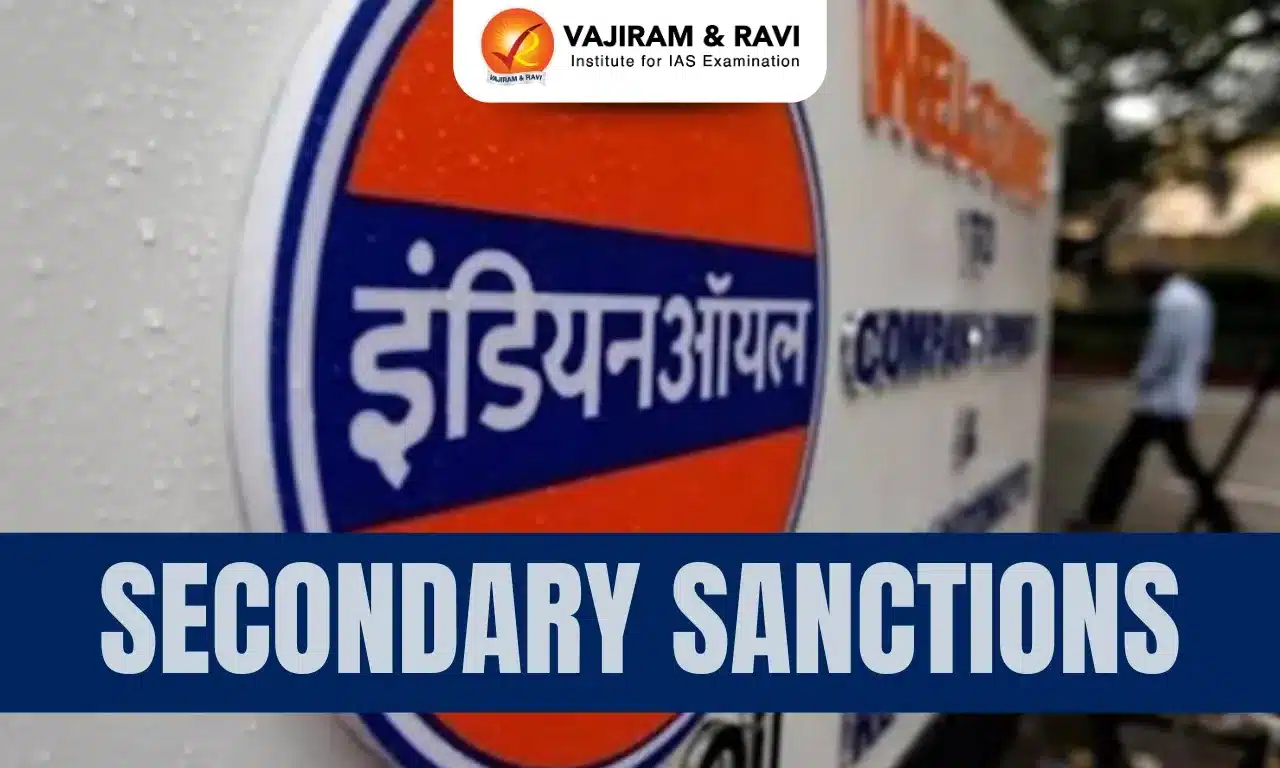
- India avoids dealing with sanctioned entities mainly due to the risk of US secondary sanctions, which could penalize third-party countries or companies doing business with the targeted nations.
Understanding Secondary Sanctions
- Secondary sanctions extend beyond the direct targets of US restrictions.
- Primary sanctions stop American citizens and companies from dealing with blacklisted entities (like Rosneft and Lukoil).
- On the other hand, secondary sanctions aim to discourage foreign countries and companies — over whom the US has no legal authority — from engaging with them.
- These measures act as “anti-circumvention tools”, forcing other nations to comply indirectly by threatening penalties.
- Because they apply outside US borders, secondary sanctions are often seen as extraterritorial and questionable under international law.


Why Countries Fear US Secondary Sanctions
- The US dollar’s dominance in global trade and the central role of the American financial system make US sanctions highly influential worldwide.
- Any company or country engaged in international trade needs access to US markets and banks — losing that access can cripple business.
- Secondary sanctions don’t always impose fines; instead, they block foreign entities from the US financial system if they act against Washington’s foreign policy interests.
- Because of this, India’s refiners and banks are expected to cut back on Russian oil imports, fearing penalties.
- The US Treasury’s warning that secondary sanctions could hit buyers of Russian crude has already had an impact — experts predict an immediate drop in India’s Russian oil imports, which currently account for over 35% of total imports.
Why US Sanctions Matter for India
- US sanctions carry real weight because they make banks, insurers, and investors cautious, cutting off access to funding and financial systems.
- Most Indian refiners — including Reliance Industries (RIL) and public sector companies — rely heavily on the US market, banking network, and technology partners. Losing that access would seriously impact their global operations.
India’s Heavy Exposure to the US
- RIL, which buys nearly half of India’s Russian oil, has subsidiaries, partnerships, and investments in the US with firms like Google, Meta, and Intel.
- Public sector refiners also depend on dollar-based payments and the American banking system to buy crude oil, pay shippers, and insurers.
- Any disruption in US dollar transactions could severely hurt India’s refining sector.
Impact on Russian Oil Imports
- To avoid secondary sanctions, Indian refiners and banks are expected to act with extreme caution, likely leading to a sharp drop in Russian oil imports.
- Government-owned refiners are already reviewing compliance risks, and RIL has said it will fully follow government guidance.
- Some refiners may try to buy Russian oil through third-party traders not directly targeted by sanctions.
- However, experts warn this loophole may not last, as the US could extend sanctions to these intermediaries if it wants to curb Russian oil flows more effectively.
India’s Official Stand
- The Indian government has reiterated that it will buy oil from wherever it gets the best price, as long as the oil itself is not under sanctions.
- However, the new US restrictions on Rosneft and Lukoil — which supply over two-thirds of India’s Russian oil — could seriously limit India’s access to cheap Russian crude in the near term.

 Last updated on Oct, 2026
→ UPSC 2027 Notification will be released on 13 January 2027 at upsconline.nic.in.
→ Check Nobel Prize 2026 Winners List here.
→ Download PIB PRiSM Monthly Magazine 2026 here.
→ Check UPSC Monthly Current Affairs Magazine The Recitals here.
→ Check out the latest UPSC Syllabus here.
→ Download UPSC Model Answers for Mains 2026
→ UPSC Mains Question Paper 2026 is out now for Essay & GS Paper 1, 2, 3 & 4.
→ UPSC Calendar 2027 has been released.
→ Enroll in Vajiram & Ravi’s UPSC Mains Test Series 2027 for structured answer writing practice, expert evaluation, and exam-oriented feedback.
→ Join Vajiram & Ravi’s UPSC Mentorship Program 2027 for personalized guidance, strategy planning, and one-to-one support from experienced mentors.
→ Go through the UPSC Mains Previous Year Papers to enhance your preparation.
→ UPSC has released UPSC Toppers List 2025 with the Civil Services final result on its official website.
→ Also check Best UPSC Coaching in India
Secondary Sanctions FAQs
Q1. What are US secondary sanctions?+
Q2. Why are secondary sanctions powerful?+
Q3. Why do US sanctions matter for India?+
Q4. How will sanctions affect India’s Russian oil imports?+
Q5. Can India continue buying Russian oil indirectly?+
Tags: mains articles secondary sanctions upsc current affairs upsc mains current affairs