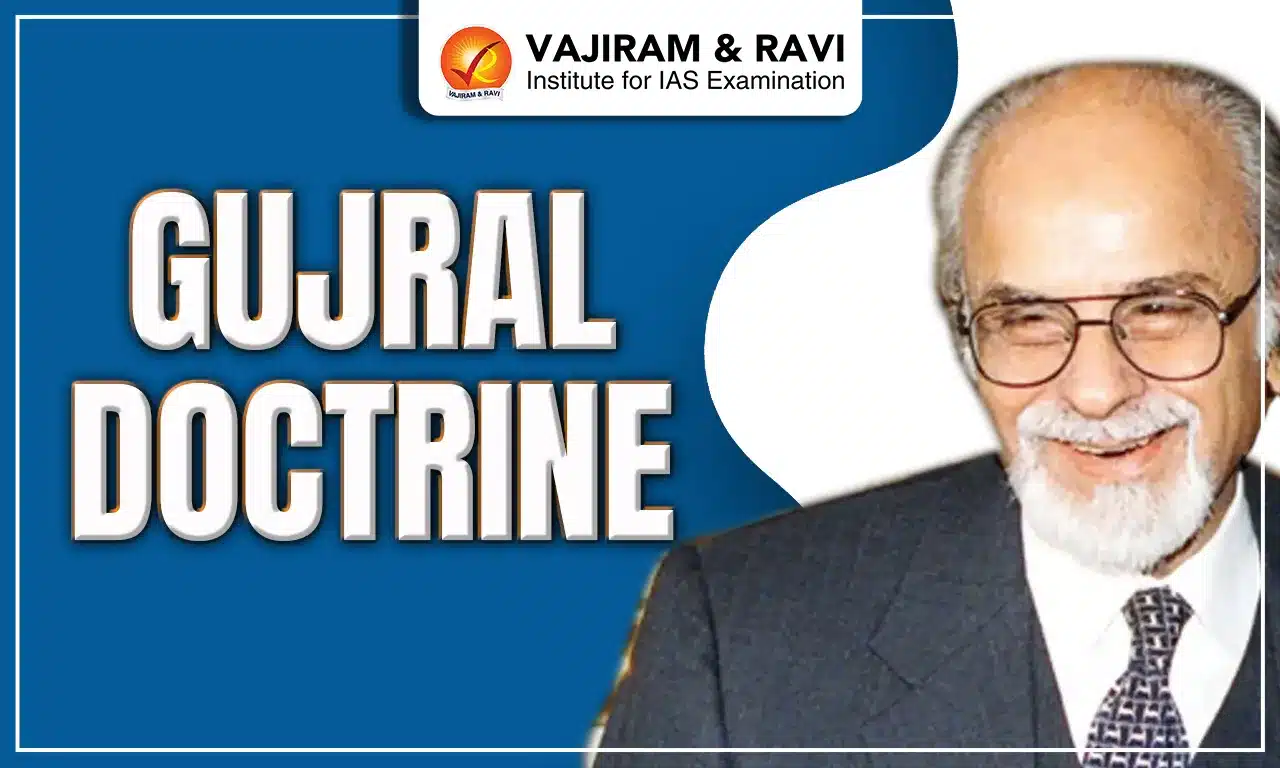
The Gujral Doctrine stands as a cornerstone of India’s post-Cold War foreign policy, emphasizing peace, non-reciprocity, and regional cooperation in South Asia. Introduced by I.K. Gujral, India’s 12th Prime Minister, during his tenure as Foreign Minister (1996-1997) and later as Prime Minister (1997-1998), the doctrine sought to redefine India’s neighborhood diplomacy by promoting goodwill, trust, and mutual respect among South Asian nations, especially in the context of India’s relations with its smaller neighbors.
Gujral Doctrine
The Gujral Doctrine is a set of five principles guiding India’s foreign policy toward its South Asian neighbors. It represented a significant shift from a security-centric approach to one rooted in mutual understanding and non-interference. The doctrine emphasized unilateral goodwill gestures by India toward its neighbors without expecting reciprocity, reflecting India’s role as a benevolent regional power.
The doctrine was officially articulated by I.K. Gujral in 1996 at the Chatham House (1996) and Colombo speech (1997), where he outlined a framework for regional peace and cooperation. It aimed to counterbalance tensions in South Asia and to establish India as a leader fostering integration and stability in the region.
Inder Kumar Gujral
Inder Kumar Gujral (I. K. Gujral) was an Indian diplomat, politician, and the 12th Prime Minister of India from 1997 to 1998. Born on December 4, 1919, in Punjab, he played a key role in shaping India’s foreign policy through his visionary Gujral Doctrine, which emphasized peace, non-reciprocity, and regional cooperation with neighboring countries. A seasoned diplomat and intellectual, Gujral also served as India’s External Affairs Minister and represented India’s moral and peaceful approach in global diplomacy.


Gujral Doctrine Principles
The Gujral Doctrine rests on five core principles that guide India’s engagement with its neighbors. These principles reflected a vision of “cooperative regionalism”, a belief that India’s prosperity is inseparable from the stability and growth of its neighborhood. The fiver principles of Gujral Doctrine are:
- Non-reciprocal Cooperation: India would extend unilateral concessions and cooperation to its smaller neighbors without expecting reciprocity, recognizing the asymmetry of size and capability.
- Non-interference in Internal Affairs: India would not interfere in the domestic matters of neighboring countries, respecting their sovereignty and independence.
- Mutual Respect for Territorial Integrity and Sovereignty: Every South Asian nation would respect the sovereignty and borders of others, promoting trust and peaceful coexistence.
- Peaceful Resolution of Disputes: All bilateral issues should be resolved through dialogue and peaceful negotiation, not through force or coercion.
- Promotion of Regional Cooperation: Strengthening SAARC and other regional frameworks was emphasized to encourage collective development, trade, and cultural exchange in South Asia.
Gujral Doctrine Objectives
The doctrine had clear strategic, political, and diplomatic objectives that aimed to transform India’s regional relations:
- To improve India’s image as a responsible and benevolent regional power.
- To enhance trust and confidence among South Asian neighbors through non-reciprocal gestures.
- To reduce tensions and promote peace, especially with countries like Bangladesh, Nepal, and Sri Lanka.
- To promote South Asian integration through economic and cultural cooperation.
- To isolate cross-border conflicts, especially with Pakistan, while engaging constructively with other neighbors.
Gujral Doctrine Historical Background
Before the 1990s, India’s relations with its neighbors were often marked by suspicion and power imbalances. The Cold War had limited India’s regional outreach, while conflicts such as the 1965 and 1971 wars with Pakistan and intervention in Sri Lanka (1987-1990) strained regional trust.
The post-Cold War environment presented both challenges and opportunities. With globalization and the rise of regional blocs like ASEAN and EU, India sought to foster similar cooperation in South Asia. I.K. Gujral recognized that India’s size and influence could either intimidate or inspire its neighbors. Hence, the doctrine sought to transform India’s foreign policy into a model of soft power diplomacy based on moral leadership and regional solidarity.
Gujral Doctrine Application
The application of the Gujral Doctrine in India’s Neighborhood has been discussed below:
- Bangladesh: Under the Gujral Doctrine, India signed the Ganga Water Treaty (1996) with Bangladesh, ending decades of disputes over river water sharing. This agreement was hailed as a major success in bilateral relations. India also pursued cooperation in trade, border management, and connectivity projects, improving trust with Dhaka.
- Nepal: The doctrine led to renewed dialogue with Nepal, emphasizing mutual respect and non-interference. Gujral’s government took steps to review old treaties and promote greater trade and transit cooperation, laying the foundation for stronger people-to-people ties.
- Sri Lanka: India’s relations with Sri Lanka improved through confidence-building measures. After the contentious IPKF episode, Gujral prioritized dialogue over intervention, focusing on cultural and economic cooperation.
- Maldives and Bhutan: Both countries continued to enjoy traditionally strong relations with India. The Gujral Doctrine reinforced India’s role as a development partner, assisting in infrastructure, education, and security collaboration.
- Pakistan: Although Gujral initiated peace talks with Pakistan under the Composite Dialogue Process (1997), progress was limited due to continuing tensions over Kashmir and terrorism. However, his approach laid the groundwork for later diplomatic efforts like the Agra Summit (2001) and the Lahore Declaration (1999).
Gujral Doctrine Impact
The Gujral Doctrine had a lasting influence on India’s foreign policy and regional relations.
Positive Impacts:
- Improved Bilateral Relations: Strengthened ties with Bangladesh, Nepal, and Sri Lanka through dialogue and cooperation.
- Enhanced India’s Image: Projected India as a benevolent regional leader willing to act without expecting immediate returns.
- Boosted SAARC’s Relevance: Encouraged South Asian cooperation, trade, and regional integration efforts.
- Foundation for Future Diplomacy: Inspired subsequent initiatives like “Neighborhood First Policy” and “Act East Policy.”
Limitations:
- Limited Reciprocity: Many smaller neighbors continued to engage with external powers like China for balance.
- Pakistan Factor: Ongoing conflicts and terrorism limited the success of non-reciprocal diplomacy.
- Institutional Weaknesses: SAARC remained largely ineffective due to political differences among member states.
Gujral Doctrine Relevance of in Present Times
In the 21st century, the Gujral Doctrine continues to influence India’s Neighborhood First Policy, focusing on trust, connectivity, and mutual growth.
- “Neighborhood First Policy” (2014) under Prime Minister Narendra Modi echoes Gujral’s vision through regional connectivity projects like BBIN (Bangladesh, Bhutan, India, Nepal) and initiatives such as Maitri power grids and cross-border rail links.
- India’s humanitarian aid to Nepal (2015 earthquake), Sri Lanka (economic crisis 2022), and Maldives (COVID-19 assistance) reflects the same principle of non-reciprocal goodwill.
- In contrast, challenges like China’s Belt and Road Initiative (BRI) in South Asia underscore the need to reinvigorate Gujral’s ideals with stronger economic and strategic engagements.
Gujral Doctrine Criticism
While the doctrine was visionary, it also faced criticism from strategic analysts and political commentators:
- Overemphasis on Moral Diplomacy: Critics argued that it ignored hard security realities, especially with Pakistan.
- Asymmetrical Expectations: India’s unilateral concessions were sometimes perceived as weakness.
- Limited Regional Integration: SAARC’s ineffectiveness diluted the intended impact of regional cooperation.
- Inconsistent Implementation: Successive governments did not fully institutionalize the doctrine, leading to policy discontinuity.
Despite these limitations, the doctrine remains a symbol of India’s ethical diplomacy and a benchmark for regional cooperation.
Gujral Doctrine and Soft Power Diplomacy
The doctrine marked a shift from traditional realpolitik to soft power diplomacy, using culture, development assistance, and moral leadership to win trust. This shift enhanced India’s regional legitimacy and fostered cooperation through persuasion rather than pressure. India used tools such as:
- Cultural diplomacy: Promoting Indian art, cinema, and education exchanges in South Asia.
- Development partnerships: Providing lines of credit, grants, and training programs to neighboring countries.
- Humanitarian aid: Timely assistance during natural disasters strengthened India’s moral influence in the region.
Gujral Doctrine Challenges
Despite of various appreciations and advancements, the Gujral Doctrine faces several backlashes as mentioned below:
Challenges:
- Persistent conflicts with Pakistan limit regional integration.
- China’s growing influence in South Asia poses strategic concerns.
- SAARC remains inactive due to political differences.
- Cross-border terrorism continues to hinder peace-building efforts.
- Domestic politics in neighboring countries affect consistency in relations.
Way Forward:
- Reinforce economic diplomacy through connectivity and trade projects.
- Strengthen multilateral frameworks like BIMSTEC and IORA.
- Invest in people-centric diplomacy through cultural and educational outreach.
- Address security concerns through dialogue while maintaining deterrence.
- Promote sustainable regional growth through joint development initiatives.
Gujral Doctrine Effectiveness
The Gujral Doctrine, propounded by I.K. Gujral in 1996, improved India’s ties with Bangladesh (1996 Ganga Water Treaty), Nepal, and Sri Lanka through dialogue and non-reciprocity. It fostered regional goodwill and inspired India’s later “Neighborhood First” policy. However, Pakistan was excluded from the non-reciprocity principle due to ongoing conflicts. Despite promoting soft diplomacy, SAARC remained weak, and China’s growing regional role limited India’s influence. The doctrine’s spirit endures as ethical diplomacy, but its institutional impact was modest.
Gujral Doctrine UPSC
The Gujral Doctrine remains a landmark in India’s foreign policy evolution. By prioritizing trust, non-reciprocity, and regional peace, it redefined India’s relations with its neighbors and inspired future diplomatic frameworks. In an era marked by global uncertainty and regional rivalries, the doctrine’s essence, mutual respect, cooperation, and peaceful coexistence, continues to offer a roadmap for South Asia’s collective progress.
The Gujral Doctrine’s legacy extends far beyond the 1990s. Its vision continues to inform India’s diplomacy in multiple ways:
- It inspired the “Neighborhood First Policy” (2014) and India’s developmental diplomacy model.
- It positioned India as a responsible regional power promoting peace and prosperity.
- The doctrine is now studied in international relations curricula as a case of successful soft diplomacy in South Asia.
- Former Prime Minister Manmohan Singh and later Narendra Modi have both acknowledged the value of Gujral’s ideas in shaping India’s foreign engagement strategy.

 Last updated on Oct, 2026
→ UPSC 2027 Notification will be released on 13 January 2027 at upsconline.nic.in.
→ Check Nobel Prize 2026 Winners List here.
→ Download PIB PRiSM Monthly Magazine 2026 here.
→ Check UPSC Monthly Current Affairs Magazine The Recitals here.
→ Check out the latest UPSC Syllabus here.
→ Download UPSC Model Answers for Mains 2026
→ UPSC Mains Question Paper 2026 is out now for Essay & GS Paper 1, 2, 3 & 4.
→ UPSC Calendar 2027 has been released.
→ Enroll in Vajiram & Ravi’s UPSC Mains Test Series 2027 for structured answer writing practice, expert evaluation, and exam-oriented feedback.
→ Join Vajiram & Ravi’s UPSC Mentorship Program 2027 for personalized guidance, strategy planning, and one-to-one support from experienced mentors.
→ Go through the UPSC Mains Previous Year Papers to enhance your preparation.
→ UPSC has released UPSC Toppers List 2025 with the Civil Services final result on its official website.
→ Also check Best UPSC Coaching in India
Gujral Doctrine FAQs
Q1. Who introduced the Gujral Doctrine?+
Q2. What are the five principles of the Gujral Doctrine?+
Q3. Which countries are primarily covered under the Gujral Doctrine?+
Q4. How is the Gujral Doctrine relevant today?+
Q5. What was the key success of the Gujral Doctrine?+
Tags: gujral doctrine