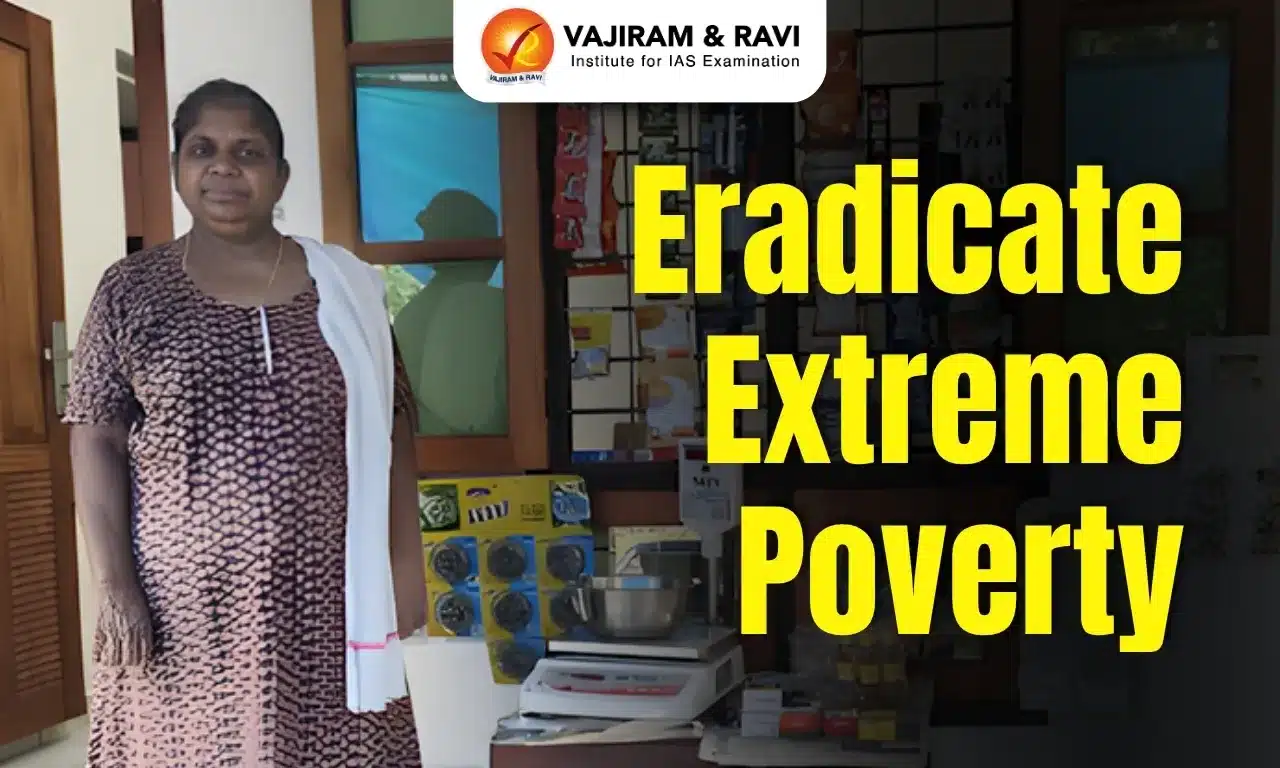
Eradicate Extreme Poverty Latest News
- On Kerala Piravi Day or Kerala Day (November 1, 2025), Chief Minister Pinarayi Vijayan declared that Kerala has eradicated extreme poverty, making it the first Indian state to achieve this milestone.
- The achievement follows a targeted four-year effort under the Extreme Poverty Eradication Programme (EPEP) led by the Left Democratic Front (LDF) government.
- This marks a significant development in India’s poverty alleviation journey, offering insights into localized, data-driven, participatory governance models, and aligning with UN Sustainable Development Goal 1 (No Poverty).
Understanding Extreme Poverty
- Global definition:
- As per the World Bank’s (June 2025) revision, anyone living on less than $3 per day (2021 PPP) is considered to be in extreme poverty. Earlier, the benchmark was $2.15/day (2017 PPP).
- The poverty line for:
- Lower-middle-income countries – $4.20/day
- Upper-middle-income countries – $8.30/day
- Difference between poverty and extreme poverty:
- Those earning below $4.20 but above $3 are poor, not extremely poor.
- Extreme poverty captures the most deprived segment in terms of basic human needs—food, shelter, health, and education.


India’s Position in the Global Context
- World Bank estimates (2025):
- 838 million people globally lived in extreme poverty in 2022 (using $3/day standard).
- In India:
- Extreme poverty declined from 16.2% (2011–12) to 2.3% (2022–23).
- About 171 million people were lifted out of extreme poverty.
- Drivers of improvement: Rising employment and urbanization. For example, urban unemployment reduced to 6.6% (Q1 FY24/25) — lowest since 2017–18.
- Persistent challenges:
- Youth unemployment: 13.3% (29% among graduates).
- Gender disparity: Female employment rate 31%.
- Informality: 77% of non-farm jobs and most farm jobs remain informal.
- Critics argue that official poverty reduction estimates may not fully capture multidimensional deprivations.
Measuring Poverty in India – The Multidimensional Approach
- NITI Aayog’s Multidimensional Poverty Index (MPI):
- It is based on Alkire-Foster methodology (Global MPI), and uses 12 indicators across three dimensions –
-
- Health: nutrition, child mortality, maternal health.
- Education: years of schooling, school attendance.
- Standard of living: housing, sanitation, assets, and cooking fuel.
-
- It is based on Alkire-Foster methodology (Global MPI), and uses 12 indicators across three dimensions –
- Kerala’s broader poverty reduction journey:
-
- NITI Aayog’s 2021 MPI: Kerala’s poverty rate was 0.7% — lowest in India.
- Poverty declined from 59.8% in the 1970s to near zero due to successive governments’ welfare policies in education, health, and social security.
- However, Kerala’s extreme poverty identification method differed from the NITI Aayog’s MPI framework.
Kerala’s Model – Extreme Poverty Eradication Programme (EPEP)
- Launch and implementation:
- Announced in 2021, soon after the LDF government began its second term.
- The Local Self-Government Department was the nodal agency.
- Around 4 lakh personnel—officials, elected representatives, and volunteers—were trained.
- Identification process:
- Initial identification: 1.18 lakh families.
- After verification and migration checks: 59,000 families confirmed.
- Criteria: Income, health, housing, and food insecurity.
- Key interventions:
- Housing: 4,677 homeless families identified; 4,005 provided homes under Life Mission Scheme.
- Food security: 20,648 families lacking stable food access were given meals by local bodies.
- Essential documents and services: Under Avakasam Athivegam (Rights Fast) campaign, families were ensured access to – Aadhaar, voter ID, bank accounts, MGNREGS job cards, social pensions, electricity, and LPG connections.
- Institutional collaboration:
- Local governance, community participation, and data verification ensured inclusivity.
- Opposition parties also extended bipartisan support for implementation.
Significance of Kerala’s Achievement
- Kerala becomes the first Indian state to claim zero extreme poverty.
- Reflects success of localized planning, micro-level targeting, and welfare convergence.
- Reinforces Kerala’s legacy in human development, education, and social justice.
Critical Perspectives and Challenges
- Tribal representation concerns:
- Adivasi Gothra Mahasabha alleged that only 5% of identified families were Scheduled Tribes, despite high deprivation among Paniya, Adiya, and Kattunaikkar communities in Wayanad and Attappady.
- Criticism of survey methodology for not ensuring tribal-specific inclusion parameters.
- Labour and welfare gaps: ASHA workers criticized the government’s poverty claims, demanding better honorarium (₹223/day). The government responded by increasing their pay by ₹1,000/month.
- Sustainability challenge: LSGD is now planning Phase II to ensure beneficiaries do not relapse into poverty, focusing on long-term livelihood stability.
Way Forward
- Institutionalise micro-planning: Integrate micro-level data systems within broader State and NITI Aayog MPI frameworks.
- Tribal and marginal inclusion: Create dedicated tribal sub-plans to ensure fair representation and land rights.
- Livelihood security: Focus on job creation, skill development, and micro-enterprise financing to prevent relapse into poverty.
- Sustainability audits: Regular monitoring and impact assessment of rehabilitated families.
- National replication: Kerala’s model offers a template for other states—combining decentralised governance, data-based targeting, and community-driven execution.
Conclusion
- Kerala’s EPEP marks a milestone in India’s fight against extreme poverty — showcasing how decentralised governance, human-centric micro-planning, and participatory implementation can transform lives.
- While political criticism and inclusivity gaps persist, the model provides a replicable framework for sustainable and equitable poverty eradication in India.
- By blending welfare delivery with dignity and empowerment, Kerala reaffirms its place as a social development pioneer.

 Last updated on Oct, 2026
→ UPSC 2027 Notification will be released on 13 January 2027 at upsconline.nic.in.
→ Check Nobel Prize 2026 Winners List here.
→ Download PIB PRiSM Monthly Magazine 2026 here.
→ Check UPSC Monthly Current Affairs Magazine The Recitals here.
→ Check out the latest UPSC Syllabus here.
→ Download UPSC Model Answers for Mains 2026
→ UPSC Mains Question Paper 2026 is out now for Essay & GS Paper 1, 2, 3 & 4.
→ UPSC Calendar 2027 has been released.
→ Enroll in Vajiram & Ravi’s UPSC Mains Test Series 2027 for structured answer writing practice, expert evaluation, and exam-oriented feedback.
→ Join Vajiram & Ravi’s UPSC Mentorship Program 2027 for personalized guidance, strategy planning, and one-to-one support from experienced mentors.
→ Go through the UPSC Mains Previous Year Papers to enhance your preparation.
→ UPSC has released UPSC Toppers List 2025 with the Civil Services final result on its official website.
→ Also check Best UPSC Coaching in India
Eradicate Extreme Poverty FAQs
Q1. What is the significance of Kerala’s EPEP in the context of India’s pursuit of SDG 1 (No Poverty)?+
Q2. How did Kerala’s decentralised governance structure contribute to the success of the EPEP initiative?+
Q3. What distinguishes Kerala’s approach to identifying extreme poverty from national and global frameworks?+
Q4. What is the role of community participation and inter-departmental coordination in the effective implementation of EPEP?+
Q5. What are the key criticisms and challenges associated with Kerala’s declaration of being free from extreme poverty?+
Tags: eradicate extreme poverty mains articles upsc current affairs upsc mains current affairs