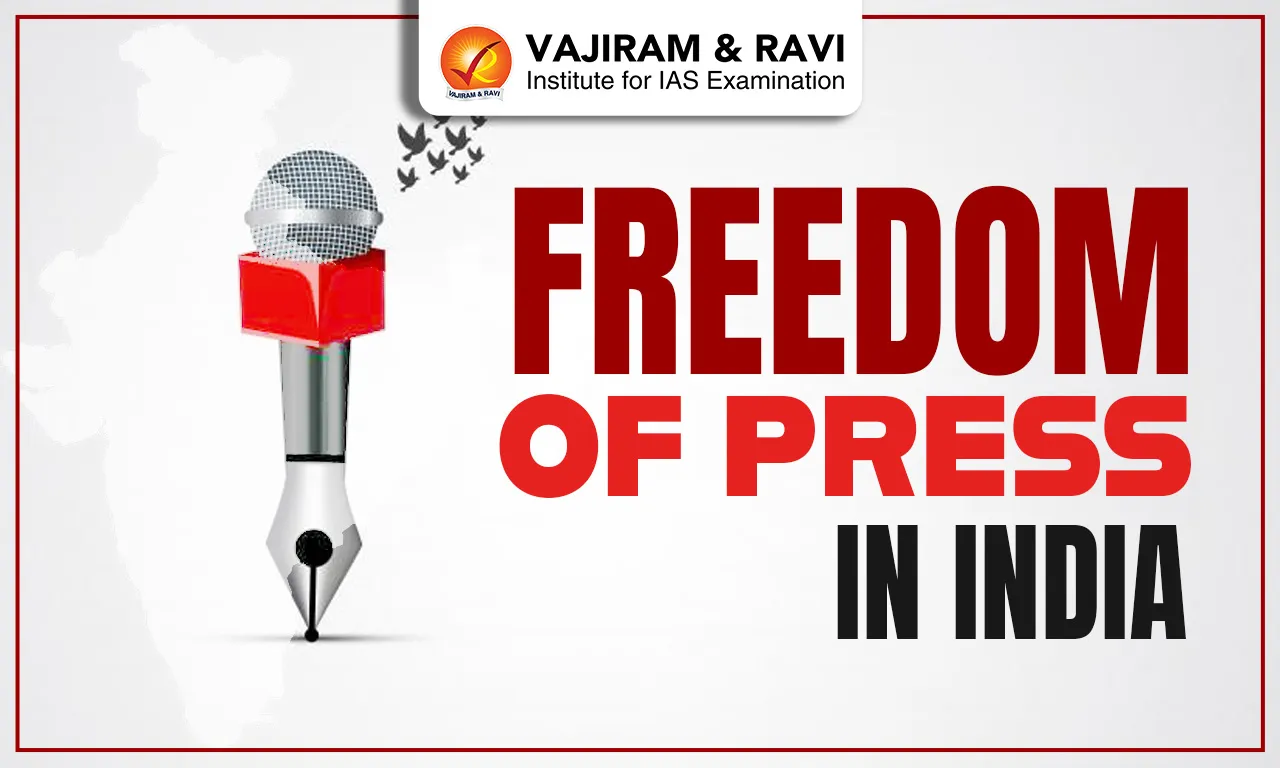
Freedom of the press is an essential pillar of democracy, ensuring that citizens are informed, governments remain accountable, and diverse opinions flourish. In India, this freedom forms the bedrock of participatory governance, enabling the media to act as the “fourth estate.” However, while India’s Constitution guarantees freedom of speech and expression under Article 19(1)(a), the scope of press freedom remains subject to several reasonable restrictions. In recent years, issues such as fake news, censorship, defamation laws, and intimidation of journalists have reignited debates on the true extent of press freedom in India.
Freedom of Press in India
Freedom of press means the right of media organizations and individuals to publish news, express opinions, and disseminate information without undue interference or censorship by the government. It plays a vital role in:
- Promoting transparency and accountability in governance.
- Safeguarding democratic rights and ensuring public participation.
- Acting as a watchdog against corruption and abuse of power.
- Facilitating informed decision-making among citizens.
- In essence, a free press acts as the voice of the people and a check on the state’s authority, making it indispensable for a healthy democracy like India.
Freedom of Digital and Social Media
The rise of digital journalism has revolutionized information flow. However, it has also brought regulatory challenges. The Information Technology (Intermediary Guidelines and Digital Media Ethics Code) Rules, 2021, empower the government to monitor digital news platforms and social media intermediaries.
While these regulations aim to curb misinformation, critics argue they may lead to censorship. Balancing digital freedom and accountability remains a pressing challenge in the digital era.


Freedom of Press in India Constitutional Framework
Although the Indian Constitution does not explicitly mention “freedom of the press,” it is derived from Article 19(1)(a), which guarantees the right to freedom of speech and expression. This interpretation was confirmed in the case of Romesh Thappar vs State of Madras (1950), where the Supreme Court held that press freedom is a part of the broader freedom of expression.
However, Article 19(2) places “reasonable restrictions” in the interests of sovereignty, public order, decency, morality, contempt of court, and defamation. Thus, while press freedom is protected, it is not absolute. The balance between liberty and responsibility defines the operational boundaries of the Indian press.
Freedom of Press in India Historical Evolution
The concept of press freedom in India dates back to colonial times.
- 1780: The first Indian newspaper, Hicky’s Bengal Gazette, was published but soon censored by British authorities.
- 1799: Lord Wellesley introduced the first censorship law through the Press Regulations Act.
- 1835: The liberal Metcalfe Act eased press restrictions, marking the first step toward press freedom.
- 1878: The Vernacular Press Act sought to suppress Indian-language publications critical of British rule.
- 1910: The Indian Press Act further restricted press freedom, particularly during nationalist movements.
- After independence, India adopted a democratic constitution that emphasized civil liberties, ensuring freedom of speech and expression for all citizens, including the press.
Press and Media Laws in India
India has a comprehensive legal and institutional framework that governs media operations, ensuring both freedom and accountability. Key Legal Provisions:
- Article 19(1)(a): Ensures freedom of speech and expression.
- Article 361A: Grants protection for publications of parliamentary proceedings.
- Press Council Act, 1978: Established the Press Council of India (PCI) to preserve press freedom and maintain journalistic ethics.
- Right to Information Act (2005): Strengthens transparency and empowers journalists to access public data.
- Whistle Blowers Protection Act (2014): Safeguards individuals exposing corruption or misconduct.
- Press and Registration of Books Act, 1867: Regulates printing presses and registration of newspapers.
- Information Technology (IT) Act, 2000: Regulates online content and cybercrime, though often debated for misuse.
- Cable Television Networks (Regulation) Act, 1995: Governs broadcast content to maintain decency and public order.
- Digital India Programme: Expands access to digital platforms, additionally empowering online journalism.
- Media Infrastructure Development Schemes: Enhance regional press facilities and training programs.
- To control the censorship and broadcasting several acts were introduced: Telecommunication Act 2023, Digital Personal Data Protection Act (2023) and Broadcasting Services (Regulation) Bill (Proposed, 2023).
Press and Media Regulation in India
The major institutional bodies and authorities responsible for the management of the Freedom of Press in India are:
- Press Council of India (PCI): A statutory, quasi-judicial body headed by a retired judge, ensures media accountability; established under the Press Council Act, 1978, oversees journalistic ethics, investigates complaints, and safeguards press freedom.
- News Broadcasting and Digital Standards Authority (NBDSA): It is a self-regulatory body established by the News Broadcasting Standards Authority (NBSA), Regulates news channels and ensures adherence to content standards
- Registrar of Newspapers for India (RNI): Manages registration of newspapers and periodicals.
- Ministry of Information and Broadcasting (MIB): Frames media policies and issues licenses.
- Prasar Bharati (Broadcasting Corporation of India): An autonomous body managing Doordarshan and All India Radio.
Freedom of Press in India Case Laws
The Indian judiciary has played a pivotal role in interpreting and reinforcing press freedom. These cases highlight how the judiciary has continuously safeguarded the role of the press as a democratic institution. Some landmark judgments include:
- Romesh Thappar vs State of Madras (1950): Recognized freedom of press as part of freedom of expression.
- Brij Bhushan vs State of Delhi (1950): Declared pre-censorship unconstitutional.
- Sakal Papers Ltd vs Union of India (1962): Struck down laws limiting newspaper circulation as unconstitutional.
- Bennett Coleman & Co. vs Union of India (1973): Upheld that press freedom is part of individual citizens’ right to free expression.
- Indian Express Newspapers vs Union of India (1985): Reaffirmed that freedom of press includes the right to print, publish, and circulate.
- R. Rajagopal vs State of Tamil Nadu (1994): Recognized journalists’ right to publish life stories without prior approval, unless defamatory.
Freedom of Press in India Global Aspect
According to the 2024 World Press Freedom Index released by Reporters Without Borders (RSF), India ranked 159th out of 180 countries, a decline from previous years. The report cited issues such as violence against journalists, misuse of sedition laws, and political pressures.
Despite being the world’s largest democracy, the Indian media environment faces challenges like ownership concentration, online trolling, and state surveillance. Yet, India continues to have one of the most vibrant and diverse media landscapes globally, with over 1,30,000 registered publications and 900+ news channels.
Freedom of Press in India International Legal Frameworks
India is a signatory to major global charters protecting press rights:
- Article 19 of the Universal Declaration of Human Rights (UDHR): Affirms the right to seek, receive, and impart information.
- Article 19 of the International Covenant on Civil and Political Rights (ICCPR): Protects freedom of expression.
- UNESCO’s Windhoek Declaration (1991): Promotes an independent and pluralistic press.
- India’s commitment to these frameworks reinforces its constitutional principles but demands better domestic implementation.
Freedom of Press in India Challenges
Major challenges in the freedom of Press in India are:
- Political Pressure and Censorship:
-
- Many journalists face intimidation for criticizing government actions.
- Way Forward: Strengthen laws against harassment and ensure editorial independence through autonomous media boards.
- Misuse of Sedition and Defamation Laws:
-
- Provisions like Section 124A of IPC (sedition) and criminal defamation are often misused to suppress dissent.
- Way Forward: Revisit and reform colonial-era laws to protect free expression.
- Violence and Safety of Journalists:
-
- A recent report suggests more than 50 Journalists were killed between 2006 and 2023 for various grounds of reporting.
- Way Forward: Implement journalist protection laws and provide legal aid mechanisms.
- Media Ownership Concentration:
-
- Corporate control over media reduces diversity of opinions.
- Way Forward: Enforce transparent ownership rules and promote independent journalism funds.
- Fake News and Disinformation:
-
- Social media platforms often spread false information.
- Way Forward: Strengthen fact-checking networks and digital literacy campaigns.
- Economic Pressures:
-
- Advertising dependence influences editorial content.
- Way Forward: Introduce subsidies and public interest journalism grants.
- Lack of Accountability:
-
- Self-regulation mechanisms remain weak.
- Way Forward: Empower the PCI with enforcement powers and create grievance redressal mechanisms.
- Internet Shutdowns:
-
- India leads globally in internet shutdowns, affecting digital journalism.
- Way Forward: Establish clear legal standards limiting arbitrary shutdowns.
- Regional Disparities:
-
- Local journalists face greater risks due to weak institutional support.
- Way Forward: Extend state-level journalist protection laws and funding.
- Public Trust Decline:
-
- Growing sensationalism and bias erode media credibility.
- Way Forward: Encourage ethics-based journalism training and transparency in reporting.
Freedom of Press in India UPSC
Freedom of the press in India stands at a crucial juncture, protected by constitutional ideals yet challenged by evolving political, economic, and technological pressures. As Mahatma Gandhi once said, “The press is a great power, but an uncontrolled pen serves but to destroy.” Hence, maintaining a balance between freedom and responsibility is vital. Strengthening institutional independence, ensuring journalist safety, and promoting ethical journalism can secure a truly free and responsible press, one that reflects the voice of India’s democracy.
According to the World Press Freedom Index 2025 by RSF, India continues to face challenges in journalist safety, media transparency, and government interference. India ranked 151st out of 180 countries in the 2025 index, an improvement from 159th in 2024, but still a low rank globally. Despite this, India’s vibrant media ecosystem, with over 900 satellite TV channels, 140,000 publications and 1 billion internet users, remains a cornerstone of democratic expression.

 Last updated on July, 2026
→ UPSC Prelims Result 2026 is now out.
→ UPSC IFoS Prelims Result 2026 is now out.
→ Enroll in Vajiram & Ravi’s UPSC Mains Test Series 2026 for structured answer writing practice, expert evaluation, and exam-oriented feedback.
→ Join Vajiram & Ravi’s UPSC Mentorship Program 2026 for personalized guidance, strategy planning, and one-to-one support from experienced mentors.
→ Join Vajiram & Ravi’s UPSC Mentorship Program 2027 for personalized guidance, strategy planning, and one-to-one support from experienced mentors.
→ UPSC Prelims Provisional Answer Key 2026 out for GS Paper 1 and CSAT.
→ UPSC Prelims Question Paper 2026 Out, Download GS Paper 1 PDF conducted on 24th May 2026.
→ UPSC Mains 2026 will be conducted from 21st August 2026 onwards, and UPSC Prelims 2027 will be held on 23rd May 2027.
→ UPSC Final Result 2025 is now out.
→ UPSC has released UPSC Toppers List 2025 with the Civil Services final result on its official website.
→ Anuj Agnihotri secured AIR 1 in the UPSC Civil Services Examination 2025.
→ UPSC Notification 2026 & UPSC IFoS Notification 2026 is now out on the official website at upsconline.nic.in.
→ UPSC Calendar 2027 has been released.
→ Check out the latest UPSC Syllabus 2026 here.
→ The UPSC Selection Process is of 3 stages-Prelims, Mains and Interview.
→ Shakti Dubey secures AIR 1 in UPSC CSE Exam 2024.
→ Also check Best UPSC Coaching in India
Freedom of Press in India FAQs
Q1. Is Freedom of Press in India a fundamental right?+
Q2. What are the main restrictions on Freedom of Press in India?+
Q3. Who regulates print and broadcast media in India?+
Q4. What is India’s rank in the 2025 World Press Freedom Index?+
Q5. Why is Freedom of Press in India vital for democracy?+
Tags: freedom of press in india