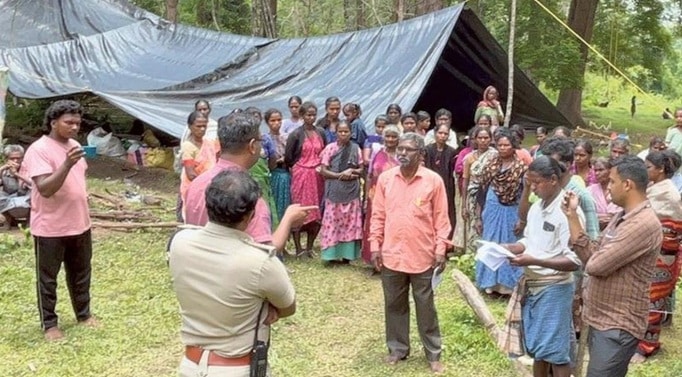
Forest Tribe Relocation Latest News
- The Union Ministry of Tribal Affairs has drafted a new policy framework detailing procedures for relocating forest-dwelling communities from tiger reserves.
- The framework seeks to harmonise wildlife conservation with tribal rights by ensuring that any relocation under existing laws—such as the Wildlife Protection Act, 1972, and the Forest Rights Act, 2006—is voluntary, transparent, and based on informed consent.
Framework for Community-Centred Conservation and Relocation
- The Tribal Affairs Ministry has prepared a policy brief titled “Reconciling Conservation and Community Rights: A Policy Framework for Relocation and Co-existence in India’s Tiger Reserves”.
- It aims to balance wildlife conservation with the rights of forest-dwelling communities.
Joint National Framework
- The policy calls for a National Framework for Community-Centred Conservation and Relocation, to be jointly managed by the Environment and Tribal Affairs Ministries.
- It will set clear procedures, timelines, and accountability for all relocation efforts.
National Database and Audits
- A National Database on Conservation-Community Interface (NDCCI) will track details of relocations, compensation, and community welfare after relocation.
- Annual independent audits by approved agencies will review compliance with the Forest Rights Act (FRA), the Wildlife Protection Act (WPA), and human rights norms.
Consent and Rights Protection
- The framework requires verifiable consent from both Gram Sabhas and individual households before any area is declared a tiger reserve.
- It ensures that communities have the option to stay in their traditional forest homes under the FRA unless relocation is ecologically necessary.
Core Principle
- The policy stresses that relocation must be voluntary, scientifically justified, and respectful of people’s rights and dignity, promoting cooperation between conservation and community interests.
Relocation of Forest Tribes Only as Last Resort
- The policy brief says that forest-dwelling communities should be relocated from tiger reserves only when absolutely necessary.
- Before any move, their rights under the Forest Rights Act, 2006, must be recognised.
- It also allows these communities to continue living inside tiger reserves and take part in protecting and managing the forest and its wildlife.


Why the Policy Brief Was Released Now
- The Ministry of Tribal Affairs prepared this policy brief after growing concerns about how the Forest Rights Act (FRA) is being ignored in tiger reserves and protected areas.
Concerns Over Non-Implementation of FRA
- State governments and Gram Sabhas inside tiger reserves complained that the rights of forest-dwelling communities under the FRA were not being recognised.
- In response, the Tribal Affairs Ministry sent the policy brief to the Environment Ministry, urging better coordination.
Trigger: NTCA’s 2024 Relocation Directive
- A June 2024 directive from the National Tiger Conservation Authority (NTCA) asked states to prioritise village relocations from tiger reserves.
- This caused widespread protests from Gram Sabhas and tribal groups, who then appealed to the National Commission for Scheduled Tribes (NCST) and the Union government to withdraw the order.
Background: Long-Standing Relocation Policy
- Relocation of villages for tiger conservation began in 1973 and is governed by both the Wildlife Protection Act (WPA), 1972, and the Forest Rights Act (FRA), 2006.
- While the WPA empowers forest departments to create space for tigers, the FRA requires that the rights of forest-dwellers be settled first—allowing them to stay or relocate voluntarily with compensation.
Issues in Implementation
- Relocation packages offer ₹15 lakh per family, but many tribes claim they are pressured to move or denied basic services if they choose to stay.
- Conflicts like the one involving the Jenu Kuruba tribe in Karnataka’s Nagarhole National Park show ongoing disputes over unrecognised land rights.
Current Status
- According to government data (August 2025), since January 2022, about 5,166 families from 56 villages in seven states have been relocated.
- However, 64,801 families across 591 villages still live within the core areas of tiger reserves, highlighting the scale and sensitivity of the issue.
Why the New Policy Brief Is Important
- Although laws already say that village relocations from tiger reserves must be voluntary and done only when coexistence isn’t possible, poor implementation has created problems.
- The Tribal Affairs Ministry’s new policy brief highlights these gaps and calls for better monitoring of relocation efforts.
- It proposes involving Tribal Affairs officials and independent experts to ensure that relocations follow the law, protect community rights, and remain truly voluntary.
Source: TH

 Last updated on Oct, 2026
→ UPSC 2027 Notification will be released on 13 January 2027 at upsconline.nic.in.
→ Check Nobel Prize 2026 Winners List here.
→ Download PIB PRiSM Monthly Magazine 2026 here.
→ Check UPSC Monthly Current Affairs Magazine The Recitals here.
→ Check out the latest UPSC Syllabus here.
→ Download UPSC Model Answers for Mains 2026
→ UPSC Mains Question Paper 2026 is out now for Essay & GS Paper 1, 2, 3 & 4.
→ UPSC Calendar 2027 has been released.
→ Enroll in Vajiram & Ravi’s UPSC Mains Test Series 2027 for structured answer writing practice, expert evaluation, and exam-oriented feedback.
→ Join Vajiram & Ravi’s UPSC Mentorship Program 2027 for personalized guidance, strategy planning, and one-to-one support from experienced mentors.
→ Go through the UPSC Mains Previous Year Papers to enhance your preparation.
→ UPSC has released UPSC Toppers List 2025 with the Civil Services final result on its official website.
→ Also check Best UPSC Coaching in India
Forest Tribe Relocation FAQs
Q1. What is the new forest tribe relocation framework?+
Q2. What laws guide the relocation process?+
Q3. Why was the new policy brief released?+
Q4. What is the role of local communities in conservation?+
Q5. How many families have been relocated so far?+
Tags: forest tribe relocation mains articles upsc current affairs upsc mains current affairs