Demonetisation Latest News
- Currency with the public has risen from ₹17.97 lakh crore in November 2016 to ₹37.29 lakh crore in October 2025, more than doubling since demonetisation.
- Although cash holdings surged, the rapid economic growth of over 6% annually has kept the currency-to-GDP ratio below pre-demonetisation levels, indicating that India’s expanding economy has absorbed the rise in currency circulation.
Demonetisation of November 2016
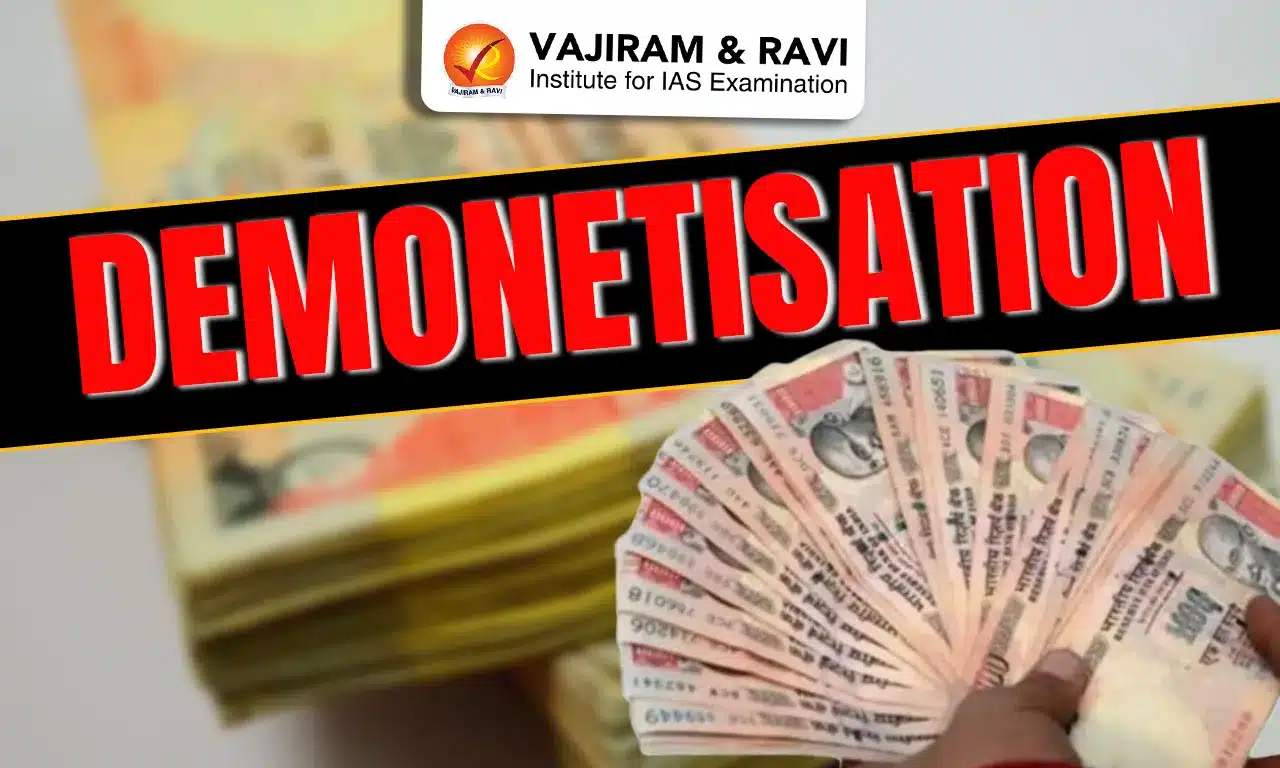
- On November 8, 2016, Prime Minister Narendra Modi announced the demonetisation of ₹500 and ₹1,000 notes, which made up 86% of the currency in circulation.
- Effective from midnight of November 9, the move aimed to eliminate black money, curb fake currency, promote digital payments, and formalise the Indian economy.


Economic Disruption and Lasting Cash Dependence After Demonetisation
- The 2016 note ban caused a sharp liquidity crisis, reducing demand and GDP growth by about 1.5%.
- Many small businesses shut down amid cash shortages, and long queues formed at banks and ATMs.
- Though new notes were introduced later, a mix of cash hoarding and continued reliance on currency pushed the money in public hands above pre-demonetisation levels, showing India’s enduring preference for cash.
Pandemic Led to Surge in Cash Holdings
- During the Covid-19 lockdown (2020–21), people rushed to keep cash on hand for essentials such as groceries and medicines.
- This precautionary behaviour drove a sharp rise in cash with the public, reversing the earlier post-demonetisation decline.
Understanding Currency with the Public and India’s Cash Usage Trends
- According to the RBI, “currency with the public” is the total currency in circulation (CIC) minus the cash held by banks.
- CIC includes all notes and coins issued by the central bank used in daily transactions.
- As of October 17, 2025, cash with the public rose by ₹30,709 crore fortnightly and ₹3.13 lakh crore year-on-year.
Currency-to-GDP Ratio Trends
- While the absolute amount of currency has increased, strong GDP growth—7.8% in Q1 FY2026—has stabilised the CIC-to-GDP ratio.
- The ratio climbed from 8.7% (2016–17) to 14.5% (2020–21) during the pandemic, then fell to 11.11% in 2025, indicating a gradual shift towards digital payments.
- A lower ratio signifies better monetary transmission, reduced cash dependence, and stronger inflation control.
Global Comparison
- India’s 11.11% currency-to-GDP ratio remains higher than major economies—Japan (9–11%), Eurozone (8–10%), China (9.5%), Russia (8.3%), and the U.S. (7.96%).
- The higher ratio in India reflects its large informal economy, cash preference, and slower—but improving—digital payment adoption.
Cash Still Dominates Despite Digital Growth
- Despite efforts to build a “less-cash society,” India’s cash usage remains high.
- The Unified Payments Interface (UPI) has revolutionised digital payments, processing 185.9 billion transactions in FY25 and growing at a 49% CAGR between FY23–FY25.
- UPI’s deep penetration in tier-2 and tier-3 cities signals a strong digital shift, yet cash remains deeply entrenched in daily economic activity.
Conclusion
- India’s cash dependency remains significant despite record digital payment growth. A stable currency-to-GDP ratio reflects the coexistence of cash comfort and digital confidence in the evolving Indian economy.

 Last updated on August, 2026
→ UPSC Mains Question Paper 2026 is out now for Essay & GS Paper 1, 2, 3 & 4.
→ UPSC Mains GS Paper 1 2026 is out now.
→ UPSC Mains GS Paper 2 2026 is out now.
→ UPSC Mains GS Paper 3 2026 is out now.
→ UPSC Mains GS Paper 4 2026 is out now.
→ UPSC Mains Indian Language Paper & English Compulsory Paper are out now.
→ Check out the latest UPSC Syllabus 2026 here.
→ UPSC Mains Admit Card 2026 is now out.
→ Enroll in Vajiram & Ravi’s UPSC Mains Test Series 2027 for structured answer writing practice, expert evaluation, and exam-oriented feedback.
→ Join Vajiram & Ravi’s UPSC Mentorship Program 2027 for personalized guidance, strategy planning, and one-to-one support from experienced mentors.
→ Go through the UPSC Mains Previous Year Papers to enhance your preparation.
→ Download UPSC Mains Essay Paper 2025, UPSC Mains GS Paper-I 2025, UPSC Mains GS Paper-II 2025, UPSC Mains GS Paper-III 2025, UPSC Mains GS Paper-IV 2025, UPSC Mains English (Compulsory) Paper 2025, UPSC Mains Hindi (Qualifying) Paper 2025 here.
→ UPSC has released UPSC Toppers List 2025 with the Civil Services final result on its official website.
→ UPSC Calendar 2027 has been released.
→ Also check Best UPSC Coaching in India
Demonetisation FAQs
Q1. How much has cash with the public increased since 2016?+
Q2. What caused the rise in cash during the pandemic?+
Q3. What is India’s current currency-to-GDP ratio?+
Q4. How does India compare globally in cash use?+
Q5. Is India becoming a less-cash economy?+
Tags: demonetisation mains articles upsc current affairs upsc mains current affairs