Rare Earth Latest News
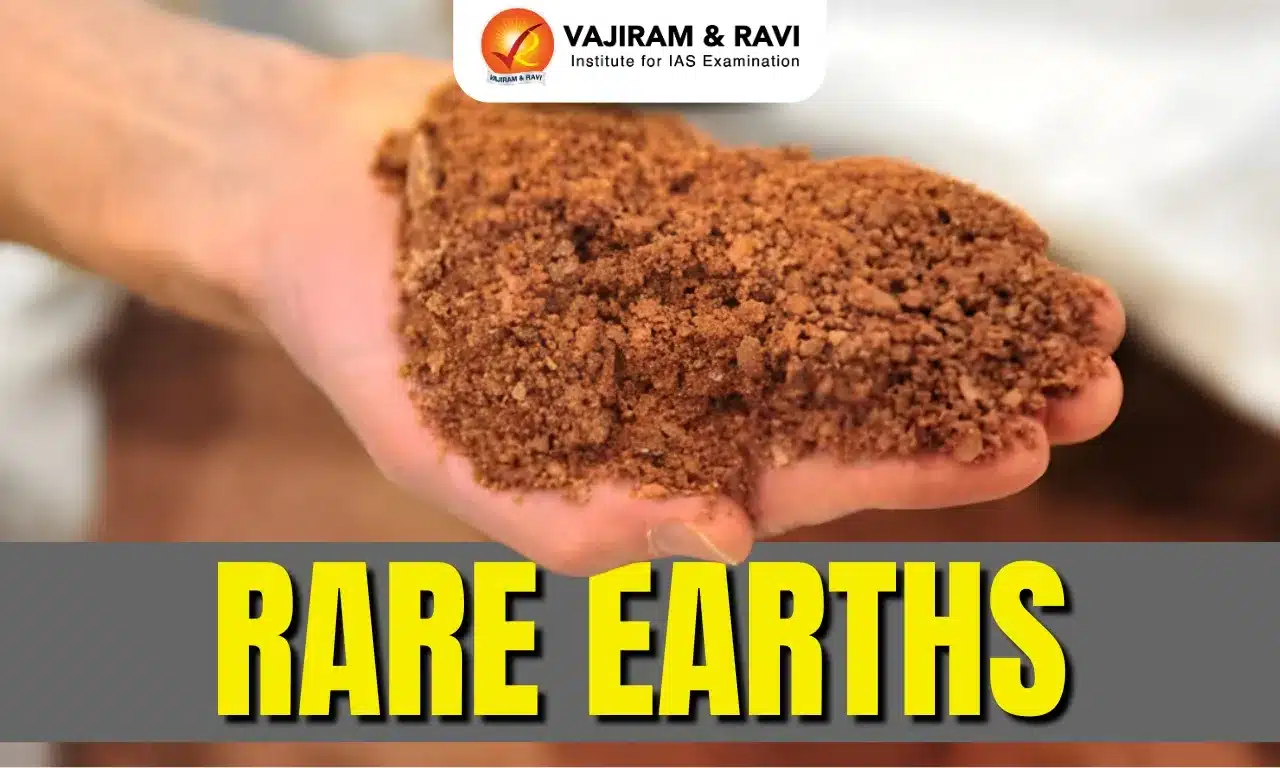
- China’s one-year pause on export controls offers only temporary relief to global rare earth users, serving merely as a brief window to recalibrate strategies before Beijing tightens its grip again.
- Japan provides a proven model for resilience. Having faced China’s coercive export tactics long before others, Japan strengthened its supply chains by diversifying sources, investing in alternatives, and preparing for disruptions — emerging as the first warning signal of China’s growing dominance in the rare earth sector.
China’s 2010 Rare Earths Blockade: A Wake-Up Call for Japan
- In 2010, after a collision involving a Chinese fishing boat and Japanese coast guard vessels, China halted rare earth exports to Japan.
- This created panic in Japan’s automobile industry, which relied heavily on rare earth magnets and imported nearly 90% of these minerals from China.
- Though the dispute was later resolved, rare earth prices skyrocketed tenfold within a year, exposing Japan’s extreme vulnerability and triggering its long-term push for supply chain resilience.


Japan’s Multi-Pronged Strategy for Rare Earth Security
- Japan responded to China’s 2010 export halt by stockpiling rare earths, boosting recycling, and rapidly diversifying supply chains.
- It invested in mines in Australia and Vietnam and achieved 60% independence in critical minerals and fossil fuels by 2022.
- Japan continues to import rare earths from China mainly for advanced materials but is now building resilient networks, forming global partnerships, and encouraging recycling and alternative technologies.
Japan’s Self-Reliance Package: Reducing Dependence on China
- Japan’s strategy includes cutting rare earth usage through new technologies, developing alternative materials, expanding recycling infrastructure, investing in overseas mines, and maintaining strategic reserves.
- This multi-layered policy approach shows that no single solution can reduce vulnerability; instead, long-term planning, diversification, and strategic stockpiles are essential.
China’s Expanding Global Control Over Rare Earths
- China’s dominance is growing: its share in global rare earth mining rose from 38% (2020) to 70% (2023), supported by investments in Africa and Latin America.
- It also controls processing capacity in Malaysia and stakes in Australia’s Lynas.
- This consolidation threatens global supply chains, especially in energy transition technologies and defence applications.
Implications for India: Limited Immediate Impact but Long-Term Challenges
- China’s restrictions will not severely affect India now, but India needs a refreshed strategy as demand rises.
- India possesses significant rare earth reserves of about 6.9 million tonnes, mainly in Odisha, Andhra Pradesh, Tamil Nadu and Rajasthan.
- Despite being among the world’s top five holders, India’s output remains very small — only 2,700 tonnes of rare earth oxides in 2023, compared to China’s 2,24,000 tonnes.
- Although India has strong potential, especially for mineral and defence applications, exploration has been slow and conservative.
- Recent reforms now aim to boost private sector participation in exploring and extracting critical minerals, signalling scope for future expansion.
- Production has begun to rise, reaching 2,900 tonnes in 2023–24 and projected to grow to around 5,000 tonnes in coming years, a sharp increase from earlier years producing under 1,000 tonnes.
- However, risks persist as China tightens its global control over rare earth mining and supply chains, posing potential supply crunch challenges.
Global Response: US and EU Push for Self-Sufficiency
- The US is stockpiling magnets and rare earths while investing in processing facilities.
- The EU is expanding its list of critical minerals and aiming for higher domestic production.
- Germany is stockpiling deep-sea metals, and companies like Solvay are scaling up processing in Europe.
- Together, these efforts aim to reduce long-term dependence on China.

 Last updated on August, 2026
→ UPSC Mains Question Paper 2026 is out now for Essay & GS Paper 1, 2, 3 & 4.
→ UPSC Mains GS Paper 1 2026 is out now.
→ UPSC Mains GS Paper 2 2026 is out now.
→ UPSC Mains GS Paper 3 2026 is out now.
→ UPSC Mains GS Paper 4 2026 is out now.
→ UPSC Mains Indian Language Paper & English Compulsory Paper are out now.
→ Check out the latest UPSC Syllabus 2026 here.
→ UPSC Mains Admit Card 2026 is now out.
→ Enroll in Vajiram & Ravi’s UPSC Mains Test Series 2027 for structured answer writing practice, expert evaluation, and exam-oriented feedback.
→ Join Vajiram & Ravi’s UPSC Mentorship Program 2027 for personalized guidance, strategy planning, and one-to-one support from experienced mentors.
→ Go through the UPSC Mains Previous Year Papers to enhance your preparation.
→ Download UPSC Mains Essay Paper 2025, UPSC Mains GS Paper-I 2025, UPSC Mains GS Paper-II 2025, UPSC Mains GS Paper-III 2025, UPSC Mains GS Paper-IV 2025, UPSC Mains English (Compulsory) Paper 2025, UPSC Mains Hindi (Qualifying) Paper 2025 here.
→ UPSC has released UPSC Toppers List 2025 with the Civil Services final result on its official website.
→ UPSC Calendar 2027 has been released.
→ Also check Best UPSC Coaching in India
Rare earth FAQs
Q1. How did Japan respond to China’s 2010 rare earth blockade?+
Q2. Why is China’s dominance in rare earths a global concern?+
Q3. What makes Japan’s rare earth strategy effective?+
Q4. What challenges does India face in rare earth production?+
Q5. How are the US and EU reducing reliance on China’s rare earth supply?+
Tags: mains articles rare earth upsc current affairs upsc mains current affairs