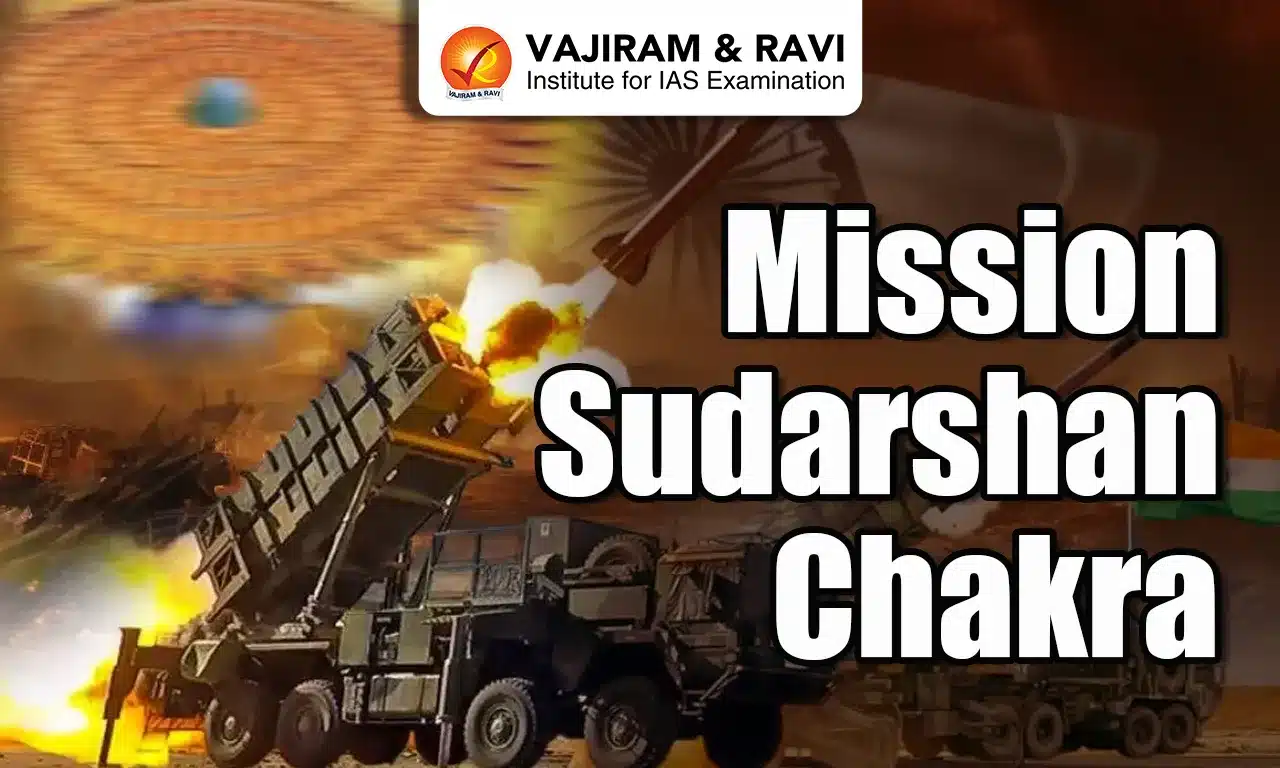
Mission Sudarshan Chakra is India’s ambitious next-generation defence initiative aimed at building a multi-layered, AI-enabled, integrated national security shield capable of countering evolving threats ranging from ballistic missiles and hypersonic weapons to drones, swarm attacks, cyber intrusions, and hybrid warfare. Designed by the Defence Research and Development Organisation (DRDO), the mission marks one of India’s most transformative military modernisation programmes, combining surveillance, cyber defence, missile interception, space-based monitoring, and offensive strike capabilities into one interlocked system.
Planned to be deployed in stages between 2030 and 2035, Mission Sudarshan Chakra will serve as both a shield and a sword, protecting critical infrastructure while also enabling rapid and precise retaliatory strikes.
Mission Sudarshan Chakra
Mission Sudarshan Chakra represents India’s shift towards a holistic, multi-domain defence ecosystem that integrates land, air, sea, space, and cyber capabilities. Inspired by Lord Krishna’s divine weapon, the system envisions a networked architecture of radars, satellites, sensors, missiles, drones, directed-energy weapons, and AI-driven command systems.
Announced by the Prime Minister on August 15, 2025, the initiative aims to strengthen India’s existing defence assets, such as the Integrated Air Command and Control System (IACCS), Akashteer, and the Trigun system, and unify offensive and defensive layers under one national security umbrella.
Mission Sudarshan Chakra Objectives
Mission Sudarshan Chakra is designed to achieve the following goals:
- Establish a national multi- domain shield for real-time threat detection, interception, and retaliation.
- Protect India’s population centres, economic corridors, military bases, and strategic assets.
- Counter new-age threats such as hypersonic vehicles, swarm drones, loitering munitions, artillery rockets, cyber warfare, and hybrid attacks.
- Integrate land-based, sea-based, and space-based surveillance systems.
- Strengthen the existing missile defence ecosystem, including ballistic missile defence readiness.
- Enhance AI-driven data analysis, predictive threat modelling, and automated battle-management.
- Promote complete indigenisation under Atmanirbhar Bharat.


Mission Sudarshan Chakra Historical Background
Mission Sudarshan Chakra was formally announced during the Independence Day speech of 2025. The decision was shaped by rising cross-border threats, including:
- Chinese-origin cyberattacks after the 2020-2021 China-India border tensions.
- The 2025 Pahalgam attack.
- Drone and missile attacks targeting sensitive religious sites, including the Golden Temple.
- Nuclear threats issued by senior Pakistan military leadership.
- Announcement of Pakistan’s Army Rocket Force.
These events demonstrated the need for an advanced, unified, and automated defence architecture capable of countering multi-vector attacks on India’s growing economic and technological assets.
Mission Sudarshan Chakra Structure
Mission Sudarshan Chakra aims to create a national surveillance and strike network based on AI-enabled analysis, big data processing, and real-time coordination across all military branches. Key Features of the Architecture:
- Integration of national radars, satellites, and command centers to form a seamless threat-monitoring grid.
- AI-based threat modelling to predict and neutralize attacks.
- A surveillance layer covering entire India plus 2,500 km beyond borders.
- Real-time coordination between the Indian Army, Navy, Air Force, and intelligence agencies.
- Ability to launch soft kill (jamming) and hard kill (missile interception) responses.
- Support for hypersonic interceptors with coverage up to 2,500 km and altitude up to 150 km.
- Nationwide drone-countering systems, laser-based weapons, and directed-energy weapons.
- Capability to detect and neutralize missiles, drones, artillery shells, and swarm-based threats.
Mission Sudarshan Chakra Components
The major components of the Mission Sudarshan Chakra have been discussed below:
- Integrated Surveillance Grid
- Marine, land, aviation, and space-based sensors.
- Over-the-horizon radars and long-range air surveillance radars.
- Real-time satellite imagery through Space Based Surveillance (SBS).
- Continuous monitoring of the Indian mainland and island territories.
- Multi-layer Interceptor System
- Hypersonic and ballistic missile interceptors.
- Short-, medium-, and long-range surface-to-air missiles.
- Directed-energy weapons and laser-based interceptors.
- Close-range anti-drone and counter-UAS systems.
- Centralised AI-enabled Command and Control
- Automated target allocation using AI and large language models.
- Integration with IACCS and Akashteer.
- Real-time battle management and threat prioritisation.
- Coordination with intelligence agencies and military commands.
- Integration with Offensive Strike Assets
- Links with Integrated Rocket Force (IRF).
- Real-time retaliation capability against hostile launch sites.
- Use of precision-guided munitions, hypersonic missiles, and DEWs.
Mission Sudarshan Chakra Subsystems
The Sub-system of the Mission Sudarshan Chakra has been given below:
Raksha Kavach
Introduced by DRDO in 2025, Raksha Kavach is a pre-cursor multi-layer defence module consisting of:
- VSHORAD
- Dharashakti Electronic Warfare System
- Arudhra Medium Power Radar
- QRSAM
- DRDO AEW&C
- ATAGS
- D-4 System
- Space-based surveillance
- UAVs
- Satellite communication systems
- Ugram assault rifle
How Raksha Kavach Works:
- Layer-1: Space-based surveillance identifies threats.
- Layer-2: AEW&C aircraft perform extended surveillance.
- Layer-3: Ground radars track incoming objects.
- Layer-4: Command center activates missiles or jamming systems.
- Layer-5: Neutralisation through SAMs, EW systems, or laser-based systems.
Integrated Air Defence Weapon System (IADWS)
Tested on 23 August 2025, this system integrates:
- QRSAM
- Advanced VSHORADS
- 5 kW laser-based directed-energy weapon
- Centralised Command and Control (C2C2)
The system successfully destroyed multiple UAV and drone targets simultaneously. Key Abilities of the system are:
- Multi-layer drone and missile defence
- Real-time battle management
- Precision interception of cruise missiles, UAVs, and aircraft
- Multi-target simultaneous engagement
Truck-mounted AK-630
- High-rate fire 30mm CIWS
- Used for protecting border and LoC zones against UAVs, rockets, artillery, and mortars
- Can fire 3,000 rounds per minute
- Equipped with all-weather electro-optical fire control
Radars and Satellites
Mission Sudarshan Chakra will deploy 6,000-7,000 radars, connected to:
- Space-based early warning satellites
- Over-the-horizon radars
- Airborne warning platforms
The combined grid will provide deep visibility into hostile territories.
Mission Sudarshan Chakra Deployment
The Mission Sudarshan Chakra Planning and Deployment has been discussed here. A high-level committee established in 2025 is preparing a detailed roadmap.
Timeline of the Mission Sudarshan Chakra:
- Phase-1 (2030)- Foundational grid, initial interceptor systems, and AI-command modules.
- Phase-2 (2035)- Full-spectrum national shield with upgraded hypersonic interceptors and expanded satellite network.
Priority Areas for Deployment:
- Nuclear power plants
- ISRO facilities
- Industrial corridors
- Financial centers
- Forward bases and border infrastructure
Mission Sudarshan Chakra International Collaboration
Russia has expressed support and readiness to collaborate with India on Mission Sudarshan Chakra (August 2025 briefing by Russian chargé d’affaires Roman Babushkin). However, the programme remains fundamentally indigenous under Atmanirbhar Bharat.
Mission Sudarshan Chakra Budget
The expected requirements include:
- ₹130,000-₹170,000 crore for complete implementation
- ₹25,000 crore annually for operations
Military analysts recommend balanced planning due to the significant financial outlay, suggesting a phased and strategic deployment focusing on high-risk zones first.
Mission Sudarshan Chakra Challenges
Despite of several advancements and progress, the Mission Sudarshan Chakra faces several backlashes and criticism:
- High Financial Cost
- Challenge: Massive capital and operational expenses.
- Way Forward: Phased implementation focused on high-priority regions first.
- Technology Integration Complexity
- Challenge: Integrating radars, satellites, sensors, and weapons across services.
- Way Forward: Develop unified, interoperable standards within DRDO and defence forces.
- Multi-domain Data Overload
- Challenge: Managing large volumes of real-time data.
- Way Forward: Expand AI-driven analytics and quantum computing capacity.
- Indigenous Capability Gaps
- Challenge: Limited domestic production of advanced systems.
- Way Forward: Expand private-sector collaboration and R&D incentives.
- Cybersecurity Vulnerabilities
- Challenge: AI-enabled systems are high-value cyber targets.
- Way Forward: Build advanced cyber hardening, zero-trust architectures, and redundant backups.
- Rapidly Evolving Threats
- Challenge: Hypersonic and autonomous weapons evolve fast.
- Way Forward: Continuous upgrades through adaptive design and modular components.
- Workforce and Skill Deficit
- Challenge: Need for specialists in AI, quantum tech, and EW systems.
- Way Forward: Dedicated defence-tech training and academic partnerships.
- Inter-Agency Coordination
- Challenge: Synchronising military, intelligence, and research bodies.
- Way Forward: Strengthen centralised command mechanisms with clear protocols.
- Space-based Limitations
- Challenge: Growing dependency on satellites.
- Way Forward: Harden space assets and expand redundancy through multiple platforms.
- Border and Terrain Challenges
- Challenge: Difficult terrain for deployment across Himalayas and coasts.
- Way Forward: Use drones, aerostats, and high-altitude radars for extended monitoring.
Mission Sudarshan Chakra UPSC
Mission Sudarshan Chakra represents a historic leap in India’s defence modernisation, transforming the nation’s security paradigm through integrated surveillance, AI-enabled warfighting, and multi-layered missile defence. Once fully operational by 2035, it will provide India with an unprecedented defence shield, countering threats across land, air, sea, space, and cyberspace while ensuring that India remains prepared for future challenges in an evolving global security environment.

 Last updated on Sep, 2026
→ UPSC 2027 Notification will be released on 13 January 2027 at upsconline.nic.in.
→ Asian Games 2026 are being held in Aichi-Nagoya, Japan, from 19 September to 4 October.
→ Check out the latest UPSC Syllabus here.
→ Download UPSC Model Answers for Mains 2026
→ UPSC Mains Question Paper 2026 is out now for Essay & GS Paper 1, 2, 3 & 4.
→ UPSC Calendar 2027 has been released.
→ Enroll in Vajiram & Ravi’s UPSC Mains Test Series 2027 for structured answer writing practice, expert evaluation, and exam-oriented feedback.
→ Join Vajiram & Ravi’s UPSC Mentorship Program 2027 for personalized guidance, strategy planning, and one-to-one support from experienced mentors.
→ Go through the UPSC Mains Previous Year Papers to enhance your preparation.
→ UPSC has released UPSC Toppers List 2025 with the Civil Services final result on its official website.
→ Also check Best UPSC Coaching in India
Mission Sudarshan Chakra FAQs
Q1. What is Mission Sudarshan Chakra?+
Q2. Why was Mission Sudarshan Chakra launched?+
Q3. Which agency implements Mission Sudarshan Chakra?+
Q4. What technologies are used under Mission Sudarshan Chakra?+
Q5. How will Mission Sudarshan Chakra benefit border management?+
Tags: mission sudarshan chakra