Bhang Latest News
- The Kerala High Court has dismissed a petition by a man who was caught with five cannabis plants on a terrace.
- He argued that since the plants had no “flowering or fruiting tops”, they couldn’t be considered ganja, which is illegal under the NDPS Act.
- The Court rejected this argument, explaining that the law makes a clear distinction:
- “Ganja” refers only to the flowering tops of the cannabis plant.
- But the Act separately bans the cultivation of any cannabis plant, regardless of whether it has flowers or not.
- The ruling settles a common misunderstanding — some parts of the cannabis plant may be exempt from the definition of a narcotic drug, but growing the plant itself is always illegal in India.
How the NDPS Act Defines Cannabis in India
- Under the Narcotic Drugs and Psychotropic Substances (NDPS) Act, 1985— introduced under strong global pressure — India did not ban every part of the cannabis plant.
- Instead, the law defines “cannabis (hemp)” narrowly:
- Charas: the resin extracted from the cannabis plant, including hashish oil.
- Ganja: only the flowering or fruiting tops of the plant.
- Excluded: the seeds and leaves, as long as they are not accompanied by the tops.
- In short, the law criminalises the intoxicating parts (resin and flowering tops) but not the seeds and leaves by themselves.


Why Bhang Is Legal: The Leaves-and-Seeds Loophole
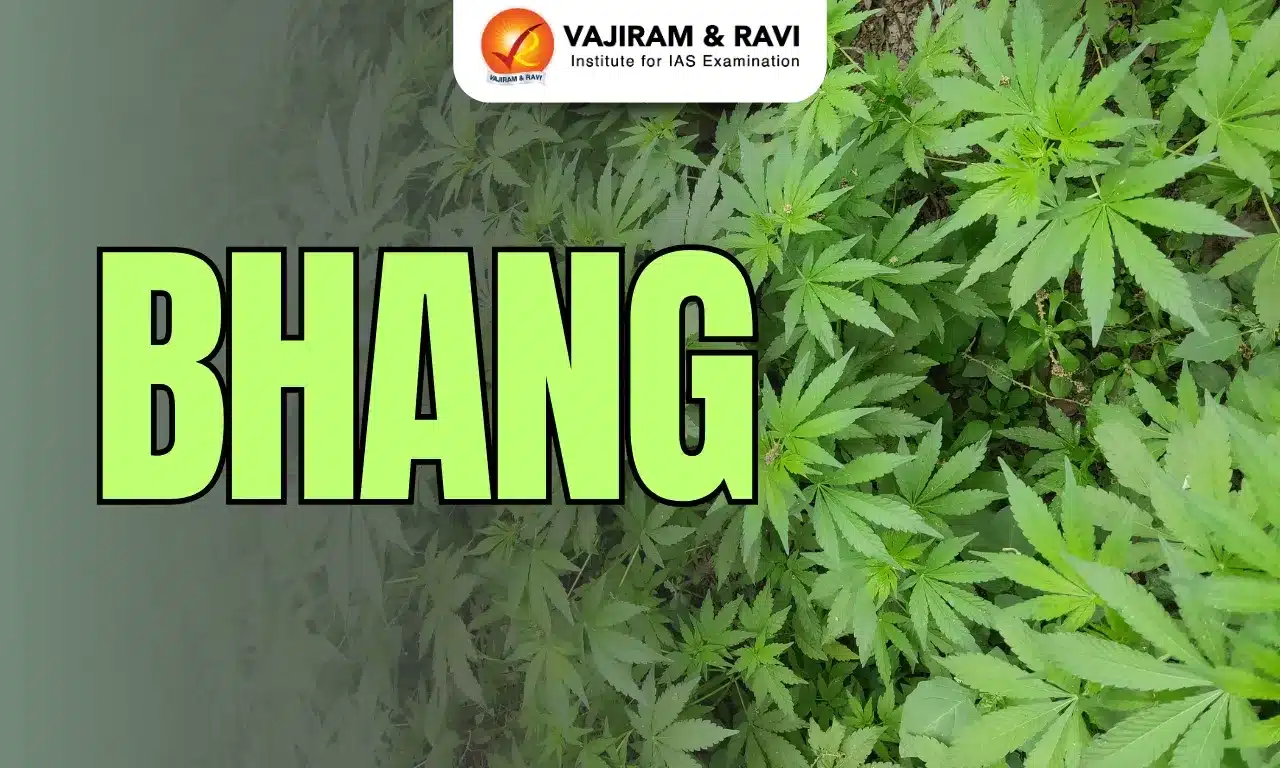
- Bhang remains legal in India because the NDPS Act excludes cannabis leaves and seeds from the definition of “cannabis”.
- Since bhang is made from leaves, it is not treated as a narcotic drug, even though other parts of the plant — like the resin (charas) and flowering tops (ganja) — are banned.
- However, bhang isn’t completely unregulated. The NDPS Act leaves its control to state governments, allowing them to regulate or even ban its production and sale.
- As a result:
- States like Uttar Pradesh and Rajasthan license bhang shops.
- Others, like Assam, have banned it under state laws.
- So, bhang is legal not because cannabis is allowed, but because the law treats leaves differently from the intoxicating parts of the plant.
Why Growing Cannabis at Home Is Illegal Even If Bhang Is Legal
- Although cannabis leaves are not banned under the NDPS Act, growing the plant itself is a crime.
- The Kerala High Court reaffirmed this by pointing to Section 8(b), which clearly bans the cultivation of any cannabis plant unless authorised for medical or scientific use.
- The law defines a “cannabis plant” as any plant of the genus cannabis, without distinguishing between plants with flowers and those without.
- The Court also clarified that “cultivation” includes raising or gardening a plant even in pots, not just farming in fields.
How the NDPS Act Punishes Cannabis Offences
- The NDPS Act sets different punishments depending on the type and quantity of cannabis involved:
- Small quantity
- Ganja: up to 1 kg
- Charas: up to 100 g
- Punishment: Up to 1 year in jail, or a ₹10,000 fine, or both.
- Commercial quantity
- Ganja: 20 kg or more
- Charas: 1 kg or more
- Punishment: 10–20 years rigorous imprisonment + ₹1–2 lakh fine
- Intermediate quantity (between small and commercial)
- Punishment: Up to 10 years in jail + ₹1 lakh fine
- Cultivating cannabis plants (even a few)
- Punishment: Up to 10 years rigorous imprisonment + ₹1 lakh fine
- In short, penalties rise sharply with quantity — and cultivation itself is treated as a serious offence.
When Cannabis Can Be Grown Legally in India
- Even though the NDPS Act bans cannabis cultivation, it allows important industrial and medical exceptions.
- Section 14 of the act lets the government permit cultivation specifically for fibre, seeds, horticulture, or medical research.
- Using this provision:
- Uttarakhand became the first state (in 2018) to license industrial hemp, a low-THC variety of cannabis.
- Uttar Pradesh, Himachal Pradesh, and Madhya Pradesh have followed with similar permissions.
- The Union government has granted licences to scientific bodies like CSIR to grow cannabis for medical studies.
- India’s first medical cannabis clinic opened in Bengaluru in 2020, prescribing cannabis-based medicines for certain conditions.
- Meanwhile, the Delhi High Court has been examining a petition challenging the cannabis ban, arguing that the restrictions are outdated and lack scientific basis.

 Last updated on August, 2026
→ UPSC Mains 2026 commenced on 21st August 2026 and will continue through 30th August 2026, as per the official examination schedule.
→ UPSC Mains Question Paper 2026 is out now for Essay & GS Paper 1, 2, 3 & 4.
→ UPSC Mains GS Paper 1 2026 is out now.
→ UPSC Mains GS Paper 2 2026 is out now.
→ UPSC Mains GS Paper 3 2026 is out now.
→ UPSC Mains GS Paper 4 2026 is out now.
→ Check out the latest UPSC Syllabus 2026 here.
→ UPSC Mains Admit Card 2026 is now out.
→ Enroll in Vajiram & Ravi’s UPSC Mains Test Series 2027 for structured answer writing practice, expert evaluation, and exam-oriented feedback.
→ Join Vajiram & Ravi’s UPSC Mentorship Program 2027 for personalized guidance, strategy planning, and one-to-one support from experienced mentors.
→ Go through the UPSC Mains Previous Year Papers to enhance your preparation.
→ Download UPSC Mains Essay Paper 2025, UPSC Mains GS Paper-I 2025, UPSC Mains GS Paper-II 2025, UPSC Mains GS Paper-III 2025, UPSC Mains GS Paper-IV 2025, UPSC Mains English (Compulsory) Paper 2025, UPSC Mains Hindi (Qualifying) Paper 2025 here.
→ UPSC has released UPSC Toppers List 2025 with the Civil Services final result on its official website.
→ UPSC Calendar 2027 has been released.
→ Also check Best UPSC Coaching in India
Bhang FAQs
Q1. Why is bhang legal but cannabis illegal in India?+
Q2. What parts of the cannabis plant are banned under Indian law?+
Q3. Why can’t you grow cannabis at home even for leaves?+
Q4. What are the punishments for cannabis-related offences?+
Q5. When is cannabis cultivation allowed legally?+
Tags: Bhang mains articles upsc current affairs upsc mains current affairs