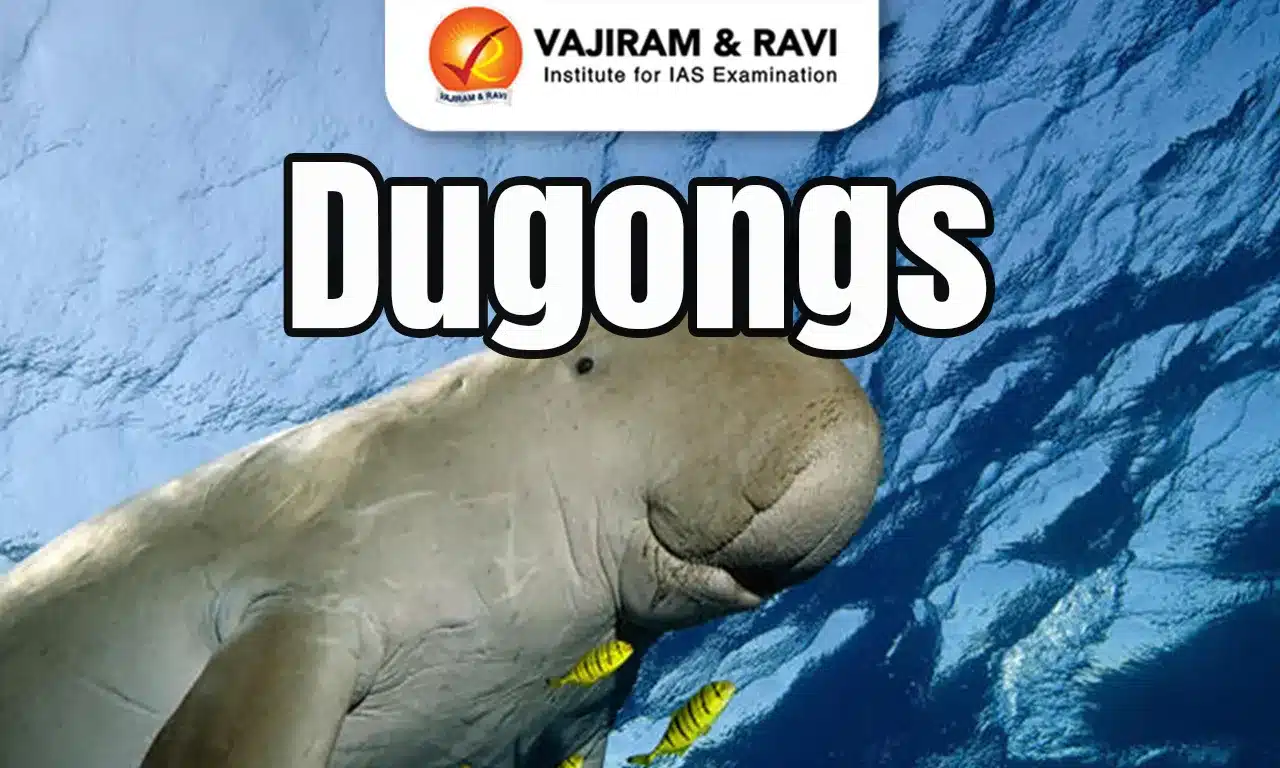
Dugong Latest News
- A recent IUCN report released at the Conservation Congress in Abu Dhabi warns that India’s dugongs (sea cows) face a growing risk of extinction.
- Found mainly in the Gulf of Kutch, Gulf of Mannar–Palk Bay, and the Andaman & Nicobar Islands, their survival outlook is grim: long-term survival in the Gulf of Kutch is “highly uncertain,” conditions in the Andamans are “challenging,” and populations in the Gulf of Mannar–Palk Bay have significantly declined.
- Dugongs are listed as Vulnerable on the IUCN Red List and enjoy the highest protection in India under Schedule I of the Wildlife (Protection) Act, 1972, which bans hunting and trade.
- These gentle marine herbivores play a crucial ecological role by maintaining healthy seagrass meadows, which support biodiversity and store carbon.
- However, dugongs face numerous threats, including coastal habitat degradation, seagrass loss, fishing-net entanglement, boat collisions, pollution, and human disturbances.
- The Indian government has initiated conservation. Despite this, the new report indicates that urgent and strengthened action is needed to prevent their decline from becoming irreversible.
Dugongs: The Gentle ‘Sea Cows’ of the Coast
- Dugongs (Dugong dugon) are large, gentle marine mammals often linked to mermaid legends due to their calm, graceful behaviour.
- Closely related to manatees, they have a rounded body and a dolphin-like tail. Adults can grow up to 10 feet long and weigh around 420 kg.
- Exclusively herbivorous, dugongs feed mainly on seagrass meadows, consuming 30–40 kg daily — earning them the name sea cows.
- They inhabit shallow, warm coastal waters, typically in sheltered bays, lagoons, and estuaries less than 10 metres deep.


Why Dugongs Matter: Guardians of Seagrass and Coastal Productivity
- Dugongs are vital to the health of seagrass ecosystems, which are among the planet’s most efficient carbon sinks.
- Their grazing naturally prunes seagrass, removes old shoots, prevents overgrowth, and enhances carbon storage in the sediment.
- By stirring up the seagrass beds while feeding, dugongs also release nutrients trapped in the sediment.
- These nutrients support a wide range of marine life, including commercially valuable fish, shellfish, sea cucumbers, and other invertebrates.
- Research shows that seagrass habitats with dugongs generate at least ₹2 crore more fish production annually, while areas lacking dugongs show significantly reduced productivity.
- In essence, dugongs are ecosystem engineers that boost biodiversity, sustain fisheries, and support coastal carbon cycles.
Declining Dugong Numbers
- Once common in Indian waters, dugongs have declined drastically. A 2012 government report estimated around 200 individuals.
- Current estimates vary: some experts suggest 400–450, while others believe the number is below 250.
- Their elusive nature and murky habitats make accurate counts difficult.
Where Dugongs Survive in India
- Palk Bay–Gulf of Mannar (Tamil Nadu): Largest and most stable group, 150–200 dugongs
- Andaman & Nicobar Islands: Fewer than 50 individuals
- Gulf of Kutch (Gujarat): Fewer than 20 individuals
- These populations are small, fragmented, and highly vulnerable.
Human Activities Driving the Decline
- The main threats come from coastal degradation and human activities:
- Fishing-net entanglement is the most common cause of death.
- High turbidity, pollution, and bycatch threaten dugongs in the Gulf of Kutch and Tamil Nadu.
- Andamans face high fisheries-related mortality.
- Industrial discharge, agricultural runoff, and untreated wastewater also pollute seagrass meadows — dugongs’ primary feeding grounds.
Toxic Pollution Found in Dugong Tissues
- A recent study analysing 46 stranded dugongs found dangerous levels of arsenic, cadmium, chromium, mercury, and lead in organs such as liver, kidneys, and muscles.
- These metals accumulate in seagrass sediments, indicating severe ecosystem contamination.
Slow Reproduction Increases Extinction Risk
- Dugongs reproduce very slowly — females give birth once every several years.
- This low reproductive rate hampers population recovery and makes the species extremely vulnerable to ongoing threats.
Government Efforts to Protect Dugongs — and What More Is Needed
- India has taken several steps to conserve dugongs. In 2010, the Centre set up a Task Force for Dugong Conservation, followed by a national dugong recovery programme in collaboration with Tamil Nadu, Gujarat, and the Andaman & Nicobar Islands.
- A major milestone was the creation of the 448 sq km Dugong Conservation Reserve in Palk Bay (2022) to safeguard seagrass meadows and dependent dugong populations.
- However, experts say conservation efforts need strengthening. Researchers call for better monitoring, reduced fishing pressure, and incentive-based programmes for coastal communities.
- While progress has been made, dugong populations will recover only with sustained, strengthened, and community-inclusive conservation actions.

 Last updated on Oct, 2026
→ UPSC 2027 Notification will be released on 13 January 2027 at upsconline.nic.in.
→ Check Nobel Prize 2026 Winners List here.
→ Download PIB PRiSM Monthly Magazine 2026 here.
→ Check UPSC Monthly Current Affairs Magazine The Recitals here.
→ Check out the latest UPSC Syllabus here.
→ Download UPSC Model Answers for Mains 2026
→ UPSC Mains Question Paper 2026 is out now for Essay & GS Paper 1, 2, 3 & 4.
→ UPSC Calendar 2027 has been released.
→ Enroll in Vajiram & Ravi’s UPSC Mains Test Series 2027 for structured answer writing practice, expert evaluation, and exam-oriented feedback.
→ Join Vajiram & Ravi’s UPSC Mentorship Program 2027 for personalized guidance, strategy planning, and one-to-one support from experienced mentors.
→ Go through the UPSC Mains Previous Year Papers to enhance your preparation.
→ UPSC has released UPSC Toppers List 2025 with the Civil Services final result on its official website.
→ Also check Best UPSC Coaching in India
Dugong FAQs
Q1. Why are India’s dugongs declining?+
Q2. Where are dugongs found in India?+
Q3. Why are dugongs important for marine ecosystems?+
Q4. What major threats do dugongs face today?+
Q5. What conservation measures has India taken?+
Tags: dugong mains articles upsc current affairs upsc mains current affairs