


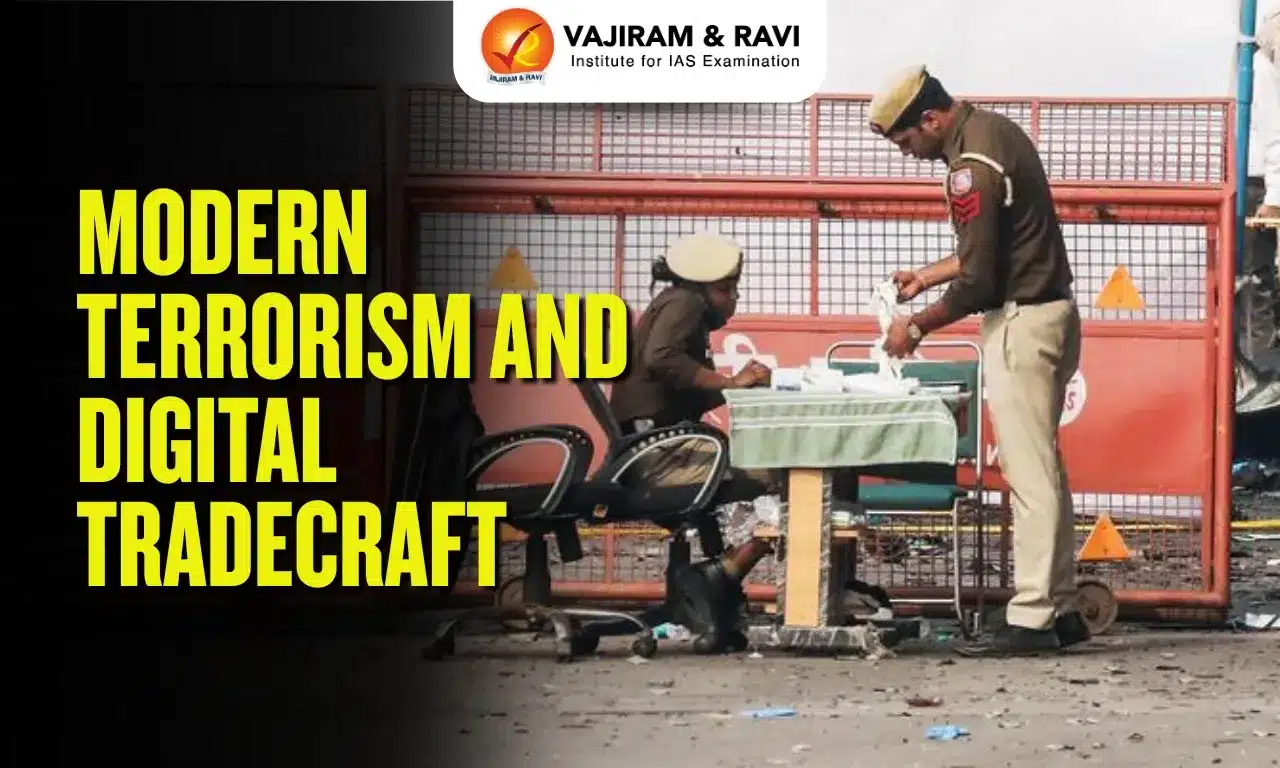
Modern Terrorism and Digital Tradecraft Latest News
- The investigation into the recent (November 10) Red Fort car explosion in Delhi — one of the deadliest attacks in recent years — has revealed the evolving nature of terrorism in India.
- The module behind the attack allegedly leveraged encrypted communication platforms, dead-drop email techniques, and high operational discipline, reflecting trends discussed in global counter-terrorism research.
- The case highlights critical gaps in India’s digital surveillance and counter-terrorism architecture.
Background of the Incident
- The attack:
- A car exploded near Gate No. 1 of the Red Fort Metro Station on November 10, killing 15 and injuring over 30.
- Treated as a terrorist attack under counter-terrorism laws; investigation handed to the NIA.
- Key suspects: Three doctors (Dr. Umar Un Nabi, Dr. Muzammil Ganaie, Dr. Shaheen Shahid) linked to Al Falah University (Faridabad) – alleged deep involvement in planning and operational support.


Major Findings of the Investigation
- Use of encrypted communication:
- Primary communication through Threema, a Swiss-based end-to-end encrypted (E2EE) app with –
- No phone number/email needed
- Random user IDs
- No metadata retention
- Two-end message deletion
- Suspected use of a private Threema server, possibly offshore.
- Primary communication through Threema, a Swiss-based end-to-end encrypted (E2EE) app with –
- Spy-style ‘Dead-Drop’ email technique: Use of a shared email account accessed via unsent drafts. Leaves almost no digital transmission footprint, complicating forensics.
- Physical reconnaissance and explosive stockpiling:
- Multiple recce missions across Delhi before the attack.
- Ammonium nitrate stockpiling traced to a red EcoSport vehicle.
- Use of familiar vehicles to avoid suspicion.
- Operational discipline and external linkages:
- Dr. Umar, who was reportedly the driver of the car that caused the blast, “switched off his phones” and cut digital ties after the arrest of his associates, a sophisticated tactic to limit exposure.
- Possible connection with Jaish-e-Mohammed (JeM) or a JeM-inspired module.
- Reflects high operational security and training.
Academic Scholarship Alignment
- Patterns consistent with counter-terrorism research:
- Growing use of E2EE platforms, VPNs, private servers by extremist groups.
- Use of digital dead-drops, blending old spycraft with new technologies.
- Adoption of multi-domain operational security: phygital (physical + digital).
- Challenge for States: Traditional surveillance tools (phone tapping, metadata scraping, email intercepts) are becoming ineffective.
Implications for National Security
- Traditional surveillance offers limited insights: Encrypted apps and decentralised servers bypass law enforcement touchpoints.
- App bans are insufficient: Threema, banned in India under Section 69A of the IT Act, still accessible via VPNs.
- Need for advanced technical capabilities: Device seizure alone is insufficient without memory forensics, server tracking, and reverse engineering capabilities.
- Potential transnational handlers: Possible JeM link indicates cross-border operational networks.
Challenges
- Lack of specialised cyber forensics: Limited expertise in analysing encrypted servers, private-network communication.
- Regulatory gaps: No clear framework for self-hosted communication infrastructure.
- Detection of digital dead-drop methods: Existing intercept systems cannot detect draft-based email communication.
- Radicalisation in professional spaces: Highly educated individuals (doctors, academics) are harder to monitor.
- Weak international coordination: Terror cells exploit jurisdictional limitations of foreign apps and servers.
Way Forward
- Build dedicated digital forensics units: Special teams for E2EE platform analysis, server forensics, memory dumps. Monitoring of VPN exit nodes and anonymisers.
- Regulate self-hosted communication servers: Mandate lawful access compliance for privately hosted servers. Strengthen cooperation with tech companies under judicial oversight.
- Update counter-terrorism laws:
- Explicitly recognise threats from decentralised networks, encrypted communication, dead-drop techniques.
- Train investigators to detect shared accounts and draft-only communication.
- Strengthen institutional counter-radicalisation: Early-warning systems in educational institutions. Focused programs for highly educated professionals.
- Deepen international intelligence cooperation:
- Collaboration on encrypted infrastructure, server access, and cross-border funding.
- Pursue tech diplomacy with countries hosting encrypted-app servers.
- Public awareness: Educate citizens on evolving terror methodologies and reporting mechanisms.
Conclusion
- The Red Fort blast underscores a critical reality – terrorism in the 21st century is driven as much by encrypted code as by physical logistics.
- Modern terror cells blend digital anonymity tools with traditional reconnaissance and ideological networks.
- For India, this incident is a stark reminder that counter-terrorism must evolve toward multidisciplinary intelligence, advanced cyber-forensics, stronger legal tools, and international cooperation.
- To protect society, security agencies must be equipped to combat threats not only on the ground but also within the encrypted, decentralised digital ecosystems where modern terror thrives.
Source: TH

 Last updated on Oct, 2026
→ UPSC 2027 Notification will be released on 13 January 2027 at upsconline.nic.in.
→ Check Nobel Prize 2026 Winners List here.
→ Download PIB PRiSM Monthly Magazine 2026 here.
→ Check UPSC Monthly Current Affairs Magazine The Recitals here.
→ Check out the latest UPSC Syllabus here.
→ Download UPSC Model Answers for Mains 2026
→ UPSC Mains Question Paper 2026 is out now for Essay & GS Paper 1, 2, 3 & 4.
→ UPSC Calendar 2027 has been released.
→ Enroll in Vajiram & Ravi’s UPSC Mains Test Series 2027 for structured answer writing practice, expert evaluation, and exam-oriented feedback.
→ Join Vajiram & Ravi’s UPSC Mentorship Program 2027 for personalized guidance, strategy planning, and one-to-one support from experienced mentors.
→ Go through the UPSC Mains Previous Year Papers to enhance your preparation.
→ UPSC has released UPSC Toppers List 2025 with the Civil Services final result on its official website.
→ Also check Best UPSC Coaching in India
Modern Terrorism and Digital Tradecraft FAQs
Q1. How encrypted communication platforms have altered the landscape of counter-terrorism in India?+
Q2. What is the relevance of digital ‘dead-drop’ techniques in modern terror operations?+
Q3. How does the Red Fort blast highlight the challenge of detecting radicalisation among highly educated individuals?+
Q4. What are the implications of private, self-hosted servers for India’s cyber security framework?+
Q5. Why is international cooperation essential in countering technologically sophisticated terror networks?+
Tags: mains articles modern terrorism and digital tradecraft upsc current affairs upsc mains current affairs








