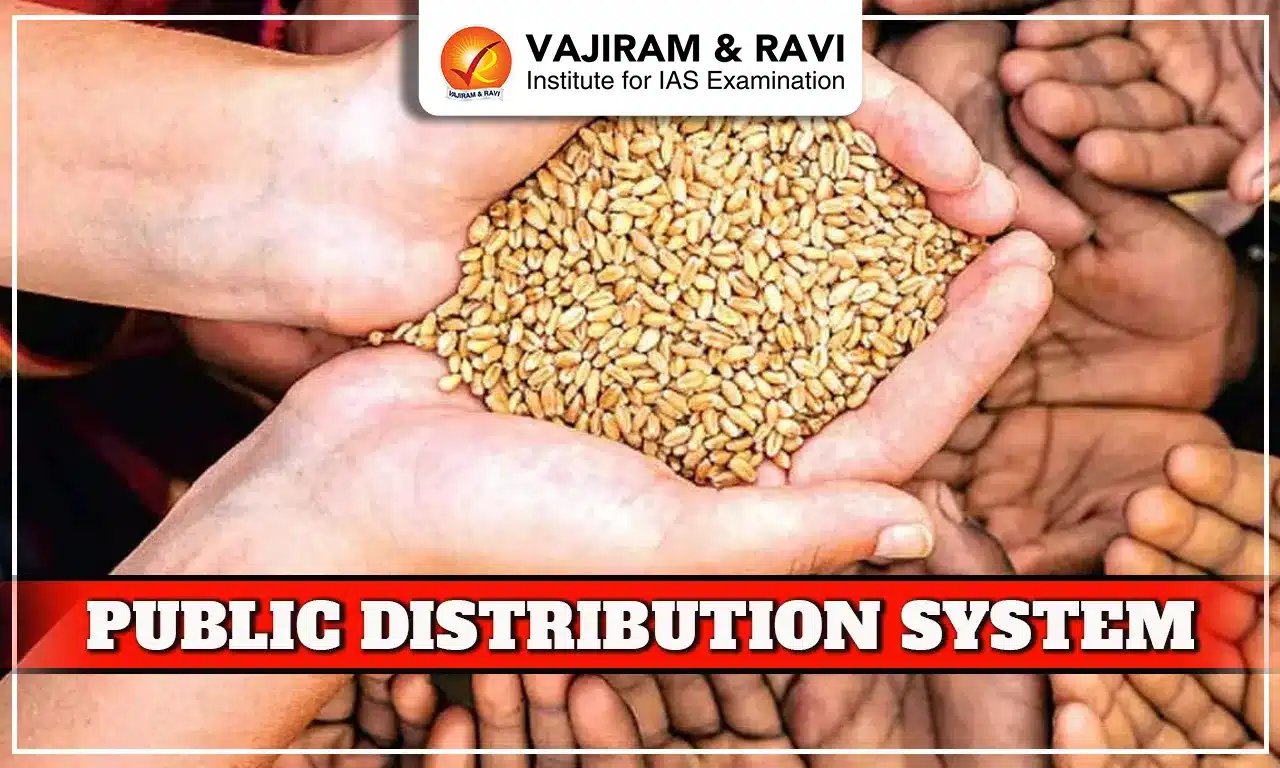
Public Distribution System (PDS) in India has evolved into a nationwide, rights-based food security network ensuring affordable access to essential food grains for vulnerable households. As of 2025, it caters to around 80.56 crore bevneficiaries under the National Food Security Act, making it one of the largest food distribution systems in the world. Over the years, PDS has expanded from a welfare-based setup to a more targeted and technology-driven system. It performs key functions such as procurement, storage, transportation, and subsidised distribution through a network of fair price shops.
Public Distribution System (PDS) Objectives
The Public Distribution System (PDS) aims to ensure food security by providing essential commodities like rice, wheat, and coarse grains to vulnerable households at subsidised rates. It seeks to stabilise food prices, reduce hunger, and support the nutritional needs of economically weaker sections across the country.
- Ensure Food Security: Provide essential food grains at subsidised prices to protect vulnerable households from hunger and malnutrition.
- Price Stabilisation: Regulate market prices of essential commodities and shield poor families from inflation and volatility.
- Nutritional Support: Supply adequate and nutritious food, especially to children, pregnant women, and economically weaker sections.
- Buffer Stock Management: Maintain national food reserves to ensure the continuous availability of food grains during emergencies, droughts, and production shortfalls.
- Equitable Distribution: Transfer food grains from surplus states to deficit regions to promote balanced access across the country.
- Support to Farmers: Procure food grains at Minimum Support Prices (MSP) to provide remunerative prices and encourage stable agricultural production.
Public Distribution System (PDS) Evolution
Public Distribution System (PDS) Evolution has transitioned from a wartime rationing mechanism during the 1940s to a nationwide welfare-oriented food security system. Over time, it has undergone major reforms, shifting from a universal model to a targeted and digitalised system aimed at improving efficiency and transparency.
Origins of PDS (World War II Phase)
- PDS began during World War II as a wartime rationing system to manage food scarcity.
- Before the 1960s, the system depended heavily on imported food grains to meet distribution needs.
Expansion During Food Shortages (1960s)
- PDS expanded significantly in the 1960s due to severe food shortages and rising population
- needs.
- The government established the Agriculture Prices Commission (now CACP) to ensure fair price policies for farmers.
- The Food Corporation of India (FCI) was created to strengthen procurement, storage, and movement of food grains for PDS.
Universal PDS Phase (1970s-1992)
- By the 1970s, PDS evolved into a universal system, offering subsidised food to all households, irrespective of income.
- Until 1992, PDS remained a general entitlement scheme with no targeting of beneficiaries.
Revamped Public Distribution System – RPDS (1992)
- Launched in June 1992 to improve reach in remote, hilly, tribal, and inaccessible regions.
- Aimed to strengthen infrastructure, reduce shortages, and ensure regular supply in disadvantaged areas.
- Focused on addressing the needs of underprivileged populations in difficult terrains.
Targeted Public Distribution System – TPDS (1997)
- Introduced in June 1997 to direct subsidies towards the poor instead of universal coverage.
- Beneficiaries classified into Below Poverty Line (BPL) and Above Poverty Line (APL) households.
- Marked the shift from a universal to a targeted welfare approach to reduce fiscal burden and improve efficiency.
Antyodaya Anna Yojana – AAY (2000)
- Launched in December 2000 for the poorest among BPL families, identified through NSS data showing 5% of people sleeping hungry.
- One crore of the poorest households were initially targeted, later expanded in phases.
- AAY provided highly subsidised grains: 35 kg per family per month, at very low issue prices.
National Food Security Act – NFSA (2013)
- Enacted in September 2013, making food security a legal right for eligible households.
- Built on the TPDS framework to provide subsidised food grains to 67% of the population.
- Introduced legally enforceable entitlements and grievance redressal mechanisms.
- Transformed access to food from a welfare provision into a justiciable right under law.
Overall Transformation of PDS
- Evolved from colonial rationing → universal welfare scheme → targeted system → legal right under NFSA.
- Gradual reforms aimed at improving coverage, efficiency, targeting, and food security outcomes, particularly for the most vulnerable.


Public Distribution System (PDS) Functions
The Public Distribution System (PDS) functions as India’s largest food security network, ensuring the procurement, storage, and distribution of essential food grains at subsidised rates to vulnerable households. The detailed functions of PDS have been listed below.
- MSP Procurement: Procures food grains from farmers at Minimum Support Price to ensure stable and assured income for agricultural producers.
- Buffer Stock Maintenance: Maintains national-level buffer stocks to manage emergencies like droughts, floods, and supply disruptions.
- Storage Management: Stores food grains in FCI warehouses and state depots to ensure continuous, year-round availability.
- Transportation & Movement: Transports grains from procurement states to deficit regions, reducing regional imbalance in food availability.
- Subsidised Distribution: Provides essential commodities such as rice and wheat at subsidised rates through Fair Price Shops to eligible households.
- Price Stabilisation: Helps control inflation by reducing pressure on open-market demand
- through distribution of subsidised grains.
- Food Security Assurance: Ensures food access for vulnerable groups under BPL, APL, AAY, and NFSA by providing legal food entitlements.
- Support to Welfare Schemes: Supplies food grains to schemes like Mid-Day Meal, ICDS, and PM-POSHAN for children, lactating mothers, and poor families.
- Hunger & Malnutrition Reduction: Ensures affordable access to cereals, reducing hunger, food deprivation, and undernutrition among poor households.
- Social Equity Promotion: Provides equal access to subsidised grains, supporting weaker and marginalised communities across regions.
- Crisis & Disaster Support: Acts as a safety net during natural disasters, pandemics, and economic crises by ensuring uninterrupted food supply.
- Quality Control: Ensures quality checks, inspection, and maintenance standards for food grains before distribution to beneficiaries.
- Transparency & Grievance Redressal: Provides accountability through NFSA grievance mechanisms, vigilance committees, and social audits.
Public Distribution System (PDS) Issues
The Public Distribution System (PDS), despite being one of the largest food security networks in the world, faces several systemic challenges that reduce its effectiveness and create significant financial and administrative burdens. These issues weaken the intended impact of welfare schemes, reduce access for genuine beneficiaries, and inflate government expenditure.
- Leakages and Diversions
-
- Around 28% leakage in PDS results in an estimated ₹69,108 crore annual loss, reflecting major inefficiencies.
- Grains are often diverted during transportation or sold illegally in the open market.
- Example: Nearly one-third of grains lifted from FCI fail to reach Fair Price Shops, reducing actual availability for poor households.
- Targeting Errors
-
- TPDS suffers from both inclusion and exclusion errors, limiting its effectiveness.
- Non-poor households often obtain ration cards, while deserving poor households are left out.
- Example: Many migrant labourers and informal workers struggle to get ration cards, whereas some urban middle-income families access subsidised food grains.
- Supply Chain Inefficiencies
-
- Problems in storage, transportation, and inter-agency coordination cause delays and wastage.
- Inadequate warehouse capacity leads to spoilage of food grains.
- Example: Remote and hilly regions frequently receive delayed deliveries, creating periodic shortages at ration shops.
- Monocropping and Reduced Crop Diversity
-
- MSP-driven procurement focuses heavily on rice and wheat, discouraging crop diversification.
- Long-term nutritional outcomes and soil health are affected.
- Example: Punjab and Haryana shifted to water-intensive rice cultivation, reducing production of millets and coarse grains.
- Rising Subsidy Burden
-
- Food subsidy increased from ₹21,200 crore in 2002-03 to nearly ₹2 lakh crore in 2024-25.
- High subsidy levels stress the Union Budget and burden FCI finances.
- Example: Subsidy dues to FCI often accumulate due to the large fiscal requirement for maintaining PDS operations.
- Urban Bias
-
- PDS works more efficiently in urban areas due to better infrastructure and monitoring.
- Rural, tribal, and remote regions face irregular supply and weaker administrative oversight.
- Example: Urban ration shops in Delhi or Mumbai receive regular stock, while tribal districts in Odisha and Jharkhand face stock-outs due to transport bottlenecks.
Public Distribution System (PDS) Reforms
- Aadhaar Seeding of Beneficiaries: Ensures proper identification, removes duplicate/ghost ration cards, and reduces inclusion–exclusion errors in TPDS.
- Digitisation of Ration Cards: Allows online verification of beneficiary data, tracking of monthly quotas, and real-time monitoring of entitlements.
- End-to-End Computerisation of Supply Chain: Tracks food grains digitally from FCI procurement centres to state depots and finally to FPS, reducing diversion and leakage.
- GPS Tracking of Food Grain Transport Vehicles: Monitors truck movement to prevent route diversion, delay, or pilferage during transportation.
- Automation with e-PoS Machines: FPS shops use biometric Point of Sale devices to authenticate beneficiaries and record transactions, improving transparency.
- Smart Ration Cards: Introduced as secure electronic cards storing beneficiary details and biometrics, preventing counterfeiting and fake entries.
- SMS-Based Monitoring System: Beneficiaries receive SMS alerts when grain is dispatched or arrives at FPS, promoting public oversight and reducing corruption.
- Online Grievance Redressal Mechanisms: State portals and toll-free helplines allow beneficiaries to lodge complaints and track resolutions, improving accountability.
- Strengthening Transparency through Social Audits: Local communities, SHGs, and NGOs participate in monitoring FPS functioning and reporting irregularities.
- Expansion of Food Basket: Some states distribute pulses, edible oils, iodised salt, and fortified foods through PDS to enhance nutritional security.
- Universal PDS Models in Select States: States like Tamil Nadu and Kerala provide subsidised food grains to all households to minimise targeting errors.
- Direct Benefit Transfer (DBT) Pilots: Cash transfer of the food subsidy directly to beneficiary bank accounts, reducing storage and transport-related leakages (implemented cautiously).
Public Distribution System (PDS) Way Forward
The Public Distribution System can be strengthened by enhancing transparency, reducing leakages, and ensuring better targeting through technology-driven reforms. Improving storage, transport, and procurement mechanisms will make food distribution more efficient and sustainable.
- End-to-End Digitalisation: Complete computerisation, GPS tracking, and e-POS-based beneficiary authentication to minimise leakages.
- Diversified Food Basket: Include millets, pulses, and fortified foods in PDS to improve nutrition and reduce dependence on rice and wheat.
- Strengthening Storage & Logistics: Modernise warehouses, expand scientific silos, and improve last-mile delivery in remote regions.
- Better Targeting & Inclusion: Regularly update beneficiary lists, integrate Aadhaar effectively, and ensure migrant portability through ONORC.

 Last updated on Oct, 2026
→ UPSC 2027 Notification will be released on 13 January 2027 at upsconline.nic.in.
→ Asian Games 2026 are being held in Aichi-Nagoya, Japan, from 19 September to 4 October.
→ Check Nobel Prize 2026 Winners List here.
→ Download PIB PRiSM Monthly Magazine 2026 here.
→ Check UPSC Monthly Current Affairs Magazine The Recitals here.
→ Check out the latest UPSC Syllabus here.
→ Download UPSC Model Answers for Mains 2026
→ UPSC Mains Question Paper 2026 is out now for Essay & GS Paper 1, 2, 3 & 4.
→ UPSC Calendar 2027 has been released.
→ Enroll in Vajiram & Ravi’s UPSC Mains Test Series 2027 for structured answer writing practice, expert evaluation, and exam-oriented feedback.
→ Join Vajiram & Ravi’s UPSC Mentorship Program 2027 for personalized guidance, strategy planning, and one-to-one support from experienced mentors.
→ Go through the UPSC Mains Previous Year Papers to enhance your preparation.
→ UPSC has released UPSC Toppers List 2025 with the Civil Services final result on its official website.
→ Also check Best UPSC Coaching in India
Public Distribution System (PDS) FAQs
Q1. What is the Public Distribution System (PDS)?+
Q2. Which ministry administers the PDS?+
Q3. What commodities are distributed under PDS?+
Q4. What is Targeted Public Distribution System (TPDS)?+
Q5. What is Antyodaya Anna Yojana (AAY)?+
Tags: public distribution system (pds)