Public Service Commissions Latest News
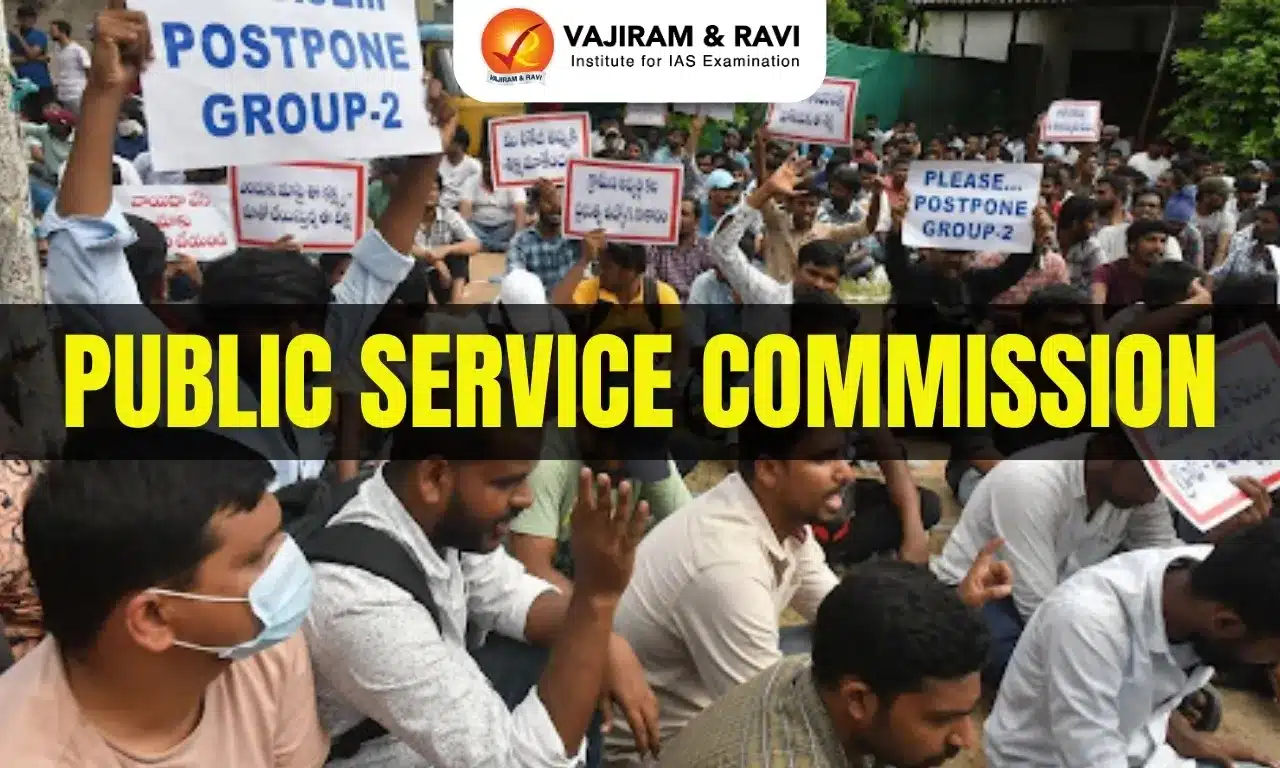
- The 2025 National Conference of State Public Service Commissions (PSCs), hosted by the Telangana State PSC, has brought renewed focus on the longstanding challenges affecting State PSCs.
Evolution of Public Service Commissions in India
- Public Service Commissions have their origins in India’s struggle for self-governance.
- According to the historical overview, the demand for merit-based entry into civil services was central to the early nationalist movement. This led to:
- The Montagu-Chelmsford Reforms, which proposed an independent office regulating service matters,
- Establishment of the first Public Service Commission in 1926,
- Provisions in the Government of India Act, 1935, mandating PSCs for each province, which the Constitution later retained; today, we have the UPSC and State PSCs.


Structural Differences Between UPSC and State PSCs
- UPSC’s Strong Governance Framework
- The UPSC operates in a politically insulated environment, ensuring independence and professionalism. Members generally:
- Are above 55 years of age,
- Have rich experience in public administration,
- Come from diverse zones of the country.
- The Union government further institutionalised recruitment processes by creating the Ministry of Personnel, Public Grievances and Pensions (1985), enabling regular manpower planning and timely declaration of vacancies.
- The UPSC operates in a politically insulated environment, ensuring independence and professionalism. Members generally:
- State PSCs’ Politicised Environment
- In contrast, State PSCs function in a “politically osmotic environment”, where:
- Appointments tend to reflect political proximity rather than experience,
- States lack dedicated personnel ministries,
- Vacancies are declared irregularly due to fiscal constraints,
- Exams are conducted infrequently, leading to widespread litigation and delays.
- These structural factors form the foundation of the credibility crisis facing State PSCs.
- In contrast, State PSCs function in a “politically osmotic environment”, where:
Procedural Challenges Undermining State PSC Efficiency
- Irregular Syllabus Updates and Academic Limitations
- Unlike the UPSC, which periodically appoints committees of academicians, civil servants, and experts, State PSCs do not frequently update their syllabi. They also:
- Depend heavily on limited academic resources within the State,
- Struggle to ensure objective evaluation due to weak moderation mechanisms.
- Unlike the UPSC, which periodically appoints committees of academicians, civil servants, and experts, State PSCs do not frequently update their syllabi. They also:
- Complex Reservation and Regional Quota Calculations
- State PSCs face significant challenges in applying:
- Vertical reservations,
- Horizontal reservations,
- Regional (zonal) reservations are especially visible in States like Telangana and Andhra Pradesh. This often leads to errors and legal disputes.
- State PSCs face significant challenges in applying:
- Recurring Examination Controversies
- Paper leaks,
- Frequent judicial interventions,
- Errors in evaluation and translation,
- Lack of confidentiality protocols.
- As a result, aspirants increasingly claim they “have lost faith in State Commissions” and express a preference for UPSC-like centralised examinations.
Reform Measures to Strengthen State PSCs
- Institutional and Manpower Reforms
- Institutionalise manpower planning,
- Provide a five-year roadmap of vacancies,
- Ensure predictable exam cycles.
- Constitutional Amendments for Professional Appointments
- The 41st Constitutional Amendment (1976) raised the PSC member age limit from 60 to 62. Experts suggest further modifications:
- Minimum age: 55 years,
- Maximum age: 65 years,
- Mandatory qualifications, e.g., former State Secretary for official members, 10 years’ professional experience for non-officials,
- Consultation with the Leader of the Opposition, ensuring bipartisan selection.
- Such criteria would help constitute panels of individuals with proven integrity, expertise, and independence.
- The 41st Constitutional Amendment (1976) raised the PSC member age limit from 60 to 62. Experts suggest further modifications:
- Exam Reforms for Fairness and Transparency
- Periodic syllabus revision with public consultation,
- Objective-type testing for State-specific subjects,
- Mixed question formats (objective + descriptive) in mains,
- Improved translation processes using technology plus human verification,
- Frequent changes in question patterns to reduce overreliance on AI tools by candidates.
- Strengthening Administrative Leadership
- The Secretary of State PSC should be a senior officer with experience in school or intermediate education boards.
- This would enhance oversight of examination processes and replicate UPSC’s emphasis on balanced confidentiality and transparency.
Source: TH

 Last updated on Sep, 2026
→ UPSC 2027 Notification will be released on 13 January 2027 at upsconline.nic.in.
→ Asian Games 2026 are being held in Aichi-Nagoya, Japan, from 19 September to 4 October.
→ Check out the latest UPSC Syllabus here.
→ Download UPSC Model Answers for Mains 2026
→ UPSC Mains Question Paper 2026 is out now for Essay & GS Paper 1, 2, 3 & 4.
→ UPSC Calendar 2027 has been released.
→ Enroll in Vajiram & Ravi’s UPSC Mains Test Series 2027 for structured answer writing practice, expert evaluation, and exam-oriented feedback.
→ Join Vajiram & Ravi’s UPSC Mentorship Program 2027 for personalized guidance, strategy planning, and one-to-one support from experienced mentors.
→ Go through the UPSC Mains Previous Year Papers to enhance your preparation.
→ UPSC has released UPSC Toppers List 2025 with the Civil Services final result on its official website.
→ Also check Best UPSC Coaching in India
Public Service Commission FAQs
Q1. Why do State PSCs face frequent controversies?+
Q2. What historical development led to PSC creation?+
Q3. Why is UPSC more efficient than State PSCs?+
Q4. What key structural reform is recommended for States?+
Q5. What exam reforms are suggested for State PSCs?+
Tags: mains articles public service commission upsc current affairs upsc mains current affairs