Bharat NCAP 2.0 Latest News
- The Ministry of Road Transport and Highways has released a revised draft of the Bharat New Car Assessment Programme (Bharat NCAP), updating the 2023 version that is valid until September 2027.
- The new draft significantly broadens the programme’s scope by adding new mandatory crash tests, revised scoring criteria, and expanded assessment verticals.
- A major shift in the draft is the inclusion of vulnerable road user (VRU) protection tests, especially for pedestrians, who make up over 20% of road accident fatalities in India.
- For the first time, vehicles will be evaluated on pedestrian safety features such as impact protection, braking systems, and design elements that reduce injury risks.
- Overall, the revised Bharat NCAP aims to enhance road safety by encouraging manufacturers to produce vehicles with higher crashworthiness and better protection for both occupants and pedestrians.
Bharat NCAP: India’s Vehicle Crashworthiness Rating System
- Bharat New Car Assessment Programme (Bharat NCAP) is a voluntary vehicle safety rating system that evaluates cars based on crashworthiness, going beyond basic roadworthiness requirements.
- Cars are tested using India-specific crash protocols, and those performing best receive a five-star safety rating.
- Designed to give Indian consumers clearer safety information, Bharat NCAP aligns with global NCAP models but adapts them to Indian conditions and technologies.
- Manufacturers can voluntarily submit vehicles for testing and use the ratings in marketing.
- The Central Institute of Road Transport (CIRT), Pune, is the authorised agency for issuing Bharat NCAP ratings.


Key Changes Proposed in Bharat NCAP 2.0
- Bharat NCAP 2025 broadens its evaluation method.
- Instead of the earlier three verticals — AOP (Adult Occupant Protection), COP (Child Occupant Protection), and SAT (Safety Assist Technologies) — the new programme rates vehicles across five assessment areas:
- Safe Driving – 10%
- Accident Avoidance – 10%
- Crash Protection – 55%
- Vulnerable Road User Protection – 20%
- Post-Crash Safety – 5%
- This gives a more holistic picture of a vehicle’s overall safety performance.
More Comprehensive Crash Tests
- The earlier version required three crash tests.
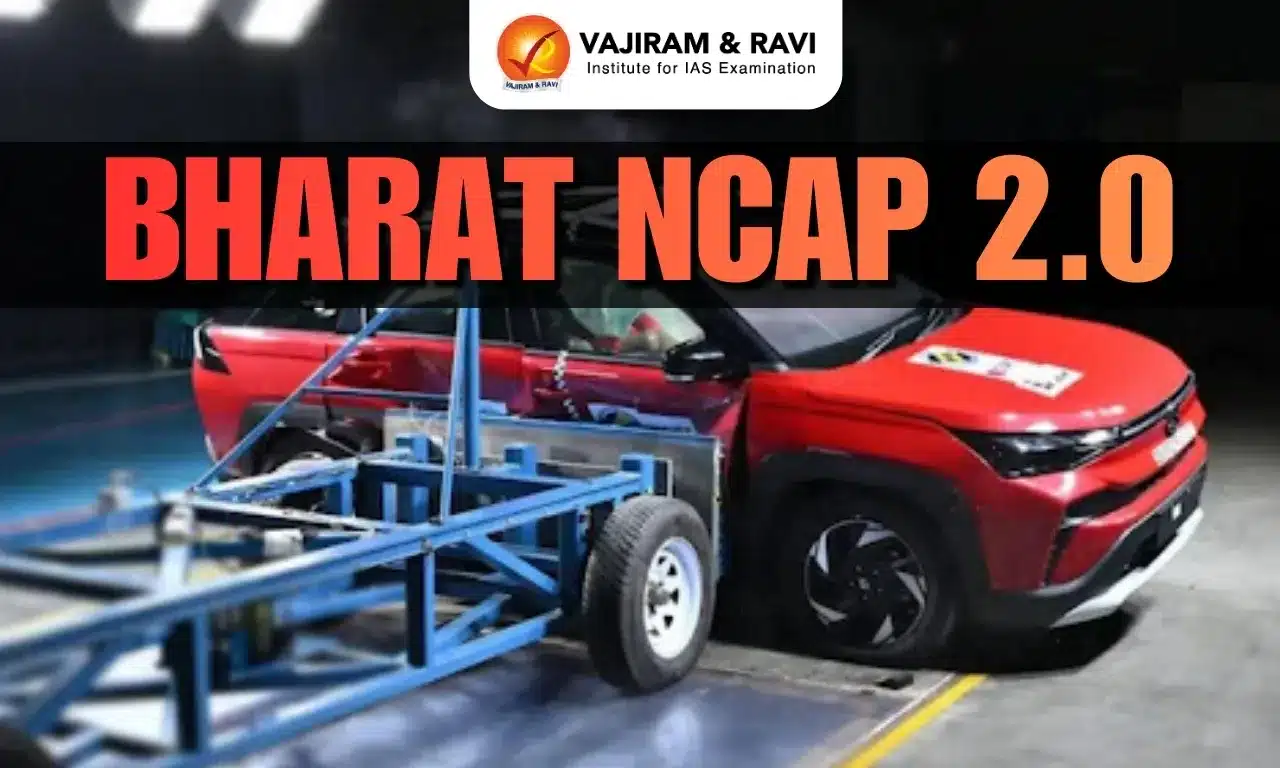
- Bharat NCAP 2.0 increases this to five mandatory crash tests:
- 64 km/h frontal impact against a deformable barrier
- 50 km/h lateral impact with a mobile deformable barrier
- 32 km/h oblique side impact against a rigid pole
- 50 km/h frontal impact against a full-width rigid barrier
- 50 km/h rear impact against a mobile rigid barrier
- These tests help assess injury risk in real-world crash scenarios.
Enhanced Injury Assessment
- Using Anthropomorphic Test Devices (ATDs) (crash-test dummies), the new draft evaluates injury risk for:
- Adult occupants
- Driver, front passenger and rear-seat occupants
- Child occupants
- This ensures a more precise measurement of protection across all seating positions.
Protection for Vulnerable Road Users
- For the first time, Bharat NCAP incorporates tests to assess:
- Pedestrian injury risk
- Cyclist safety measures
- This addresses India’s high share of pedestrian fatalities.
Vulnerable Road User Protection: Key Safety Measures in Bharat NCAP 2.0
- Bharat NCAP 2025 introduces a dedicated Vulnerable Road User Protection vertical with 20% weightage, assessing how well vehicles protect pedestrians, cyclists, and motorcyclists during crashes.
Mandatory Impact Tests
- Pedestrian legform impact on the vehicle bumper
- Adult headform impact on the bonnet/windshield
- Child headform impact on the bonnet/windshield
- These tests evaluate how vehicle design minimizes injury during collisions.
Optional AEBS Assessments
- Performance of Autonomous Emergency Braking Systems (AEBS) is assessed for:
- Child pedestrian detection
- Adult pedestrian detection
- Car-to-motorcyclist rear-end scenarios
Accident-Avoidance Technologies
- This new vertical focuses on driver-assist technologies that help prevent crashes before they occur.
- Key Requirements
- Electronic Stability Control (ESC): Mandatory for eligibility under Bharat NCAP 2.0
- ESC helps maintain vehicle stability, especially during skids or sudden manoeuvres.
- AEBS: Optional but encouraged to enhance star ratings
- Electronic Stability Control (ESC): Mandatory for eligibility under Bharat NCAP 2.0
Post-Crash Safety Measures
- A new vertical ensures vehicles help protect occupants after a crash.
- Mandatory Evaluations
- Energy Management for Fire & Electrical Hazards – Ensures protection from electric shocks, especially in EVs
- Occupant Extrication Assessment – Checks ease of door opening; Evaluates seatbelt buckle release after collision.
- Mandatory Evaluations
- These measures ensure emergency responders can rescue occupants quickly.
Revised Star Rating System Under Bharat NCAP 2.0
- Bharat NCAP 2.0 introduces a stricter star-rating structure to enhance vehicle safety standards.
- The thresholds for 4-star and 5-star ratings have been raised to 65 and 80 points, up from 60 and 70 in the 2023 framework.
- The thresholds for 1-star, 2-star, and 3-star ratings are fixed at 30, 40, and 50 points, respectively.
- A minimum Adult Occupant Protection (AOP) score of 55% within the Crash Protection vertical is mandatory to qualify for 3 stars or above. Falling short results in a 1-star penalty.
Additional safeguards include
- A 5-star vehicle cannot score zero in any assessment vertical; otherwise, its rating is capped at 4 stars.
- No injury values in the red zone for adult or child ATDs (Anthropomorphic Test Device — commonly known as a crash test dummy) are permitted in a 5-star rating before modifiers are applied.

 Last updated on August, 2026
→ UPSC Mains 2026 will be conducted on 21st, 22nd, 23rd, 29th and 30th August 2026.
→ Check out the latest UPSC Syllabus 2026 here.
→ UPSC Mains Admit Card 2026 is expected to be released soon at upsc.gov.in or upsconline.nic.in
→ Enroll in Vajiram & Ravi’s UPSC Mains Test Series 2027 for structured answer writing practice, expert evaluation, and exam-oriented feedback.
→ Join Vajiram & Ravi’s UPSC Mentorship Program 2027 for personalized guidance, strategy planning, and one-to-one support from experienced mentors.
→ Go through the UPSC Mains Previous Year Papers to enhance your preparation.
→ Download UPSC Mains Essay Paper 2025, UPSC Mains GS Paper-I 2025, UPSC Mains GS Paper-II 2025, UPSC Mains GS Paper-III 2025, UPSC Mains GS Paper-IV 2025, UPSC Mains English (Compulsory) Paper 2025, UPSC Mains Hindi (Qualifying) Paper 2025 here.
→ UPSC has released UPSC Toppers List 2025 with the Civil Services final result on its official website.
→ UPSC Calendar 2027 has been released.
→ Also check Best UPSC Coaching in India
Bharat NCAP 2.0 FAQs
Q1. What is Bharat NCAP 2.0?+
Q2. What are the new assessment areas introduced?+
Q3. How many crash tests are now mandatory?+
Q4. How does the programme protect pedestrians and cyclists?+
Q5. What changes affect the star rating system?+
Tags: Bharat NCAP 2.0 mains articles upsc current affairs upsc mains current affairs