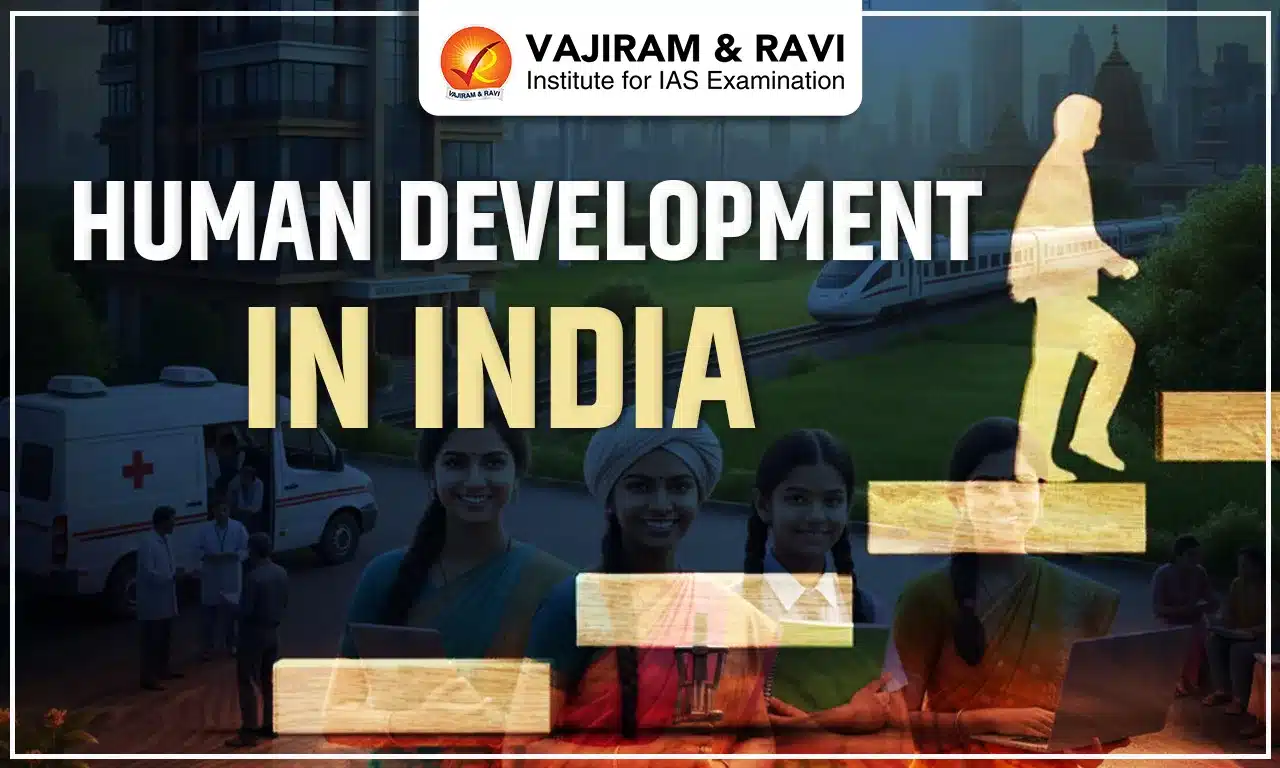
The Human Development Index is a composite measure assessing a country’s progress in health, education, and standard of living. It uses indicators such as life expectancy, years of schooling, and per capita income. HDI provides a broader understanding of well-being beyond GDP-centric growth. It helps compare countries and evaluate policy outcomes in human development.
The article highlights details related to Human Development in India, HDI and its components, Government Initiatives for Human Development in India, challenges and way forward for better India.
Human Development in India
Human development in India has steadily improved over the decades, supported by rising literacy, expanding healthcare access, and social welfare schemes.
According to UNDP’s Human Development Report 2024, India ranks 134 out of 193 countries, with an HDI value of 0.644, showing consistent progress from 0.556 in 2010.
Life expectancy has increased to 67.7 years, while school expectancy stands at 12.6 years, reflecting gains in education and health.
Human Development Index (HDI)
The Human Development Index (HDI), introduced by UNDP in 1990, provides a composite measure of human progress that captures the essence that economic growth is important, but without education, health, and dignity, true development cannot take place.
Importance of HDI for India
- Offers global benchmarking of India’s human development outcomes
- Highlights gaps in states’ performance and guides policy focus
- Helps measure long-term social investments (health, education)
- Enhances accountability through global comparisons
Components of Human Development Index (HDI)
Human Development Index (HDI) is calculated using three major dimensions that reflect basic human capabilities. These indicators provide a well-rounded understanding of how societies are progressing beyond economic wealth.
- Health
- Indicator: Life expectancy at birth
Reflects overall health conditions, nutrition levels, quality of medical care, disease control, and sanitation coverage. - India’s life expectancy is around 70.1 years (UNDP 2023), still below the global average (73.4 years).
- Education
- Indicators: Mean Years of Schooling (MYS) + Expected Years of Schooling (EYS)
- Mean years of schooling in India: 6.6 years (UNDP 2023)
Expected years of schooling: 11.9 years - Education quality remains a key area of concern despite high enrollment.
- Standard of Living
- Indicator: Gross National Income (GNI) per capita (PPP)
- India’s GNI per capita (PPP): $6,951 (UNDP 2023)
- Income inequality remains high; top 10% hold over 57% of national income.


India’s Performance in Global Human Development Index
India ranks 134 out of 193 countries in HDI 2023, placing it in the medium human development category. Over the decades, India’s HDI has steadily improved from 0.434 in 1990 to 0.644 in 2023, reflecting better access to education, healthcare, and economic opportunities. But issues like malnutrition, learning losses, gender inequality, and low public spending slow progress.
Facts on India’s HDI Performance
- HDI Value (2023): 0.644
- Category: Medium Human Development
- Gender Development Index (GDI): 0.820, indicating gender-based inequality
- Inequality-adjusted HDI (IHDI) drops by over 25% due to inequality in access
Reasons for Moderate HDI Rank
- Low public health expenditure (~2.1% of GDP)
- High malnutrition among children (35% stunting in NFHS-5)
- Skewed income distribution
- Rural-urban and north-south gaps
Human Development NITI Aayog’s Role and SDG Progress
NITI Aayog is central to India’s human development strategy through evidence-based policymaking and tracking progress on Sustainable Development Goals (SDGs). Its SDG India Index ranks states, encouraging competition and targeted interventions.
States like Kerala, Himachal Pradesh, and Tamil Nadu consistently perform well due to strong health and education systems.
NITI Aayog Contributions to Human Development
- SDG India Index: Tracks progress in No Poverty, Zero Hunger, Health, Education, Gender Equality, etc.
- Aspirational Districts Programme (ADP): Focuses on 112 underdeveloped districts, improving health, nutrition, education, and agriculture.
- POSHAN Abhiyaan & Nutrition Strategy: Reduces stunting, anemia, and malnutrition.
- Education Quality Improvement: Learning outcomes monitored through NIPUN Bharat and school infrastructure reforms.
SDG Achievements
- Over 41.5 crore people lifted out of multidimensional poverty since 2005-06.
- Clean cooking fuel access via Ujjwala: 10 crore+ beneficiaries.
- Improved sanitation coverage through Swachh Bharat: Open Defecation Free (ODF) status across rural India.
Human Development in India Government Initiatives
India’s development model relies heavily on welfare-driven and rights-based schemes to address multidimensional deprivation. These initiatives cover social security, health, nutrition, digital empowerment, and gender equality.
1. Health Initiatives
- Ayushman Bharat (PM-JAY): World’s largest health insurance program offering ₹5 lakh per family
- Health and Wellness Centres (HWCs): Strengthening primary healthcare
- National Health Mission (NHM): Maternal, newborn, and child health focus
- Mission Indradhanush: It aims for universal immunisation coverage.
2. Education Initiatives
- Samagra Shiksha Abhiyan: School infrastructure + quality improvement
- NEP 2020: Modernization, flexibility, multi-disciplinary approaches
- PM POSHAN (Mid-Day Meal): Nutrition for school children
- Right to Education Act (RTE), 2009: It guarantees free and compulsory education for children aged 6-14.
3. Nutrition & Social Protection
- POSHAN Abhiyaan: Targets stunting, wasting, anaemia
- ICDS: Maternal-child nutrition & early childhood care
- MGNREGA: Largest rural employment program ensuring wage security
- NFSA: Subsidised food grains for 81.35 crore people
4. Housing, Sanitation & Financial Inclusion
- PM Awas Yojana: Affordable housing for rural and urban poor
- Swachh Bharat Mission: Sanitation success with 11 crore toilets
- PM Jan Dhan Yojana: 51 crore+ bank accounts → financial inclusion
Challenges to Human Development in India
Human Development in India faces multiple structural challenges arising from socio-economic inequality, regional imbalances, and gaps in health, education, and employment.
1. Health and Nutrition Challenges
- High Child Malnutrition: NFHS-5 shows 35.5% children stunted, 19.3% wasted, and 57% women (15-49 years) are anemic.
- Low Health Spending: India’s public health expenditure is around 2.1% of GDP, lower than WHO’s recommended 5%.
- High Out-of-Pocket Expenditure (OOPE): OOPE accounts for ~48% of total health spending, pushing millions into poverty every year.
2. Educational Inequality
- Foundational Learning Gap: ASER 2023 shows only 43% of Class 5 students can read a Class 2-level text; numeracy outcomes equally poor.
- Dropout Rates: Secondary level dropout is ~14.6%, higher among girls due to early marriage and domestic responsibilities.
- Digital Divide: During COVID-19, ~29% students lacked access to smartphones or internet for online learning.
3. Gender Inequality
- Gender Gap in Workforce: Women contribute only 18% to India’s GDP compared to the global average of 37%.
- Violence & Safety Concerns: NFHS-5 reports 29% of women face domestic violence.
- Education Gap: Though gender parity has improved, female dropout rates after Class 8 are still high.
4. Social Exclusion & Inequality
- Caste-Based Disparities: SC/ST communities face gaps in education, health, and income due to historical discrimination.
- Disabled Population Challenges: 2.2% of India’s population is disabled; access to education and employment remains limited.
5. Regional and Social Disparities
- State-Level HDI Gaps: Kerala’s HDI (0.782) is comparable to Eastern Europe, while Bihar’s HDI (~0.576) resembles low-income countries.
- North-South Divide: Southern states (Kerala, TN, Karnataka) lead in health and education, while BIMARU states lag.
- SC/ST & Minority Deprivation: Poverty among STs is ~33%, almost triple the national average (NITI Aayog MPI 2023).
- Urban-Rural Divide: Rural poverty is 2.5 times higher than urban poverty; access to schools and hospitals also uneven.
Way Forward
Strengthening Human Development in India requires a multidimensional strategy that focuses on reducing inequalities, boosting public investment, and enhancing the quality of essential services. India must shift from welfare-driven approaches to capability-building models that empower individuals through education, health, skills, and social protection
1. Increase Public Investment in Health & Education
- Raise health expenditure to 3% of GDP and education expenditure to 6% of GDP as recommended by the NEP and WHO.
- Strengthen primary health infrastructure by expanding Health & Wellness Centres (HWCs).
2. Address Malnutrition & Improve Public Health Outcomes
- Expand POSHAN Abhiyaan with stronger monitoring through real-time nutrition dashboards.
- Integrate ICDS, PM Poshan, and health services for a life-cycle approach to child and maternal health.
- Increase access to safe drinking water and sanitation to reduce diarrheal diseases, which account for 10% of child deaths.
3. Reduce Income Inequality & Expand Decent Employment
- Promote labour-intensive industries like textiles, tourism, food processing, and MSMEs.
- Strengthen skilling under PMKVY, Skill India Mission, and link skills to market demand.
- Expand formalisation through EPFO/ESIC enrollment to reduce informal workforce dependency.
4. Strengthen Social Protection
- Expand coverage of PM-JAY, pensions, maternity benefits, and unemployment support.
- Improve DBT efficiency through Aadhaar-linked accounts while ensuring inclusion and grievance redressal.
5. Promote Climate-Resilient Development
- India loses 1.8% of GDP annually due to climate disasters (UNEP 2023).
- Implement climate-smart agriculture; 50% of farmers still depend on monsoons.
- Renewable energy: India has 180+ GW installed RE capacity; expanding to meet the 500 GW target by 2030.
- Improve air quality: 14 of the world’s top 20 polluted cities are in India; NCAP aims for 40% PM reduction by 2026.
6. Improve Governance, Transparency & Service Delivery
- India ranks 111/125 on the Global Hunger Index due to weak state capacity and leakages.
- Implement social audits in PDS, MGNREGA, PMAY, etc.
- Strengthen Panchayati Raj Institutions, only 1.5% of GDP is spent through local bodies, far below global norms (5-7%).

 Last updated on Oct, 2026
→ UPSC 2027 Notification will be released on 13 January 2027 at upsconline.nic.in.
→ Check Nobel Prize 2026 Winners List here.
→ Download PIB PRiSM Monthly Magazine 2026 here.
→ Check UPSC Monthly Current Affairs Magazine The Recitals here.
→ Check out the latest UPSC Syllabus here.
→ Download UPSC Model Answers for Mains 2026
→ UPSC Mains Question Paper 2026 is out now for Essay & GS Paper 1, 2, 3 & 4.
→ UPSC Calendar 2027 has been released.
→ Enroll in Vajiram & Ravi’s UPSC Mains Test Series 2027 for structured answer writing practice, expert evaluation, and exam-oriented feedback.
→ Join Vajiram & Ravi’s UPSC Mentorship Program 2027 for personalized guidance, strategy planning, and one-to-one support from experienced mentors.
→ Go through the UPSC Mains Previous Year Papers to enhance your preparation.
→ UPSC has released UPSC Toppers List 2025 with the Civil Services final result on its official website.
→ Also check Best UPSC Coaching in India
Human Development in India FAQs
Q1. What is human development according to UNDP?+
Q2. What is India’s rank in HDI?+
Q3. Which state has the highest human development indicators in India?+
Q4. What are the biggest challenges to human development in India?+
Q5. What role does NITI Aayog play in human development?+
Tags: human development in india