The Unification of Germany was a major political transformation of Europe during the late 19th century which led to the creation of a unified German Empire in 1871 under the Prussian leadership. Before unification, the regions included 39 states under the German Confederation (1815) for which the two dominant powers: Austria and Prussia competed for influence. The process involved wars, diplomatic and economic strategies, treaties, nationalism, etc. that was primarily led by Prussian Chancellor Bismarck, which resulted in the altered European power and shaping Modern Germany’s Territory, Polity, etc.
What is Unification of Germany?
The Unification of Germany refers to the series of political and military steps that consolidated more than 300 German Speaking States (kingdoms, duchies, principalities & free cities) into a unified German Empire under the Prussian Leadership of Emperor Wilhelm I at the Palace of Versailles (1871). The process resulted into the formation of a modern Industrial State, covering an area ~540,000 sq. km with ~41 million population. Historically the structure of the Empire evolved from the Holy Roman Empire (962-1806) to the Confederation of Rhine (1806-1813), the German Confederation (1815-1866) and the North German Confederation (1867-1871) leading to the German Empire (1871 onwards).
Unification of Germany Timeline
The Unification of Germany Timeline has been given below including the series of political and economic events that led to the creation of the German Empire:
- 1806: Fall of Holy Roman Empire after Napoleon’s Victory.
- 1806-1813: Formation of the Confederation of Rhine
- 1815: Establishment of German Confederation of 39 States under Austrian Presidency at the Congress of Vienna, after Napoleon’s defeat.
- 1834: Formation of the Zollverein (Customs Union) led by Prussia (25 states by 1842) which integrated economies except Austria.
- 1848: Frankfurt Parliament attempted to unify the German Empire, but failed after the rejection of its constitution by the Prussian King.
- 1862: Otto von Bismarck became the Prime Minister of Prussia and promoted unification by “blood and iron” strategy.
- 1864: Second Schleswig War (Prussia + Austria vs. Denmark), resulting in Danish defeat and annexing Schleswig and Holstein.
- 1866: Austro-Prussian War (Seven Weeks’ War), resulting- Prussian Victory at the Battle of Königgrätz and dissolution of German Confederation.
- 1867: North Germany Confederation established under Prussian leadership.
- 1870-71: Franco-Prussian War resulted in French defeat and joining of southern German states.
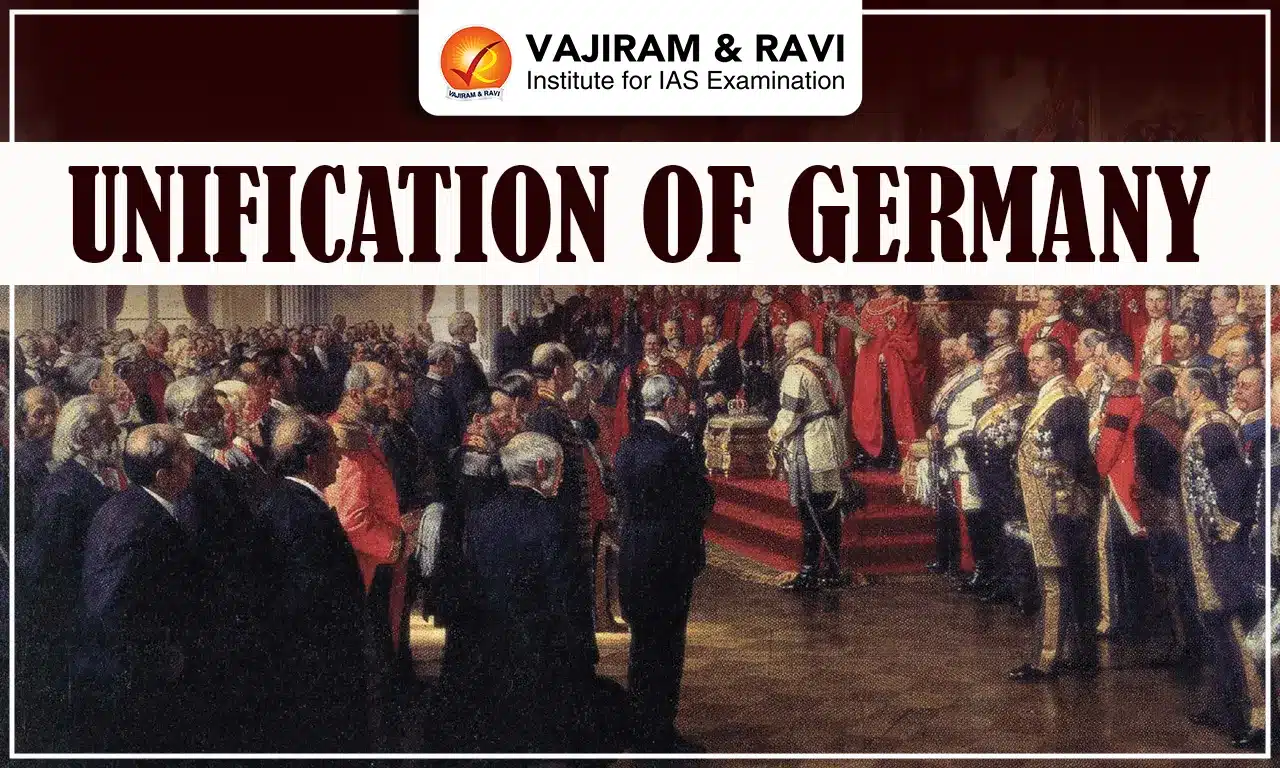
- Jan 18, 1871: Proclamation of German Empire in the Hall of Mirrors (Versailles) and crowning of Kaiser Wilhelm I.


Unification of Germany Reasons
The Unification of Germany was the result of various factors including nationalism, economic needs, rise of Prussia, several wars and strategies of Bismarck, etc. as listed below:
- Rise of Nationalism: The nationalism rose, inspired by the Napoleonic Occupation which dissolved the Holy Roman Empire, during 1848. It was promoted by thinkers like ‘Fichte’. The Hambach Festival (1832) united 30,000 people. The demand of the revolution was Constitutional Unity but failed after 1848 due to the failure of Frankfurt Parliament because of lack of military support and Austrian opposition.
- Economic Integration by Zollverein: The Zollverein was formed in 1834 by Prussia which included the large economies but excluded Austria. It was the unified customs system among 25 German States by 1842. It resulted in the increase of trade volume above 80% (1834-50) due to elimination of internal tariffs across German States which eventually boosted the industrial growth by 1860. The Zollverein produced ~60% of Coal and ~55% of Steel in Europe.
- Role of Otto Von Bismarck: Bismarck was appointed as the Prussian Minister-President (Prime Minister) in 1862. He adopted the strategy of “Blood and Iron” and followed the policy of “Realpolitik” by using diplomacy, manipulation and wars for the German Unification. He strengthened the Prussian Army under the reforms of Helmuth Von Moltke and Albrecht Von Roon. His diplomatic strategy included neutralising Russia by supporting Polish repression (1863) and Italy with secret promises (1866). He manipulated the southern German States to join the Northern Confederation by provoking nationalism through shared German Language and culture.
- Wars Leading to Unification: The strategic wars provided territorial gains, elimination of rival influences, annexation of the German states under Prussia, which led to the rise of Industrial and Military strength under the House of Hohenzollern. The major wars indirectly paving way for the unification are:
- Second Schleswig War (1864): In this war, Prussia and Austria together defeated the Danish Army and annexed the territories of Schleswig and Holstein under joint Prussian-Austrian rule.
- Austro-Prussian War (1866): Also known as Seven Week War as it lasted for the same duration. In this, the Prussian Army won at the Battle of Königgrätz in July 1866. This led to the annexation of Hannover, Nassau and Frankfurt. After the annexation, German Confederation was dissolved and led to the establishment of North German Confederation (1867).
- Franco-Prussian War (1870-71): The war was sparked by the manipulation of Ems Dispatch. In the Battle of Sedan (Sep 1870) of this war, France was defeated and the territory of Alsace-Lorraine was ceded to Prussia. Along with it, southern states like Bavaria, Württemberg, Baden, etc. joined the empire and eventually triggered the proclamation of the German Empire.
- Decline of Austrian Power: Austria struggled with several factors including economic, internal revolts, etc. It was excluded from the Zollverein since 1834. Internal ethnic revolts in Hungary, Italy, etc. demolished its strength. The major defeat in the Austro-Prussian War (1866) eliminated Austria dominance under Habsburg.
Unification of Germany Process
The Unification of Germany included multiple aspect processes including diplomatic strategies, military combats, treaties, alliances, etc. The complete process involved in the unification is given below:
- Modernization of Prussian Army: Prussia modernized its army (1860-62) through Krupp Steel supplied artillery that dominated battle and doubled the rail mobilization capacity to 11000 km by 1870.
- Diplomatic Strategies: The war with Denmark was eventually for the purpose of gaining territories. Further, Bismarck isolated Austria diplomatically through the alliances (neutralisation) of Russia and Italy. The strategic defeat of France prevented the formation of anti-Prussian coalitions.
- Formation of North German Confederation: After defeating Austria (1866), the German Confederation was replaced by North German Confederation (1867), which created federal structures including- Reichstag (universal male suffrage), Bundesrat and federal army. It included 22 states and adopted the constitution with the Prussian King as President.
- Inclusion of Southern German States: The Southern German States voluntarily joined after the victory in the Franco-Prussian War (1870). The States signed the November Treaties with Prussia while agreeing to unite. It signed Defence Treaties with the states of Bavaria, Baden, Württemberg (1866-67).
- Proclamation of German Empire (1871): On Jan 18th, 1871, the Prussian King- Wilhelm I was crowned as the German Emperor (Kaiser) and Bismarck was appointed as the chancellor at Versailles. The new constitution came into force by May 1871 with strong Prussian dominance as 2/3rd of the population and 3/5th of the territory of the new empire was controlled by Prussia. The federal structure retained certain rights to the southern states (eg: postal services, excise duty, etc.).
Result of Unification of Germany
The Unification of Germany impacted the geopolitics of Europe. The outcomes of the Unification of Germany can be studied into several aspects as mentioned below:
- The Unification led to the coverage of ~540,000 sq km area with initial population ~41 million (1871), rising to ~67 million by 1914.
- It led to the rapid industrial growth of the German Empire, with steel production rose from 0.2 million tons (1871) to over 14 million tonnes by 1913, surpassing Britain.
- It became Europe’s most powerful industrial nation by 1890 and the largest economy in Europe by 1910, producing 16 percent of global manufacturing output.
- Germany became a major continental power, replacing France as dominant land power in Europe; greatly shifted European balance-of-power politics.
- Increased militarisation ultimately contributed to tensions leading to World War I.

 Last updated on Oct, 2026
→ UPSC 2027 Notification will be released on 13 January 2027 at upsconline.nic.in.
→ Check Nobel Prize 2026 Winners List here.
→ Download PIB PRiSM Monthly Magazine 2026 here.
→ Check UPSC Monthly Current Affairs Magazine The Recitals here.
→ Check out the latest UPSC Syllabus here.
→ Download UPSC Model Answers for Mains 2026
→ UPSC Mains Question Paper 2026 is out now for Essay & GS Paper 1, 2, 3 & 4.
→ UPSC Calendar 2027 has been released.
→ Enroll in Vajiram & Ravi’s UPSC Mains Test Series 2027 for structured answer writing practice, expert evaluation, and exam-oriented feedback.
→ Join Vajiram & Ravi’s UPSC Mentorship Program 2027 for personalized guidance, strategy planning, and one-to-one support from experienced mentors.
→ Go through the UPSC Mains Previous Year Papers to enhance your preparation.
→ UPSC has released UPSC Toppers List 2025 with the Civil Services final result on its official website.
→ Also check Best UPSC Coaching in India
Unification of Germany FAQs
Q1. What is meant by the Unification of Germany?+
Q2. Who led the Unification of Germany?+
Q3. Which wars contributed to German unification?+
Q4. When was the German Empire proclaimed?+
Q5. What was the major result of German unification?+
Tags: unification of germany world history