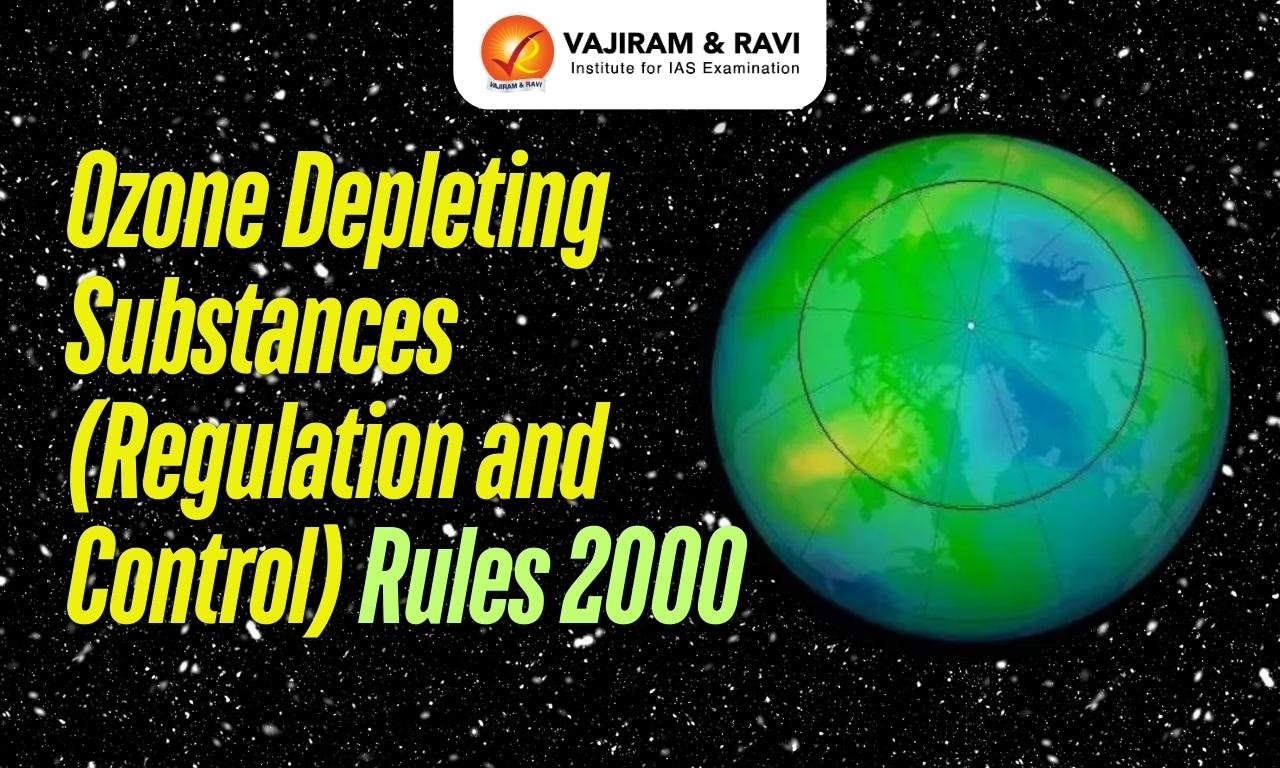
The Ozone Depleting Substances (Regulation and Control) Rules 2000 are major regulatory frameworks enacted by India to control the production, trade, and use of ozone-depleting substances in line with global environmental commitments. It was established under the Environment (Protection) Act 1986, these rules help India comply with the Vienna Convention and the Montreal Protocol. They focus on restricting Ozone Depleting Substances consumption, licensing trade, and promoting phase-out programmes. Over time, these rules have become central to India’s national environmental protection strategy.
Ozone Depleting Substances (Regulation and Control) Rules 2000
The Ozone Depleting Substances (Regulation and Control) Rules 2000 were notified on 19 July 2000 to regulate the production, consumption, import, export, sale, and use of ODS in India. These rules aim to gradually eliminate harmful substances such as CFCs, CTC, Halons, HCFCs, and Methyl Bromide. India introduced these rules to fulfil its obligations under the Montreal Protocol (1987), which legally binds member nations to phase out Ozone Depleting Substances.
Also Read: Wetland (Conservation and Management) Rules 2010 & 2017
Ozone Depleting Substances (Regulation and Control) Rules 2000 Historical Background
The rules emerged from decades of international scientific concern, negotiations, conventions, and global agreements to control ozone-damaging chemicals.
- 1976: UNEP Governing Council first discussed ozone depletion concerns.
- 1977: UNEP and WMO formed the Coordinating Committee on the Ozone Layer (CCOL).
- 1981: Intergovernmental negotiations began on an international framework to restrict ODS.
- March 1985: Vienna Convention for the Protection of the Ozone Layer adopted.
- September 1987: Montreal Protocol signed to create binding ODS phase-out targets.
- 1986: India prepared domestic regulatory framework under the Environment Protection Act.
- 1992: India ratified the Montreal Protocol.
- 19 July 2000: India notified the ODS Rules 2000.
- 2014: Rules amended to align with accelerated HCFC phase-out schedules.


Ozone Depleting Substances (Regulation and Control) Rules 2000 Provisions
The rules impose strict controls on production, trade, and use of ODS with licensing, restrictions, and progressive phase-out requirements.
- Prohibit production and consumption of ODS beyond limits notified by the central authority.
- Ban import and export of ODS to or from non-party countries under the Montreal Protocol.
- Require prior licence for import and export of ODS even with listed countries.
- Regulate sale, purchase, storage, and use of substances containing ODS.
- Restrict circulation or sale of listed ODS without special permission.
- Provide regulation for industries using ODS-based equipment.
- Apply controls on manufacturing processes using CFCs, CTC, Halons, HCFCs, and other listed chemicals.
Ozone Depleting Substances (Regulation and Control) Rules 2000 Features
The rules define applicability, regulatory mechanisms, licensing requirements, and compliance obligations for phase-out of Ozone Depleting Substances in India.
- Enforced under the Environment Protection Act 1986.
- Implemented to fulfil obligations under the Vienna Convention and Montreal Protocol.
- Apply to producers, sellers, traders, importers, and users of all notified ODS.
- Cover substances such as CFCs, HCFCs, Halons, CTC, Methyl Chloroform, and Methyl Bromide.
- Mandate licensing for import, export, sale, purchase, and storage.
- Require reporting and record-keeping to monitor usage and production.
- Enable central government to issue updated schedules and amendments.
- Restrict ODS-based equipment manufacturing and servicing.
Ozone Depleting Substances (Regulation and Control) Rules 2000 Challenges
Implementation of the Ozone Depleting Substances (Regulation and Control) Rules 2000 faces scientific, technological, financial, industrial, and enforcement-related challenges across multiple sectors as highlighted below:
- High cost of shifting to non-ODS and climate-friendly alternatives for industries.
- Need for advanced technology to replace ODS in refrigeration, fire protection, solvents, and aerosols.
- Strong dependence of small-scale manufacturers on older ODS-based equipment.
- Limited technical capacity for monitoring large and diverse industrial sectors.
- Need for continuous policy alignment with evolving international obligations including HCFC phase-out schedules and HFC control under new agreements.
Ozone Depleting Substances (Regulation and Control) Rules 2000 Achievements
India has consistently met its Ozone Depleting Substances phase-out targets and modernised regulations to match global environmental standards.
- By 1 January 2015, global phase-out of CFCs, CTC, Halons, Methyl Chloroform, and Methyl Bromide achieved.
- India successfully phased out CFCs, CTC, Halons, and progressing on HCFC elimination in Aug 2008.
- Multiple amendments supporting national phase-out management plans.
- Adoption of new technologies and training programmes across refrigeration and fire-suppression sectors.
- Reduction in ODS demand due to climatic regulations and market transition.
- Consistent compliance reporting to UNEP and Montreal Protocol bodies.
Kigali Agreement
The Kigali Agreement is the amendment ot the Montreal Protocol which adds HFCs to regulated substances, guiding long-term climate-friendly refrigerant transitions.
- Came into force 1 January 2019, legally binding for parties.
- Follows CBDR-RC, offering flexibility to developing economies including India.
- Aims to phase down high-GWP HFCs with financial support from the Multilateral Fund.
- India secured favourable baseline and freeze years enabling industrial growth.
- Promotes energy-efficient alternatives during refrigerant transition.
- Expected to reduce greenhouse gas emissions significantly while aiding technological advancement.

 Last updated on Sep, 2026
→ UPSC 2027 Notification will be released on 13 January 2027 at upsconline.nic.in.
→ Asian Games 2026 are being held in Aichi-Nagoya, Japan, from 19 September to 4 October.
→ Check out the latest UPSC Syllabus here.
→ Download UPSC Model Answers for Mains 2026
→ UPSC Mains Question Paper 2026 is out now for Essay & GS Paper 1, 2, 3 & 4.
→ UPSC Calendar 2027 has been released.
→ Enroll in Vajiram & Ravi’s UPSC Mains Test Series 2027 for structured answer writing practice, expert evaluation, and exam-oriented feedback.
→ Join Vajiram & Ravi’s UPSC Mentorship Program 2027 for personalized guidance, strategy planning, and one-to-one support from experienced mentors.
→ Go through the UPSC Mains Previous Year Papers to enhance your preparation.
→ UPSC has released UPSC Toppers List 2025 with the Civil Services final result on its official website.
→ Also check Best UPSC Coaching in India
Ozone Depleting Substances (Regulation and Control) Rules 2000 FAQs
Q1. What are the Ozone Depleting Substances (Regulation and Control) Rules 2000?+
Q2. Who enforces the Ozone Depleting Substances (Regulation and Control) Rules 2000?+
Q3. What substances are covered under Ozone Depleting Substances (Regulation and Control) Rules 2000?+
Q4. What major restrictions are included in the Ozone Depleting Substances (Regulation and Control) Rules 2000?+
Q5. Are exemptions allowed under Ozone Depleting Substances (Regulation and Control) Rules 2000?+
Tags: qzone depleting substances rules 2000