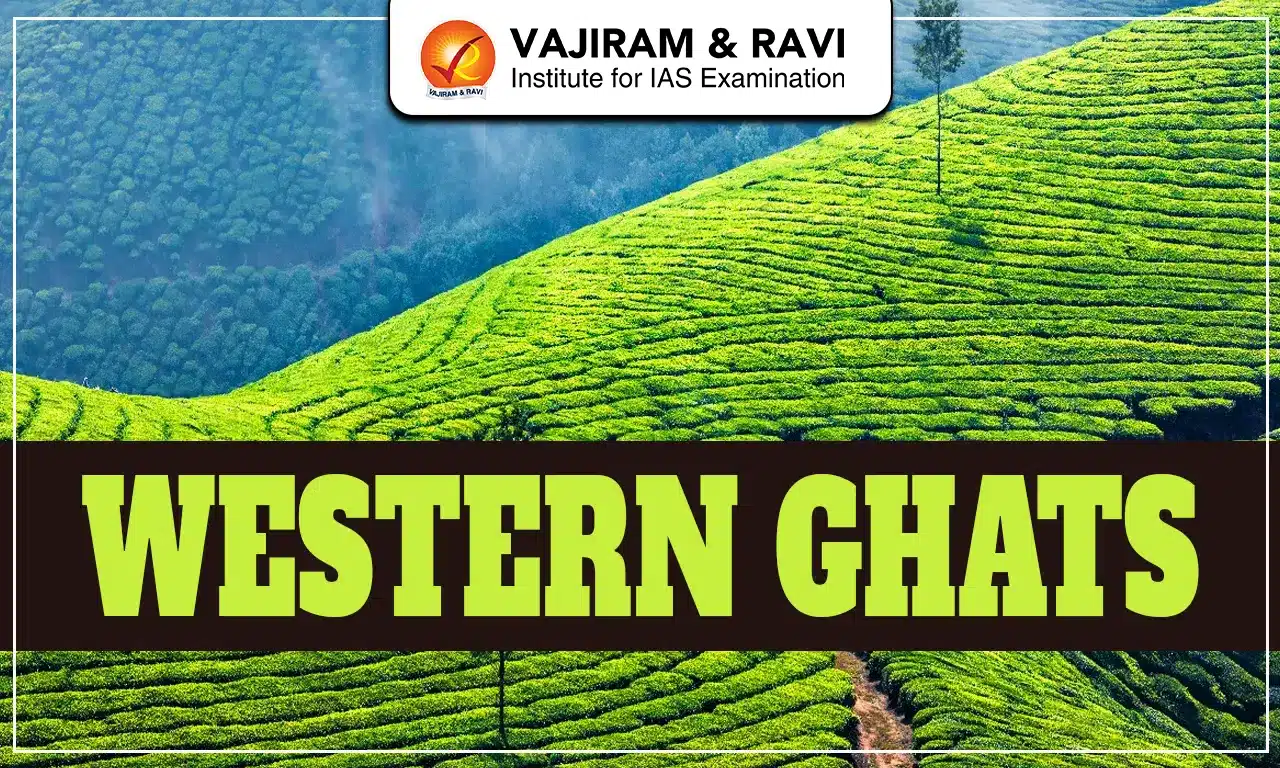
The Western Ghats are one of the most significant ecological zones in India with exceptional biodiversity, strong influence on climate and major role in hydrological functions. It is spanned across six states- Gujarat, Maharashtra, Goa, Karnataka, Tamil Nadu and Kerala, stretching from Satpura Range to Kanyakumari, covering about 160,000 sq km of area. It has a major role in the regulation of monsoon and is the home to 300+ threatened species. It supports millions of people through water, forests, minerals and agriculture.
Western Ghats
The Western Ghats border the Deccan Plateau of India in the western region. It is sometimes called the “Great Escarpment of India” as they form a continuous chain of escarpments, steep valleys, high plateaus, and deep gorges. It is known as Sahyadri in Maharashtra and Sahya Parvatham in Kerala. These mountains influence climate by intercepting southwest monsoon winds. It supports evergreen, semi-evergreen, moist deciduous, and dry deciduous forests on different slopes.
Western Ghats Geography
The Western Ghats formed through tectonic events shaping the faulted edges of the Deccan Plateau. It is formed by the subduction of the Arabian basin and tilting of the eastern and north-eastern region.
- The Ghats are block mountains formed due to downwarping of land towards the Arabian Sea.
- Scholars suggest they are not true mountains but represent the western faulted edge of the Deccan Plateau.
- Their uplifted edges create steep western cliffs and gentler eastern slopes.
- This ancient terrain influences drainage, monsoon interception, soil formation, and biodiversity across peninsular India.
- The Ghats contain varied rock systems: basalt, charnockite, granite gneiss, metamorphic gneiss, khondalite and leptynite.
- Several important passes cut across the Western Ghats, enabling connectivity between coastal and inland regions like: Thal Ghat, Amba Ghat, Bhor Ghat, etc.


Western Ghats Divisions
The Western Ghats are divided into northern, central, and southern sections with distinct geology, climate, and biodiversity. These divisions reflect sharp variations in elevation, rainfall, forest type, and species distribution.
- Northern Western Ghats: Includes the Sahyadri in Maharashtra, Konkan Coast to the west, and Desh region to the east; marked by basaltic plateaus (lava covered). Important Peaks are: Kalsubai (highest), Salher, Mahabaleshwar, etc.
- Middle/ Central Western Ghats: It is called Kanara and includes Karnataka’s Ghats, with high rainfall, dense evergreen forests, and key rivers like Sharavathi and Netravati; the region around Malanadu is prominent. Major peaks are Vavul Mala, Kudremukh, etc.
- Southern Western Ghats: Includes Kerala and Tamil Nadu regions, Nilgiri malai, and high peaks like Anamudi, Annamalai, Cardamom; includes the Malabar Coast.
Western Ghats Mountain Ranges
The Western Ghats contain interconnected massifs, linking key southern hill systems and hosting the tallest peaks and major hill stations. These ancient highlands support deep valleys, steep escarpments, and plateaus shaping peninsular India’s physical diversity.
- Nilgiri: It is located southeast of Mysore and links the Western Ghats to the Eastern Ghats through the Shevaroys and Tirumala range.
- Anamudi: It is located in Kerala is the highest peak of the Western Ghats and the tallest mountain in India outside the Himalayas.
- Hills: Major hill Stations include Matheran, Mahabaleshwar, Panchgani, Lonavala-Khandala, Amboli Ghat, Kodagu, and Kudremukh.
Western Ghats Rivers
The Western Ghats give rise to major west-flowing and east-flowing rivers that shape peninsular India’s water systems. Most peninsular states depend on Western Ghats rivers for agriculture, drinking water, and hydropower.
- West Flowing Rivers:
- West-flowing rivers include Periyar, Netravati, Sharavathi, Mandovi, and Bharathappuzha; they are fast-moving due to steep descent.
- Their sharp gradients and short travel distances make them major hydropower sources, especially in Karnataka and Kerala.
- East Flowing Rivers
- East-flowing rivers include Godavari, Krishna, and Kaveri, along with tributaries like Tunga, Bhadra, Bhima, Malaprabha, Hemavathi, and Kabini.
- These slower, longer rivers drain into the Bay of Bengal and support major irrigation systems.
Western Ghats Environment
The Western Ghats regulate monsoons and support diverse forest types across western and eastern slopes.
- Western slopes host evergreen and moist broadleaf forests with rosewood, mahogany, and cedar; they remain green year-round.
- Eastern slopes have dry and moist deciduous forests dominated by teak, sal, sandalwood, and shisham.
- The Ghats intercept moisture containing monsoon winds which influence the rainfall patterns over peninsular India.
- High montane forests strongly impact monsoon circulation.
- The region hosts at least 325 globally threatened species of flora and fauna.
Western Ghats Biodiversity
The Western Ghats form a global biodiversity hotspot with high endemism, protected areas, and rare species.
- It is recognised as a UNESCO World Heritage Site and one of the eight global biodiversity hotspots.
- It is home to 325 globally threatened species (IUCN): 229 plants, 31 mammals, 15 birds, 43 amphibians, 5 reptiles, and 1 fish.
- Endemic animals include Nilgiri tahr, lion-tailed macaque, and Nilgiri marten.
- Protected areas include 2 biosphere reserves, 13 national parks, and numerous wildlife sanctuaries.
- The Nilgiri Biosphere Reserve is the largest contiguous protected forest zone.
- Silent Valley National Park protects the last tropical evergreen forest tracts in India
Western Ghats Significance
The Western Ghats are vital for hydrology, climate regulation, biodiversity, economy, and indigenous livelihoods.
- Feed major rivers like Godavari, Krishna, and Kaveri; crucial for water supply in peninsular states.
- Intercept monsoon winds and influence India’s tropical climate.
- Sequester nearly 4 million tonnes of carbon annually, about 10 percent of India’s forest-based carbon capture.
- Host exceptional plant and animal diversity with high endemism.
- Rich in iron, manganese, and bauxite; important for forest-based industries like paper, plywood, poly-fibres, and matchwood.
- Indigenous communities depend on forests for non-timber forest produce.
Western Ghat Challenges
The Western Ghats face increasing threats from mining, deforestation, settlements, plantations, and climate change.
- Mining violations in Goa and sand mining in Kerala degrade land and water sources.
- Over-extraction of forest produce affects sustainability and biodiversity.
- Grazing by dense livestock populations causes habitat loss.
- Human-wildlife conflict is widespread in human-dominated landscapes.
- Hunting using guns, snares, and traps threatens endemic species.
- Monoculture plantations like tea, coffee, rubber, oil palm cause forest loss.
- Encroachment by settlements fragments protected areas.
- Hydropower projects disrupt ecosystems.
- Deforestation and illegal logging worsen ecological decline.
- Climate change increases rainfall variability and floods.
Western Ghats Conservation
India has taken several measures to conserve the Western Ghats through expert committees and protected area expansion.
- Gadgil Committee (2011): Proposed declaring the entire Ghats as Ecologically Sensitive Areas with graded restrictions.
- Kasturirangan Committee (2013): Recommended 37 percent of the Ghats be designated ESA with bans on mining and quarrying.
- Protected areas expanded through biosphere reserves, national parks, and wildlife sanctuaries.
- Conservation efforts focus on controlling mining, regulating plantations, restricting hydropower development, and managing human settlements.
- Forest restoration and protection of endemic species remain central strategies.

 Last updated on Oct, 2026
→ UPSC 2027 Notification will be released on 13 January 2027 at upsconline.nic.in.
→ Asian Games 2026 are being held in Aichi-Nagoya, Japan, from 19 September to 4 October.
→ Check Nobel Prize 2026 Winners List here.
→ Download PIB PRiSM Monthly Magazine 2026 here.
→ Check UPSC Monthly Current Affairs Magazine The Recitals here.
→ Check out the latest UPSC Syllabus here.
→ Download UPSC Model Answers for Mains 2026
→ UPSC Mains Question Paper 2026 is out now for Essay & GS Paper 1, 2, 3 & 4.
→ UPSC Calendar 2027 has been released.
→ Enroll in Vajiram & Ravi’s UPSC Mains Test Series 2027 for structured answer writing practice, expert evaluation, and exam-oriented feedback.
→ Join Vajiram & Ravi’s UPSC Mentorship Program 2027 for personalized guidance, strategy planning, and one-to-one support from experienced mentors.
→ Go through the UPSC Mains Previous Year Papers to enhance your preparation.
→ UPSC has released UPSC Toppers List 2025 with the Civil Services final result on its official website.
→ Also check Best UPSC Coaching in India
Western Ghats FAQs
Q1. What are the Western Ghats?+
Q2. Why are the Western Ghats important for biodiversity?+
Q3. Which major rivers originate in the Western Ghats?+
Q4. What are the major threats to the Western Ghats?+
Q5. What conservation measures exist for the Western Ghats?+
Tags: western ghats