Demerit Goods Latest News
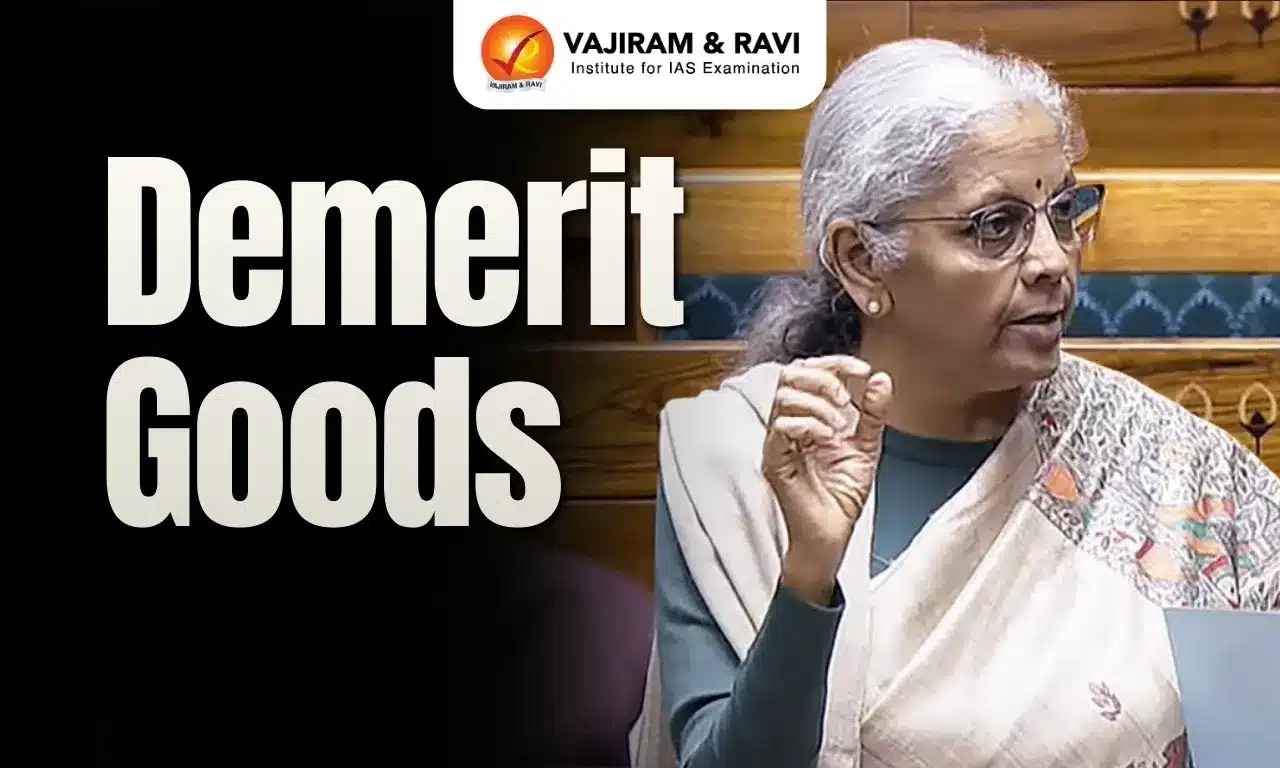
- The Union Finance Minister recently introduced the Health Security Se National Security Cess Bill, 2025 in Parliament, clarifying that the proposed cess will apply only to demerit goods such as pan masala and will not affect essential commodities.
Health and National Security Cess
- The proposed cess marks a new fiscal instrument designed to raise dedicated funds for two domains the government considers critical, health and national security.
- It will be levied exclusively on demerit goods, especially those associated with high public health risks, such as pan masala.
- According to the Finance Minister, these goods impose substantial health burdens on society, and the cess serves a dual purpose: discouraging consumption and generating revenue for public welfare.
- The government has emphasised that no essential household goods will attract this cess, ensuring no inflationary impact on everyday consumption.


Key Features of the Proposed Cess
- Cess Applicable Only on Demerit Goods
- The cess will apply on specified goods linked to significant health risks, such as pan masala, which has long been under scrutiny due to its public health impacts.
- The government clarified that the cess is not consumption-based; rather, it will be imposed on a capacity-based, machine-linked system in manufacturing units.
- Each factory’s liability will depend on its installed machinery and production processes.
- This structure aims to reduce tax evasion and bring transparency to sectors historically difficult to regulate.
- Revenue Sharing with States
- A notable aspect is that a portion of revenue collected will be shared with states, specifically for health awareness initiatives and health-related schemes.
- This is an important deviation from traditional cesses, which are generally not shareable with states, a point that has drawn federalism-related criticism in the past.
- By explicitly providing for shared revenue, the Centre aims to strengthen cooperative fiscal federalism.
- No Adverse Impact on GST System
- The Minister clarified that the cess will not interfere with GST revenue sharing or GST Council mechanisms. For example:
- Pan masala currently attracts 28% GST + compensation cess.
- The proposed cess is independent of GST and relates instead to production capacity.
- It ensures no disruption of the GST compensation framework.
Objectives Behind the Cess
- Dedicated Resource for National Priorities
- The Bill’s stated purpose is to augment resources for national security and public health expenditure, two high-priority domains with rising fiscal demands.
- The government argued that linking revenue collection directly to demerit goods enhances both accountability and predictability in funding.
- Deterrence Through Targeted Taxation
- By taxing goods associated with lifestyle health risks, the cess intends to act as a disincentive, similar to the rationale behind “sin taxes” in public finance.
- The Minister noted that the cess is intended to impose a social cost on harmful products to reduce their usage over time.
Concerns and Criticisms Raised in Parliament
- Burden on MSMEs
- Opposition members argued that capacity-based taxation could hurt small manufacturing units, especially MSMEs, which may struggle with compliance and cost burdens.
- They claimed the system may disproportionately affect smaller players who lack the capital to upgrade machinery or navigate bureaucratic procedures.
- Fear of ‘Inspector Raj’
- Concerns were raised that capacity-based cesses could lead to increased inspection and regulatory oversight, potentially reviving the spectre of “inspector raj.”
- Members feared this could open the door to harassment, rent-seeking, and operational disruptions in smaller factories.
- Debate over Alternative Approaches
- Some MPs argued that if the intent is to curb harmful consumption, outright bans, as seen in Bihar for pan masala, would be a more effective strategy.
- Others criticised the government for relying increasingly on cesses, calling it “cessification of governance.”
Government’s Defence and Rationale
- The Treasury benches strongly defended the Bill, highlighting:
- Transparency in revenue utilisation, claiming that this is the first legislation explicitly committing to tracing the use of every rupee collected from demerit goods.
- National interest, asserting that funding for health and security should receive unanimous support.
- Reduction in tax evasion, especially in the pan masala sector, due to machine-linked assessment.

 Last updated on Sep, 2026
→ UPSC 2027 Notification will be released on 13 January 2027 at upsconline.nic.in.
→ Asian Games 2026 are being held in Aichi-Nagoya, Japan, from 19 September to 4 October.
→ Check out the latest UPSC Syllabus here.
→ Download UPSC Model Answers for Mains 2026
→ UPSC Mains Question Paper 2026 is out now for Essay & GS Paper 1, 2, 3 & 4.
→ UPSC Calendar 2027 has been released.
→ Enroll in Vajiram & Ravi’s UPSC Mains Test Series 2027 for structured answer writing practice, expert evaluation, and exam-oriented feedback.
→ Join Vajiram & Ravi’s UPSC Mentorship Program 2027 for personalized guidance, strategy planning, and one-to-one support from experienced mentors.
→ Go through the UPSC Mains Previous Year Papers to enhance your preparation.
→ UPSC has released UPSC Toppers List 2025 with the Civil Services final result on its official website.
→ Also check Best UPSC Coaching in India
Demerit Goods FAQs
Q1. On which goods will the Health and National Security Cess be levied?+
Q2. Will the cess affect GST revenues?+
Q3. How will the revenue from the cess be used?+
Q4. Why is the cess capacity-based?+
Q5. What are the main criticisms of the proposed cess?+
Tags: demerit goods mains articles upsc current affairs upsc mains current affairs