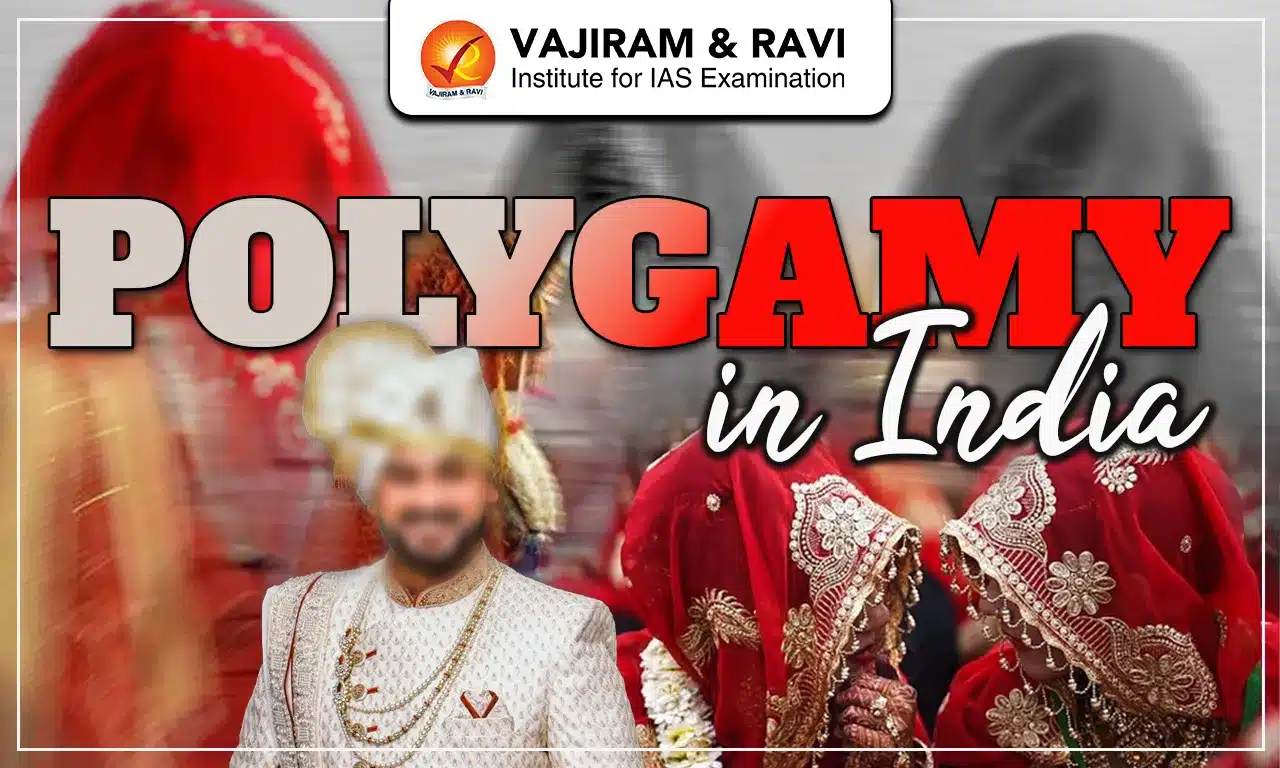
Polygamy in India is a sensitive social and legal topic because it involves marriage, personal laws, and gender rights. Although the practice has reduced a lot over the years, it still exists in some communities, especially among tribal groups and a few districts in the Northeast.
Polygamy means having more than one spouse at the same time. While some consider it a cultural or religious practice, many argue that it leads to emotional, financial, and legal problems in families.
Polygamy in India
Polygamy comes from “poly” (many) and “gamos” (marriage). It means a marriage where a person has more than one husband or wife at the same time. This is different from monogamy, where a person marries only one partner. Polygamy appears in different forms, depending on culture and customs.
Types of Polygamy
Polygamy refers to a marriage practice where one person has more than one spouse at the same time. In India, it appears in different social, cultural, and community contexts, mainly in two major forms.
1. Polygyny
- A system where one man marries multiple women.
- This is the most common form of polygamy seen historically in many societies.
- It has been observed among some tribal groups and in select communities for social or economic reasons.
2. Polyandry
- A system where one woman marries multiple men
- This form is rare and practiced only in a few regions, mainly due to economic pressure or scarcity of resources.
- Examples include the fraternal polyandry practiced historically in parts of Himachal Pradesh, Ladakh, and some Himalayan tribal groups.
3. Bigamy
- Bigamy means marrying another person while the first marriage is still legally valid, without obtaining a divorce.
- It is a punishable offence under Section 494 of the Indian Penal Code (IPC) for most communities in India (except where personal laws permit polygamy).
- Conviction for bigamy can lead to up to 7 years of imprisonment and a fine, making it a serious criminal violation of marital law.


Legal Provisions Related to Polygamy in India
Polygamy in India is regulated mainly through personal laws and criminal laws. For most communities, second marriage during the lifetime of the first spouse is illegal and punishable. However, the legality varies across different religious groups, making it a complex area of family law in India.
Hindu Marriage Act (HMA), 1955
- Section 5 clearly states that marriage is valid only if neither partner has a living spouse.
- Polygamy is strictly prohibited for Hindus, Buddhists, Jains, and Sikhs.
- Any second marriage while the first is still valid is void under Section 11.
Indian Penal Code (IPC), Section 494 – Bigamy
- Makes bigamy a criminal offence for all communities except those whose personal laws allow it.
- Punishment: Up to 7 years imprisonment and fine.
- Applies even if the second marriage is performed with consent of the first spouse.
Muslim Personal Law
- A Muslim man is legally permitted to have up to four wives at the same time, provided he treats them equally.
- However, courts have increasingly scrutinized misuse; in several judgments, unequal treatment is considered grounds for legal challenge.
- Muslim women cannot have multiple husbands.
Christian Marriage Act, 1872 & Divorce Act, 1869
- Christians in India are legally bound by monogamy.
- Any second marriage without divorce is invalid and may attract IPC 494.
Parsi Marriage and Divorce Act, 1936
- Strictly enforces monogamy.
- A second marriage without divorce is illegal and punishable.
Special Marriage Act (SMA), 1954
- People marrying under Special Marriage Act must practice monogamy, regardless of religion.
- A second marriage is void and attracts IPC 494.
Status of Polygamy in India
Even though people believe polygamy is common, data shows it is very low in India. Surveys like NFHS provide updated information.
| Religion-wise Polygamy (NFHS-5, 2019–21) | |
| Religion | Polygamy (%) |
|
Christians |
2.1 |
|
Muslims |
1.9 |
|
Hindus |
1.3 |
|
Others |
1.6 |
|
India Average |
1.4 |
| Districts with Highest Polygamy (Northeast India) | |
| Group | Polygamy (%) |
|
Scheduled Tribes (ST) |
2.4 |
|
Scheduled Castes (SC) |
1.5 |
|
OBC |
1.3 |
|
Others |
1.2 |
Important Judgements Related to Polygamy in India
Indian courts have played an important role in defining how polygamy is interpreted under different personal laws.
Sarla Mudgal vs. Union of India (1995)
- The Supreme Court held that a Hindu man cannot convert to Islam only to marry again without divorcing his first wife.
- Such second marriage is invalid and punishable under Section 494 IPC.
- The Court said this practice harms women’s rights and urged the government to consider a Uniform Civil Code (UCC).
Shayara Bano vs. Union of India (2017) – Triple Talaq Case
- Supreme Court declared instant triple talaq (talaq-e-biddat) unconstitutional.
- While not directly about polygamy, the judgement highlighted the need for gender justice and equality in Muslim personal law.
- It strengthened the debate that practices enabling arbitrary male dominance in marriage should be re-examined.
Khursheed Ahmad Khan vs. State of Uttar Pradesh (2015)
- SC ruled that polygamy is not an essential religious practice in Islam.
- The Court said the state can restrict or prohibit polygamy in the interest of social welfare.
Javed vs. State of Haryana (2003)
- Supreme Court upheld a law disqualifying people with more than two children from contesting panchayat elections.
- Petitioners argued that Muslim men are allowed four wives and may have more children.
- The Court held that polygamy is not a “fundamental right” and states can impose restrictions for public welfare.
Impact of Polygamy on Indian Society
- Reinforces Gender Inequality: NFHS-5 shows polygamy is more common in socially vulnerable groups (STs: 2.4%, national average: 1.4%), where women already face weaker social and economic rights, increasing male dominance in households.
- Reduced Educational and Health Outcomes for Children: NFHS-5 indicates that children in polygynous families have lower school attendance and higher malnutrition risk.
- Economic Strain on the Household: Supporting multiple partners increases financial pressure. Research shows polygynous households spend less per child on healthcare, nutrition, and education, deepening intergenerational poverty.
- Strengthens Harmful Social Practices: Polygamy in certain tribal and North-Eastern regions is linked with child marriage, bride purchase, and trafficking, especially in districts like East Jaintia Hills where rates reach 20%.
- Weakens Women’s Autonomy and Rights: Women often lack agency to refuse polygamy due to social pressure. Multiple studies show lower workforce participation and decision-making power for women in polygynous families.
Way Forward
- Awareness in High-Prevalence Areas: Launch targeted awareness programmes in communities where polygamy is higher (e.g., STs 2.4%, NFHS-5) to highlight its economic and social harm.
- Clear Legal Framework: Introduce a uniform, religion-neutral law to regulate or restrict polygamy, similar to the triple talaq law to remove ambiguity between IPC and personal laws.
- Protect Children’s Rights: Implement Law Commission recommendations to safeguard inheritance, maintenance, and guardianship rights of children from polygamous marriages.
- Women’s Empowerment Measures: Expand access to legal aid, education, property rights, and livelihood programmes so women are not forced into polygamous arrangements due to economic dependence.
- Move Toward a Uniform Civil Code (UCC): Push for a balanced and consultative UCC to ensure equal marriage and inheritance rights for all communities in line with constitutional values.

 Last updated on Oct, 2026
→ UPSC 2027 Notification will be released on 13 January 2027 at upsconline.nic.in.
→ Asian Games 2026 are being held in Aichi-Nagoya, Japan, from 19 September to 4 October.
→ Check Nobel Prize 2026 Winners List here.
→ Download PIB PRiSM Monthly Magazine 2026 here.
→ Check UPSC Monthly Current Affairs Magazine The Recitals here.
→ Check out the latest UPSC Syllabus here.
→ Download UPSC Model Answers for Mains 2026
→ UPSC Mains Question Paper 2026 is out now for Essay & GS Paper 1, 2, 3 & 4.
→ UPSC Calendar 2027 has been released.
→ Enroll in Vajiram & Ravi’s UPSC Mains Test Series 2027 for structured answer writing practice, expert evaluation, and exam-oriented feedback.
→ Join Vajiram & Ravi’s UPSC Mentorship Program 2027 for personalized guidance, strategy planning, and one-to-one support from experienced mentors.
→ Go through the UPSC Mains Previous Year Papers to enhance your preparation.
→ UPSC has released UPSC Toppers List 2025 with the Civil Services final result on its official website.
→ Also check Best UPSC Coaching in India
Polygamy in India FAQs
Q1. What is polygamy?+
Q2. Is polygamy legal in India?+
Q3. What are the punishments for illegal polygamy?+
Q4. Can someone convert to another religion to marry again?+
Q5. What are the social impacts of polygamy?+
Tags: polygamy in india