Why in News?
The Kudankulam Nuclear Power Plant (KKNPP) is in the news after a ransomware group called World Leaks allegedly uploaded around 19,000 files (about 14.3 GB) linked to the project on the Dark Web. The leaked documents reportedly include engineering blueprints, supplier details, inspection records, and insurance documents associated with a contractor involved in the construction of the plant’s Units 3 and 4.
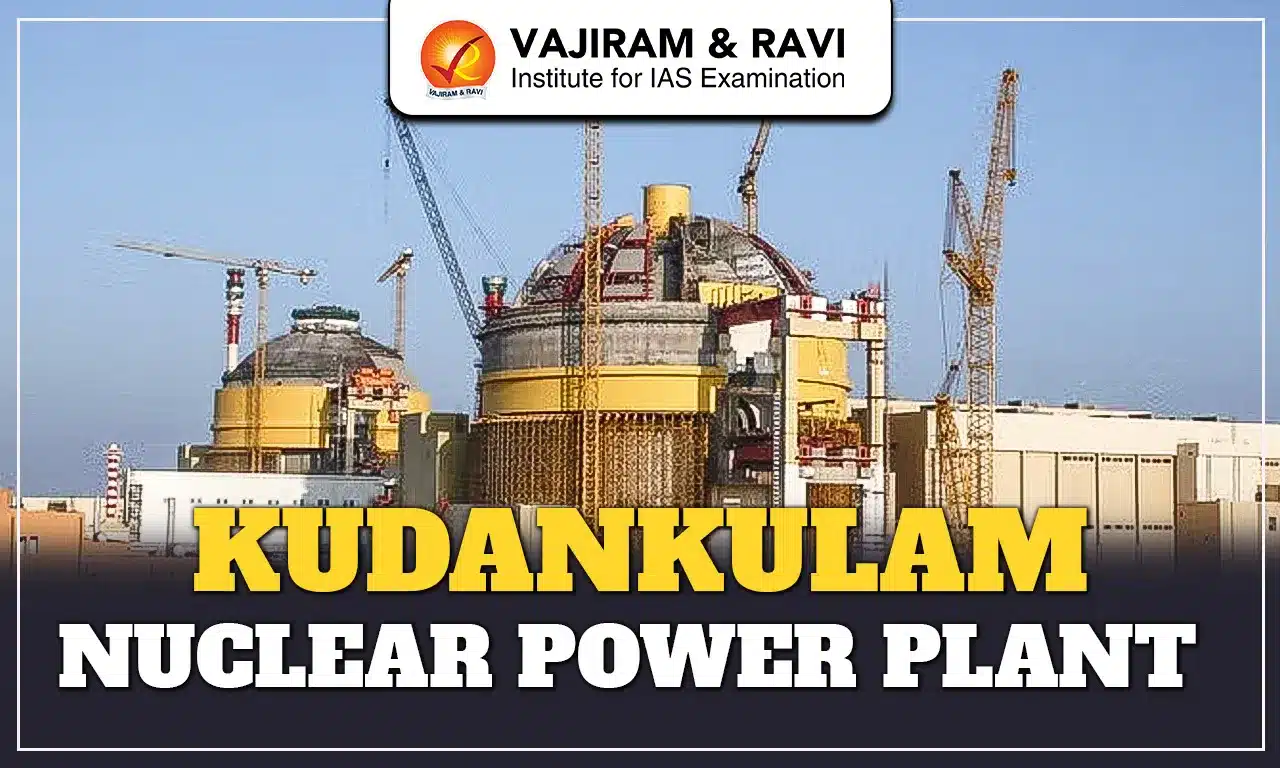
Kudankulam Nuclear Power Plant
The Kudankulam Nuclear Power Plant (KKNPP), also known as Kudankulam NPP, is the largest nuclear installation in India. The construction began on 31 March 2002 and the plant uses Russian VVER-1000 reactors developed in partnership with Atomstroyexport and the Nuclear Power Corporation of India Limited (NPCIL). With a planned six units of 1,000 MW each, the plant will reach 6,000 MW capacity. NPCIL announced a tariff of ₹4.29/ kWh in 2015 for electricity supplied from the plant. Unit 1 was synchronized to the grid on 22 October 2013, and successive units have followed, making the facility a key asset in India’s power sector.
Also Read: Nuclear Power Plants in India


Kudankulam Nuclear Power Plant Historical Background
The Kudankulam Nuclear Power Plant project emerged from a 1988 Indo-Soviet agreement revived after geopolitical changes.
- The intergovernmental agreement was signed in 1988 by Prime Minister Rajiv Gandhi and Soviet leader Mikhail Gorbachev for two reactors.
- The project remained dormant for a decade due to the dissolution of the USSR and objections from the United States under Nuclear Suppliers Group norms.
- Revival occurred on 21 June 1998, restarting planning efforts and opening doors for renewed Indo-Russian nuclear cooperation.
- Work began on 31 March 2002 with an initial target for Unit 1 by 2007, later postponed due to consistent interruptions.
- A dedicated small port opened in 2004 to safely transport large reactor components otherwise at risk on road routes.
- Negotiations in 2008 explored four additional reactors of 1,200 MW each, but these units never entered planning due to protests and technical reasons.
- Construction of Units 3 and 4 began in 2017 after AERB approvals, followed by Units 5 and 6 in 2021.
- Unit 5 is expected to be commissioned in December 2026 and Unit 6 by September 2027.
Kudankulam Nuclear Power Plant Units
The Kudankulam Nuclear Power Plant consists of six VVER-1000 units, out of which two are operational and four are under construction.
- Unit 1: 1,000 MW; grid-connected in October 2013; commercial operation from December 2014.
- Unit 2: 1,000 MW; grid-connected in August 2016; commercial operation from October 2016.
- Unit 3: Construction started in 2017; expected commissioning in 2026.
- Unit 4: Construction parallel to Unit 3; scheduled for commissioning soon after Unit 3.
- Unit 5: Concrete pour in 2020; commissioning planned for December 2026.
- Unit 6: Construction began in 2021; scheduled for commissioning in September 2027.
Kudankulam Nuclear Power Plant Features
Kudankulam Nuclear Power Plant uses advanced Russian pressurized water reactor technology suited for large-scale base-load power.
- Reactors are VVER-1000/V-412 (AES-92 design), water-cooled and water-moderated, with a thermal capacity of 3,000 MW.
- Each reactor produces 1,000 MW gross and 917 MW net output.
- The project is built jointly by NPCIL and Atomstroyexport, forming India’s largest nuclear complex at 2 GW operational capacity so far.
- Safety features include double containment, high-pressure resistance, and post-Fukushima safety upgrades.
- Units 3-6 follow updated reactor designs based on new Russian nuclear safety and efficiency standards.
Also Read: Nuclear Energy
Kudankulam Nuclear Power Plant Criticism
Various oppositions and criticisms emerged against Kudankulam Nuclear Power Plant due to safety concerns, environmental risks, and post-Fukushima fears.
- Protests began as early as 1979 and halted planning for decades until the project returned in 2000.
- The 2011 Fukushima disaster triggered large local protests involving thousands from nearby villages.
- Activists expressed concerns over evacuation challenges and potential radiation risks.
- A 2011 PIL sought suspension of construction until independent safety verification.
- The Supreme Court upheld the project in 2013 as being in national interest, However, opposition continued in several villages.
- Allegations of foreign funding for protests were reported, while church groups supported local concerns.
Kudankulam Nuclear Power Plant Recent Developments
During Putin’s Visit to India (December 2025), Russia has reaffirmed its commitment to help India operate the Kudankulam Nuclear Power Plant at full 6,000 MW capacity, with two VVER-1000 reactors already supplying power since 2013 and 2016. Four additional units are under construction, supported by long-term Russian fuel supply. Rosatom has begun delivering the first fuel batches for Unit 3, part of a 2024 contract ensuring lifetime fuel supply. President Putin highlighted that full-capacity operation will significantly strengthen India’s growing energy demand.

 Last updated on Sep, 2026
→ UPSC 2027 Notification will be released on 13 January 2027 at upsconline.nic.in.
→ Asian Games 2026 are being held in Aichi-Nagoya, Japan, from 19 September to 4 October.
→ Check out the latest UPSC Syllabus here.
→ Download UPSC Model Answers for Mains 2026
→ UPSC Mains Question Paper 2026 is out now for Essay & GS Paper 1, 2, 3 & 4.
→ UPSC Calendar 2027 has been released.
→ Enroll in Vajiram & Ravi’s UPSC Mains Test Series 2027 for structured answer writing practice, expert evaluation, and exam-oriented feedback.
→ Join Vajiram & Ravi’s UPSC Mentorship Program 2027 for personalized guidance, strategy planning, and one-to-one support from experienced mentors.
→ Go through the UPSC Mains Previous Year Papers to enhance your preparation.
→ UPSC has released UPSC Toppers List 2025 with the Civil Services final result on its official website.
→ Also check Best UPSC Coaching in India
Kudankulam Nuclear Power Plant FAQs
Q1. What is the Kudankulam Nuclear Power Plant?+
Q2. How many reactors are operational at Kudankulam Nuclear Power Plant?+
Q3. Which countries are involved in building KKNPP?+
Q4. When did the Kudankulam Nuclear Power Plant project start?+
Q5. Why has Kudankulam Nuclear Power Plant faced opposition?+
Tags: kudankulam nuclear power plant