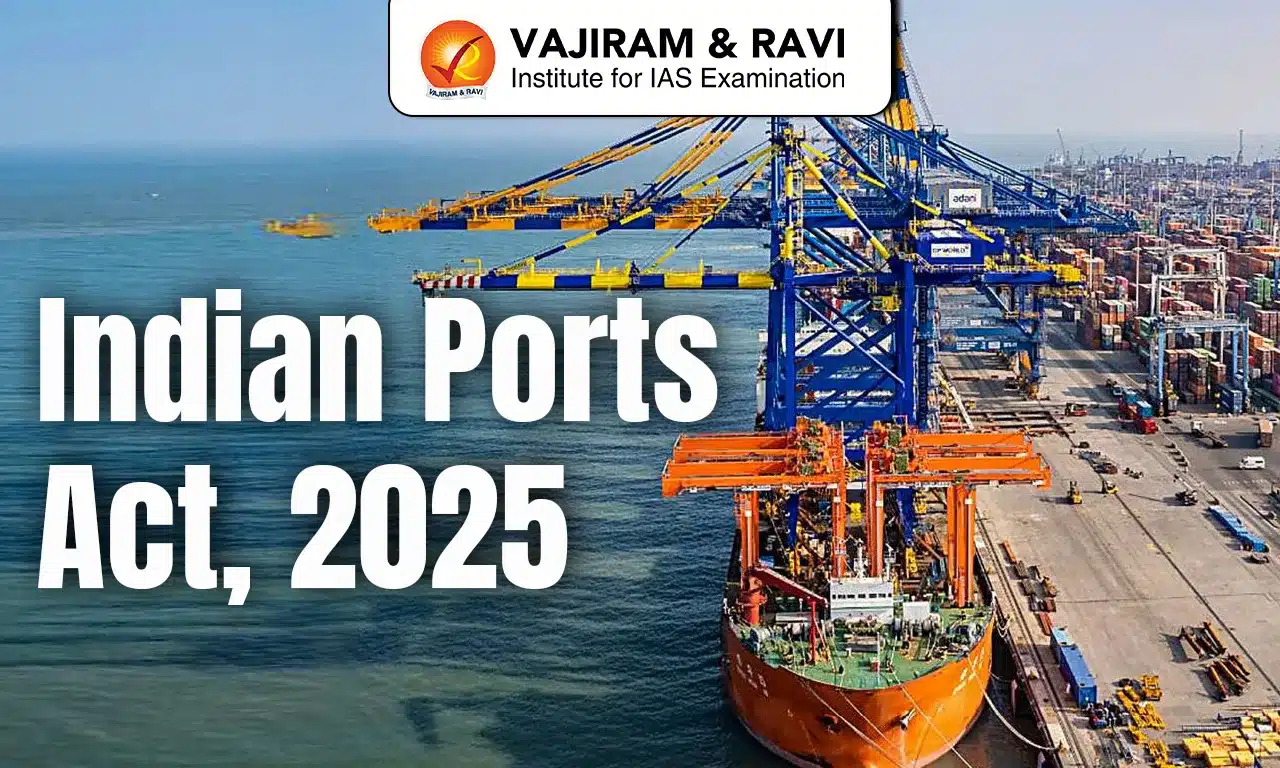
The Indian Ports Act 2025 marks a major step in modernizing India’s maritime governance by replacing the century-old Indian Ports Act 1908. Ports handle nearly 95% of India’s EXIM cargo by volume and 70% by value, making them central to trade, logistics, and industrial growth. With 12 major ports, upcoming major ports like Vadhavan and Chabahar and over 200 minor ports, the sector’s expansion demands updated regulations, cooperative federalism, and integrated development. The Act introduces a contemporary framework focused on efficiency, sustainability, and global competitiveness.
Indian Ports Act 2025
The Indian Ports Act 2025, passed by Parliament in August 2025, provides an integrated legal structure to regulate port development and operations across India. It replaces outdated colonial-era provisions and introduces modern standards for port governance, digitalisation, environmental compliance, and disaster readiness. This Act strengthens coordination between the Centre and coastal States and equips ports to become engines of economic growth, trade facilitation, and regional connectivity.
Also Read: Disaster Management Act
Indian Ports Act 2025 Objectives
The Indian Ports Act 2025 aims to establish a modern, coordinated, and globally competitive maritime framework aiming for Viksit Bharat by 2047. The main objective and vision of the act are:
- Promote integrated and uniform development of ports across India’s coastline.
- Strengthen cooperative federalism through structured Centre-State coordination.
- Enhance global competitiveness by aligning port operations with international maritime practices.
- Improve governance, transparency, and accountability across port institutions.
- Promote digitalisation to simplify procedures and improve operational efficiency.
- Strengthen environmental safeguards and disaster readiness across ports.
- Facilitate sustainable port-led growth while ensuring regulatory clarity.
- Build a predictable policy environment to support long-term investments.
- Ensure ports act as engines of industrial, logistical, and regional development.
- Promote data transparency and evidence-based planning through updated institutional mechanisms.


Indian Ports Act 2025 Provisions
The Indian Ports Act 2025 introduces structural, operational, regulatory, and environmental reforms to modernise port governance. The major provisions of the act are given below:
- Designation of Port Officers: The conservator is formally empowered as the port officer with expanded authority over vessel movements, fee recovery, damage assessment, disease control, and enforcement of penalties.
- Recognition of State Maritime Boards: State Maritime Boards are given statutory backing to oversee planning, licensing, tariff regulation, infrastructure expansion, and safety compliance for non-major ports.
- Statutory Maritime State Development Council (MSDC): The MSDC coordinates national planning, inter-state data sharing, legislative reforms, and connectivity strategies to ensure unified development.
- Dispute Resolution Committees (DRCs): States must establish DRCs for conflicts involving non-major ports, concessionaires, and service operators, with appeals directed to the High Court.
- Tariff Regulation Mechanism: Major ports will determine tariffs through the Major Port Authority Board, while State Maritime Boards or concessionaires will set tariffs for non-major ports with mandatory electronic publication for transparency.
- Safety Provisions: Stricter penalties are imposed for damaging navigational aids, unsafe handling of combustibles, and violations of safety norms within port limits.
- Environmental and Global Norms Compliance: Ports must comply with MARPOL, Ballast Water Management rules, pollution control mandates, and disaster preparedness protocols.
- Central Government Environmental Audits: Specialised audits will verify compliance with waste management, emergency planning, and pollution-control measures.
- Digitalisation and Modern Operations: The Act promotes Maritime Single Window systems, advanced traffic management technologies, and digitised documentation to improve Ease of Doing Business.
- Strengthening of Regulatory Enforcement: Updated regulatory powers enable better monitoring of port operations, infrastructure use, and adherence to national maritime standards.
Also Read: Mediation Act
Indian Ports Act 2025 Significance
The Indian Ports Act 2025 creates a unified, transparent, and future-oriented maritime governance system. The key importance of the act are:
- Unified Legal Framework: Replaces fragmented century-old provisions with a consolidated modern system covering all aspects of port operations.
- Enhanced Ease of Doing Business: Transparent tariffs, digital systems, and uniform regulations reduce procedural delays and promote investor confidence.
- Integrated National Development: Supports coordinated planning across coastal states, enabling strategic port-led industrial and logistics growth.
- Stronger Institutional Capacity: State Maritime Boards and the MSDC gain statutory roles, improving governance and long-term port planning.
- Improved Safety and Navigation: Updated safety norms strengthen navigational reliability, port security, and emergency preparedness.
- Environmental Sustainability: Mandatory global green norms support pollution control, waste management, and ecosystem protection within port limits.
- Better Disaster Readiness: Ports must maintain robust plans for emergencies, environmental hazards, and operational disruptions.
- Faster Dispute Resolution: DRCs and High Court-based appeals create clearer, more efficient mechanisms to settle port-related disputes.
- Boost to Competitiveness: The Act aligns India’s maritime governance with global standards, supporting India’s position as a rising maritime power.
- Strategic Maritime Growth: Encourages holistic utilization of India’s 7500 km coastline for trade, connectivity, and industrial transformation.

 Last updated on Oct, 2026
→ UPSC 2027 Notification will be released on 13 January 2027 at upsconline.nic.in.
→ Check Nobel Prize 2026 Winners List here.
→ Download PIB PRiSM Monthly Magazine 2026 here.
→ Check UPSC Monthly Current Affairs Magazine The Recitals here.
→ Check out the latest UPSC Syllabus here.
→ Download UPSC Model Answers for Mains 2026
→ UPSC Mains Question Paper 2026 is out now for Essay & GS Paper 1, 2, 3 & 4.
→ UPSC Calendar 2027 has been released.
→ Enroll in Vajiram & Ravi’s UPSC Mains Test Series 2027 for structured answer writing practice, expert evaluation, and exam-oriented feedback.
→ Join Vajiram & Ravi’s UPSC Mentorship Program 2027 for personalized guidance, strategy planning, and one-to-one support from experienced mentors.
→ Go through the UPSC Mains Previous Year Papers to enhance your preparation.
→ UPSC has released UPSC Toppers List 2025 with the Civil Services final result on its official website.
→ Also check Best UPSC Coaching in India
Indian Ports Act 2025 FAQs
Q1. What is the Indian Ports Act 2025?+
Q2. Why was the old 1908 Ports Act replaced with Indian Ports Act 2025?+
Q3. What new institutions are created under the Indian Ports Act 2025?+
Q4. How does the Indian Ports Act 2025 improve transparency?+
Q5. What environmental safeguards are included in Indian Ports Act 2025?+
Tags: indian ports act 2025