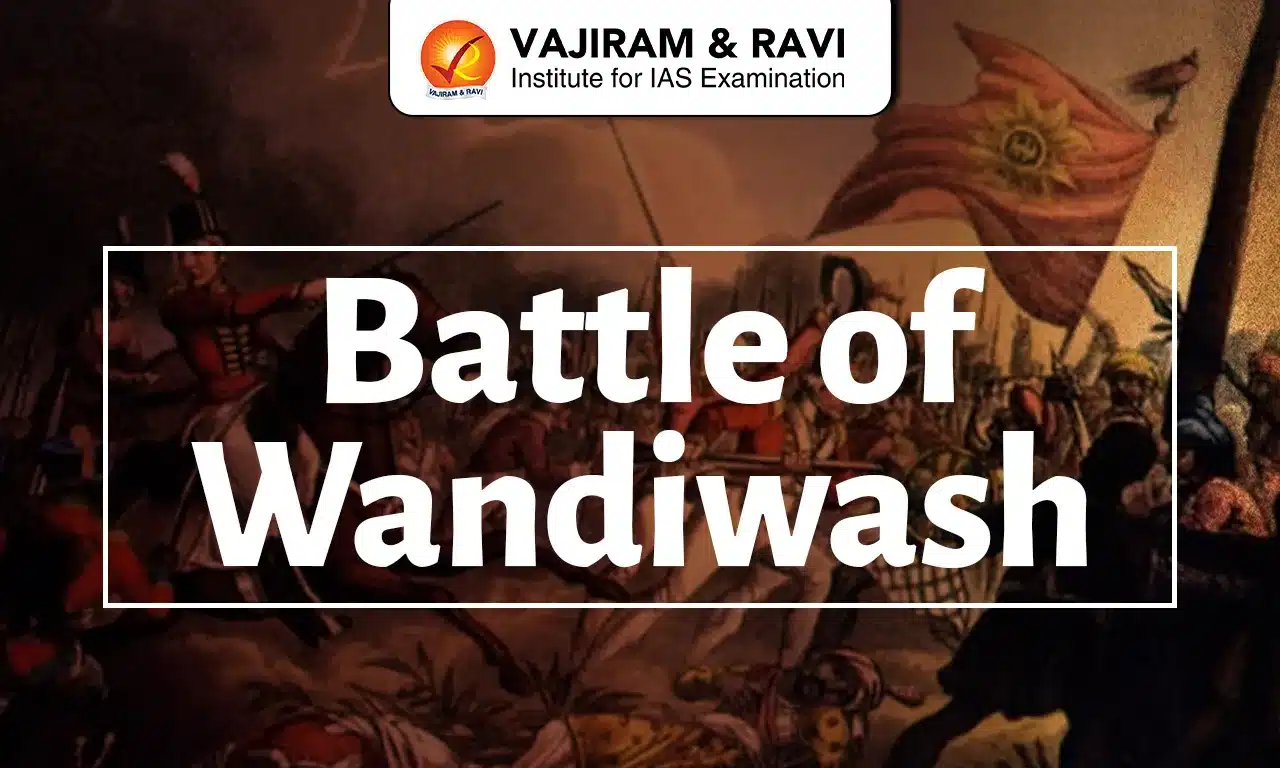
The Battle of Wandiwash, fought on 22 January 1760, was a decisive military engagement in South India that permanently altered the balance of European power in the subcontinent. It occurred during the Third Carnatic War, which itself was part of the global Seven Years’ War. The battle marked the final collapse of French political and military ambitions in India and paved the way for British supremacy through the East India Company.
Battle of Wandiwash
The Battle of Wandiwash was fought between the British East India Company forces under Sir Eyre Coote and the French army led by Count Thomas Arthur de Lally. It took place near the fortified town of Vandavasi (Anglicised as Wandiwash), strategically located inland from the Coromandel Coast. Despite having comparable troop strength, the French army suffered a decisive defeat. The British victory eliminated the last serious European rival in India. Notably, Indian sepoys fought on both sides, highlighting how European dominance was built using local manpower. Wandiwash thus stands as a critical milestone that enabled the British East India Company to move from a trading entity to a territorial power ruling India.
Battle of Wandiwash Causes
The Battle of Wandiwash resulted from escalating Anglo-French rivalry in India during the Seven Years’ War and the struggle for political dominance in the Carnatic region.
- Seven Years’ War impact (1756-1763): European conflict between Britain and France expanded to India, making Carnatic a major theatre.
- Third Carnatic War (1758-1763): Continued struggle between British and French East India Companies for supremacy in South India.
- French offensive under Count de Lally (1758): Capture of Fort St. David and attacks on Madras intensified hostilities.
- British recovery strategy: Sir Eyre Coote reorganised British forces after losses and planned decisive engagement.
- Strategic importance of Wandiwash: Control of Vandavasi secured inland communication lines to Pondicherry.
- Declining French resources: Weak naval support under Admiral d’Aché and shortage of funds forced risky French campaigns.


Battle of Wandiwash Course
The Battle of Wandiwash on 22 January 1760 unfolded through a well-planned British counterattack against a resource-strained French force attempting to capture Vandavasi.
- French objective: Count de Lally advanced to recapture the fort of Wandiwash to restore French strategic control in Carnatic.
- British response: Sir Eyre Coote marched rapidly from Arcot to intercept French forces before fort consolidation.
- Troop deployment: British fielded about 1,900 European infantry, 2,100 sepoys, 330 cavalry and 26 guns.
- French strength: French forces comprised nearly 2,250 European infantry, 1,300 sepoys, 300 cavalry and 16 guns.
- Artillery dominance: Superior British artillery fire disrupted French formations early in the engagement.
- Cavalry failure: French cavalry charges collapsed due to poor coordination and terrain constraints.
- Decisive outcome: The French line broke, leading to rout, heavy losses and capture of Marquis de Bussy.
Battle of Wandiwash Outcomes
The British victory at the Battle of Wandiwash dismantled French military power in South India and reshaped colonial politics permanently.
- The British captured key French-held territories: Chetpattu, Tiruvannamalai, Tindivanam and Perumukkal during 1760.
- Marquis de Bussy’s forces withdrew, restricting French presence to Pondicherry alone.
- Pondicherry surrendered to the British on 16 January 1761 after an eight-month siege.
- The French lost strategic centres including Gingee, Mahe and Karaikal soon after.
- The defeat compelled France to accept the Treaty of Paris in 1763.
- France retained Pondicherry and Chandannagar only for trade, without fortifications or troops.
- The British East India Company emerged as the supreme European power in India.
Battle of Wandiwash Reason for French Defeat
The French defeat was not merely tactical but structural, reflecting deeper administrative, naval and financial weaknesses.
- Inferior naval support: British naval dominance cut French sea links with France, disrupting reinforcements and supplies after 1758.
- Financial weakness: French focus on territorial control weakened their commercial revenue base.
- State-controlled company: The French East India Company suffered from bureaucratic delays and rigid control due to direct state control from Paris.
- Leadership limitations: Apart from Lally and Dupleix, France lacked strong military leadership in India.
- Artillery disadvantage: French deployed only 16 guns compared to the British 26 guns during the battle, although similar deployment of troops.
- British command superiority: Leaders like Eyre Coote and Stringer Lawrence ensured better coordination.
- Strategic depth disadvantage: British control of Madras, Bombay and Calcutta gave logistical superiority as the French hold only Pondicherry.
Battle of Wandiwash Treaty
The Treaty of Paris (1763) formally ended the War and confirmed British political supremacy in India. Although, it was not directly signed after the Battle of Wandiwash, but after the resulting victory in the Third Carnatic War.
- Treaty date: Signed in February 1763, concluding the global Seven Years’ War (1756-1763).
- Territories restored: France regained Pondicherry and Chandannagar, along with Mahe, Karaikal and Yanam for trade purposes.
- Military restrictions: France was prohibited from fortifying settlements or maintaining troops in India.
- Political impact: French East India Company lost all political and military authority in the subcontinent.
- British advantage: British East India Company emerged as the sole dominant European power in India.

 Last updated on Oct, 2026
→ UPSC 2027 Notification will be released on 13 January 2027 at upsconline.nic.in.
→ Check Nobel Prize 2026 Winners List here.
→ Download PIB PRiSM Monthly Magazine 2026 here.
→ Check UPSC Monthly Current Affairs Magazine The Recitals here.
→ Check out the latest UPSC Syllabus here.
→ Download UPSC Model Answers for Mains 2026
→ UPSC Mains Question Paper 2026 is out now for Essay & GS Paper 1, 2, 3 & 4.
→ UPSC Calendar 2027 has been released.
→ Enroll in Vajiram & Ravi’s UPSC Mains Test Series 2027 for structured answer writing practice, expert evaluation, and exam-oriented feedback.
→ Join Vajiram & Ravi’s UPSC Mentorship Program 2027 for personalized guidance, strategy planning, and one-to-one support from experienced mentors.
→ Go through the UPSC Mains Previous Year Papers to enhance your preparation.
→ UPSC has released UPSC Toppers List 2025 with the Civil Services final result on its official website.
→ Also check Best UPSC Coaching in India
Battle of Wandiwash FAQs
Q1. When and where was the Battle of Wandiwash fought?+
Q2. Who led the British and French forces in the Battle of Wandiwash?+
Q3. Why is the Battle of Wandiwash historically important?+
Q4. Which war was the Battle of Wandiwash a part of?+
Q5. What was the main outcome of the Battle of Wandiwash?+
Tags: battle of wandiwash