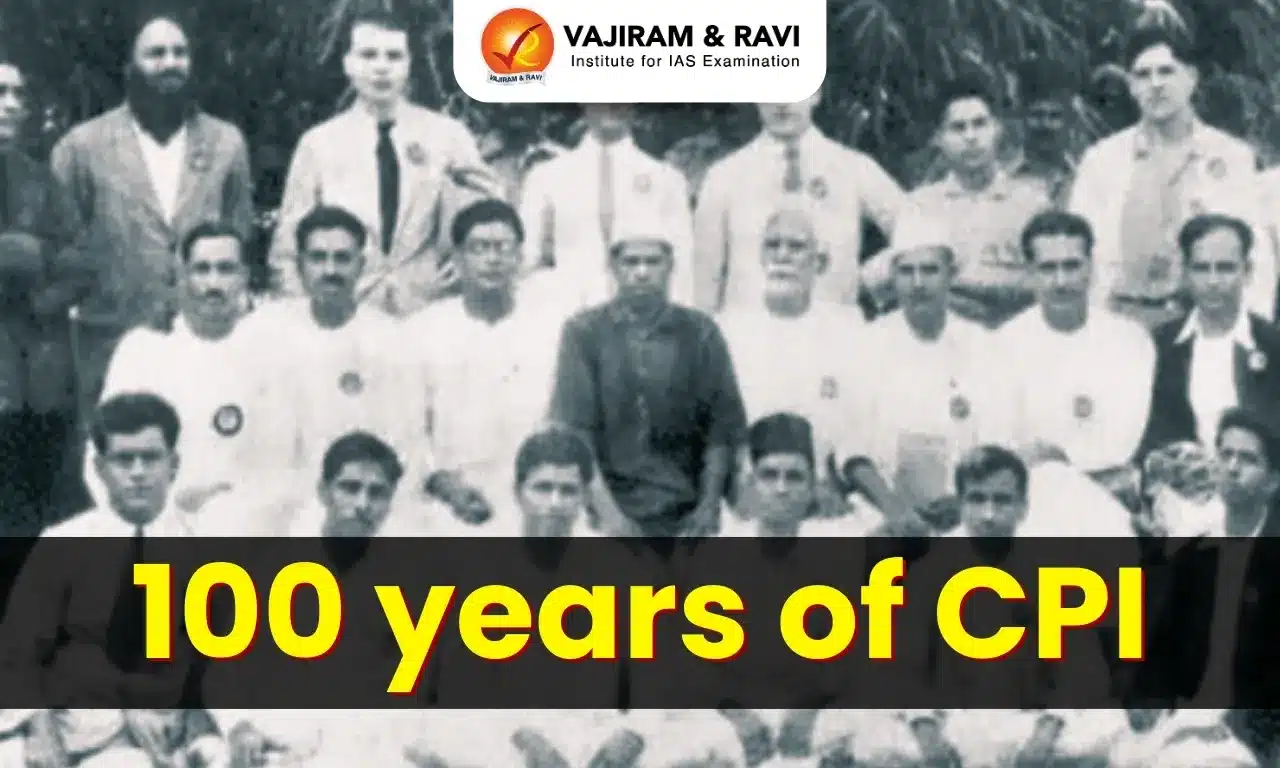
100 years of CPI Latest News
- The Communist Party of India (CPI) has completed 100 years, tracing its origins to the Kanpur conference of December 26, 1925.
- The milestone has renewed attention on how communism took root in India, its ideological influences, organisational evolution, and role in the freedom struggle.
Global Antecedents of Indian Communism
- The roots of communism lie in European political upheavals after the French Revolution (1789) and Napoleonic Wars (1796–1815), which polarised society between defenders of monarchy and advocates of republican change.
- The Industrial Revolution intensified inequalities, creating fertile ground for socialist ideas.
- Karl Marx, writing in 19th-century Europe, argued for a transition from capitalism to socialism.
- While Marx expected socialist revolutions in advanced capitalist societies, the first successful socialist revolution occurred in Russia in 1917, a relatively backward, Tsarist empire.
- The Russian Revolution combined anti-feudal, anti-capitalist, and anti-imperialist elements, making it especially attractive to colonised countries like India.


Three Political Strands Behind CPI’s Formation
- Indian communism emerged from three distinct but converging strands:
The MN Roy–Comintern Strand
- MN Roy, a revolutionary who lived in the US, Mexico, Berlin, and later the USSR, played a pivotal role.
- He attended the 1920 Comintern (Communist International) meeting as India’s representative.
- The Comintern assessed how communism could adapt to colonial conditions, influencing Indian communists.
- There were other groups of diasporic Indian revolutionaries active in Berlin, led by Virendranath Chattopadhyay, and Kabul, led by Raja Mahendra Pratap.
Independent Left Groups in India
- Separate Left formations emerged in Lahore (Ghulam Hussain), Bombay (S A Dange), Calcutta (Muzaffar Ahmad), and Madras (Singaravelu Chettiar).
- These groups operated independently but shared anti-imperialist and socialist goals.
Worker–Peasant Organisations
- Trade unions and peasant bodies such as the All-India Trade Union Congress (AITUC), formed in 1920, provided a mass base.
- These organisations linked socialism with labour and agrarian struggles.
Origin Story: Tashkent vs Kanpur Debate
- 1920, Tashkent
- Four Indian revolutionaries (including MN Roy and Abani Mukherji) set up a Communist Party under Comintern influence.
- Aim: liberate India from British rule and establish socialism.
- However, it lacked support from Indian-based Left groups and the diaspora.
- 1925, Kanpur Conference
- Indian communist groups organised a national conference in Kanpur, resolving to form the Communist Party of India.
- Objectives included:
- Ending British rule
- Establishing a workers’ and peasants’ republic
- Socialising the means of production and distribution
- Key ideological divide
- The CPI(M) later traced its origins to Tashkent (1920), emphasising internationalism.
- The CPI identified Kanpur (1925) as the foundation, highlighting the Indian component of communism.
Social Reform and Anti-Oppression Stance
- Early Communists opposed not only colonial exploitation but also caste oppression and patriarchy.
- At Kanpur, conference chair M Singaravelu condemned untouchability.
- The CPI became the first organisation to bar members of communal bodies, underscoring its secular and inclusive ethos.
Role in the Freedom Struggle (1925–1947)
- 1925–28: Communists were active in organising workers’ and peasants’ movements.
- 1929: Leaders were arrested in the Meerut Conspiracy Case, accused of organising railway strikes; many were jailed or deported.
- 1930s: Communists worked with the Congress Socialist Party in a United Front against imperialism.
- 1939: The United Front collapsed due to ideological and political differences.
- Post-1945: Communists led major peasant struggles, especially in Bengal and Telangana.
Shaping the Constitution and Mass Mobilisation
- Communist influence was evident in Constituent Assembly debates on land reforms, workers’ rights, and protections for backward classes.
- Movements like the Telangana Rebellion showcased commitment to agrarian justice.
- The CPI mobilised society through organisations such as the All India Trade Union Congress, All India Kisan Sabha, All India Students’ Federation, and the Progressive Writers’ Association, embedding ideals of liberty, equality, fraternity, and justice in post-Independence discourse.
Post-Independence Trajectory
- After 1947, Indian communists followed divergent paths:
- Some adopted armed, insurrectionary strategies.
- Others chose the parliamentary democratic route, seeking power through elections.
- These differences eventually led to splits within the communist movement, most notably in 1964 (CPI–CPI(M) split).

 Last updated on Oct, 2026
→ UPSC 2027 Notification will be released on 13 January 2027 at upsconline.nic.in.
→ Check Nobel Prize 2026 Winners List here.
→ Download PIB PRiSM Monthly Magazine 2026 here.
→ Check UPSC Monthly Current Affairs Magazine The Recitals here.
→ Check out the latest UPSC Syllabus here.
→ Download UPSC Model Answers for Mains 2026
→ UPSC Mains Question Paper 2026 is out now for Essay & GS Paper 1, 2, 3 & 4.
→ UPSC Calendar 2027 has been released.
→ Enroll in Vajiram & Ravi’s UPSC Mains Test Series 2027 for structured answer writing practice, expert evaluation, and exam-oriented feedback.
→ Join Vajiram & Ravi’s UPSC Mentorship Program 2027 for personalized guidance, strategy planning, and one-to-one support from experienced mentors.
→ Go through the UPSC Mains Previous Year Papers to enhance your preparation.
→ UPSC has released UPSC Toppers List 2025 with the Civil Services final result on its official website.
→ Also check Best UPSC Coaching in India
100 years of CPI FAQs
Q1. Why is 100 years of CPI significant?+
Q2. What global ideas influenced the CPI?+
Q3. What were the main strands behind CPI’s formation?+
Q4. How did CPI contribute to India’s independence movement?+
Q5. How did CPI influence the Indian Constitution?+
Tags: 100 years of CPI mains articles upsc current affairs upsc mains current affairs