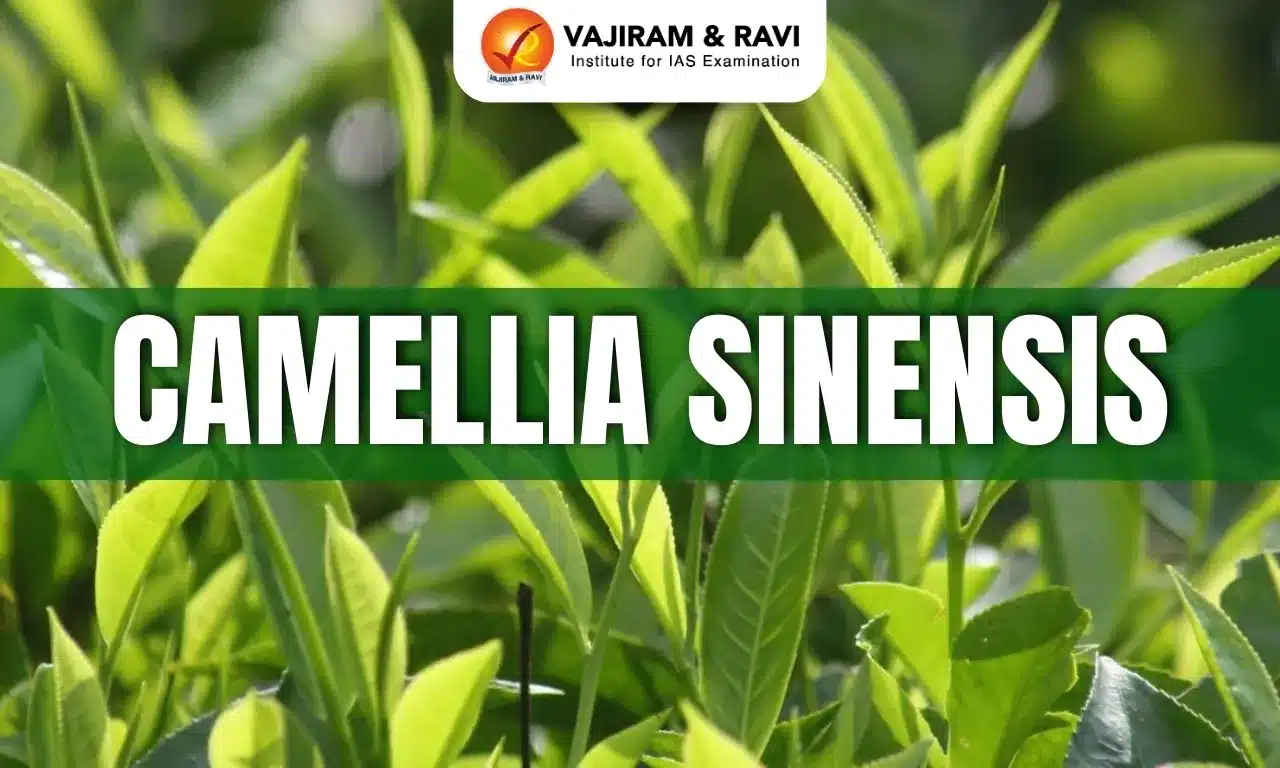
Camellia sinensis Latest News
Recently, the Food Safety and Standards Authority of India (FSSAI) issued a clarification that a beverage qualifies to be called tea only if it is derived from the plant Camellia sinensis.
About Camellia sinensis
- It belongs to the family Theaceae, commonly known as the tea plant.
- It is the source of various types of tea including green tea, black tea, and oolong tea.
- It is a shrub or evergreen tree up to 16 m in height.
- It is widely cultivated in mountain slopes, altitude up to 2200 m.
- Required Climatic Conditions
- Temperature: Range of 15°C–23°C (optimal growth)
- Climate: Warm and humid climate with at least 5 hours of sunlight daily
- Rainfall: Annual rainfall of 150–300 cm, evenly distributed
- Soil: Slightly acidic, calcium-free soil with porous sub-soil
- Terrain: Sloping terrain to ensure proper drainage
- Reproduction: Camellia species flowers are complete, bisexual, i.e., with functional male (androecium) and female (gynoecium), including stamens, carpels and ovary.
- Global Distribution: Cultivated in Subtropical and warm temperate zones of South-east Asia
- It is mainly grown in Bangladesh, Bhutan, China, India, Japan, Korea and Malaysia.
Types of Tea Produced in India
- Green tea: Oxidation is prevented by quickly heating (steaming or pan-frying) the leaves after plucking to keep them green.
- Oolong Tea: Partially oxidized, falling between green and black teas in flavour and colour.
- Black tea: It is fully oxidized before drying, resulting in its characteristic dark colour and strong taste.
- White tea: Minimal processing, often just withered and dried, preserves its delicate nature.
Source: TH


 Last updated on Oct, 2026
→ UPSC 2027 Notification will be released on 13 January 2027 at upsconline.nic.in.
→ Check Nobel Prize 2026 Winners List here.
→ Download PIB PRiSM Monthly Magazine 2026 here.
→ Check UPSC Monthly Current Affairs Magazine The Recitals here.
→ Check out the latest UPSC Syllabus here.
→ Download UPSC Model Answers for Mains 2026
→ UPSC Mains Question Paper 2026 is out now for Essay & GS Paper 1, 2, 3 & 4.
→ UPSC Calendar 2027 has been released.
→ Enroll in Vajiram & Ravi’s UPSC Mains Test Series 2027 for structured answer writing practice, expert evaluation, and exam-oriented feedback.
→ Join Vajiram & Ravi’s UPSC Mentorship Program 2027 for personalized guidance, strategy planning, and one-to-one support from experienced mentors.
→ Go through the UPSC Mains Previous Year Papers to enhance your preparation.
→ UPSC has released UPSC Toppers List 2025 with the Civil Services final result on its official website.
→ Also check Best UPSC Coaching in India
Camellia sinensis FAQs
Q1. What is Camellia sinensis?+
Q2. Black tea is produced from?+
Tags: camellia sinensis prelims pointer upsc prelims current affairs