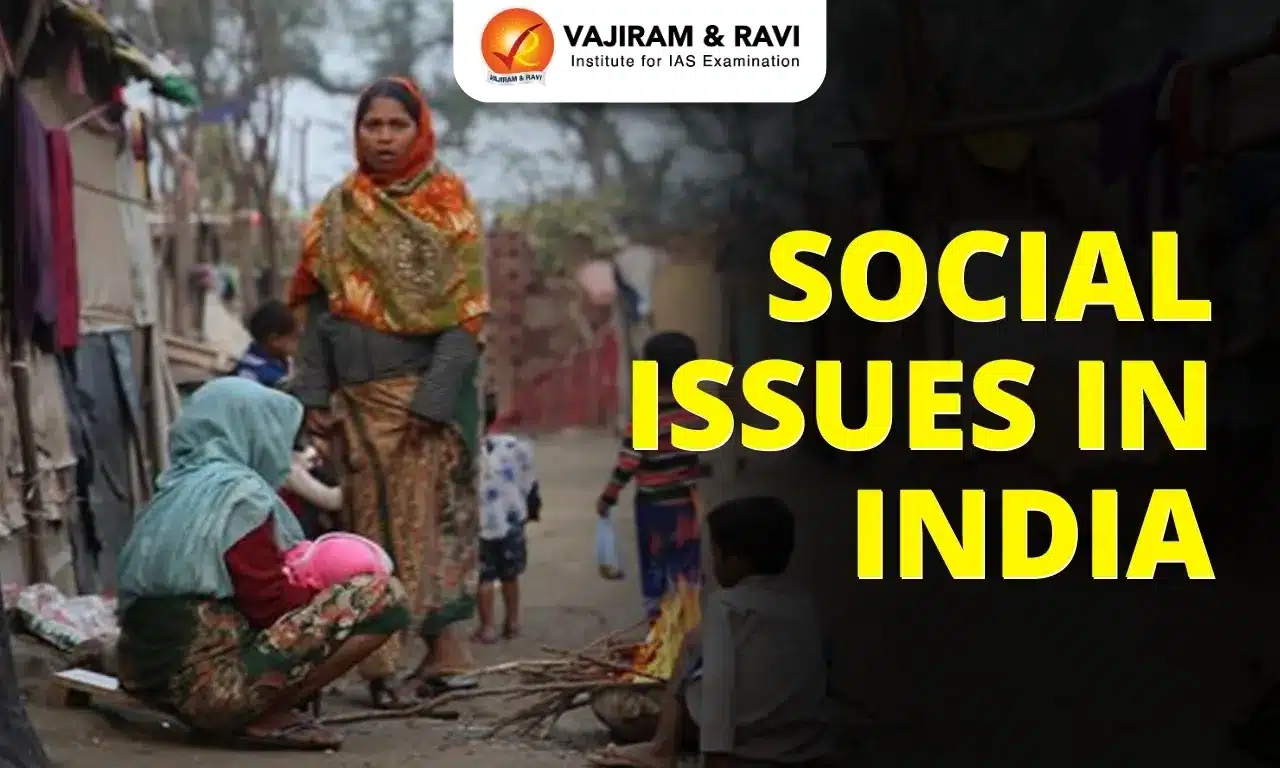
Social Issues in India are deeply interconnected and rooted in historical, economic, and structural factors. While constitutional safeguards, government schemes, and civil society efforts have brought measurable progress, persistent inequalities remain. These problems are interconnected and influence education, health, employment, safety, and social harmony. Addressing these challenges requires inclusive growth, effective governance, social awareness, and sustained investment in education, healthcare, employment, and environmental protection.
Social Issues in India
Social Issues in India arise from historical inequalities, rapid urbanisation, population pressure, economic disparities, and uneven access to public services. Challenges such as caste discrimination, gender inequality, poverty, healthcare gaps, education disparities, environmental degradation, unemployment, crime, and digital exclusion continue to shape daily life. Government interventions, legal reforms, and civil society movements have shown progress, but structural problems persist, requiring sustained policy focus and public participation.
Top 10 Social Issues in India List
The detailed discussion of major List of Social Problems in India has been provided below:


Caste System and Discrimination
The caste system continues to shape access to education, employment, housing, and social dignity across regions.
- Historical Origins: Varna-based hierarchy emerged in ancient society, later becoming rigid birth-based stratification.
- Scheduled Castes Impact: SC communities face higher poverty, lower literacy, and employment discrimination.
- Educational Barriers: Dropout rates remain higher among SC and ST students.
- Employment Inequality: Informal and hazardous jobs dominate lower-caste employment patterns.
- Social Exclusion: Residential segregation persists in rural and urban settlements.
- Legal Safeguards: Untouchability is abolished under Article 17 of the Constitution.
- Reservation Policy: Quotas exist for SCs, STs, and OBCs in education and public employment.
- Atrocity Laws: SC/ST Prevention of Atrocities Act criminalises caste-based violence.
- Awareness Campaigns: Government-led social justice programs promote inclusion.
- Continuing Challenge: Social mobility remains uneven despite constitutional protections.
Gender Inequality
Gender inequality affects workforce participation, safety, health outcomes, and decision-making power.
- Economic Participation: Women contribute about 17% to India’s GDP.
- Missing Women: Census and survey data indicate 63 million missing women nationally.
- Wage Gap: Women earn significantly less than men for similar work.
- Workplace Barriers: Promotion and leadership opportunities remain limited.
- Gender Violence: High incidence of domestic violence and sexual crimes reported annually.
- Safety Concerns: Public transport and workplaces remain unsafe for many women.
- Legal Protection: Sexual Harassment at Workplace Act enacted in 2013.
- Girl Child Schemes: Beti Bachao Beti Padhao addresses declining child sex ratio.
- Marriage Rights: Triple Talaq law strengthened women’s legal security.
- Social Change Need: Cultural attitudes slow progress despite strong legal framework.
Poverty Issues
Economic inequality remains a core social challenge despite poverty reduction efforts.
- Rural Poverty: Rural households face limited employment and infrastructure access.
- Urban Inequality: Urban poverty exists alongside concentrated wealth.
- Basic Amenities: Clean water and sanitation remain inaccessible for many rural families.
- COVID Impact: Pew Research reported 75 million Indians pushed into poverty.
- Shrinking Middle Class: Nearly 32 million people slipped out of middle-income status.
- Employment Guarantee: MGNREGA provides 100 days of wage employment.
- Food Security: Public Distribution System supplies subsidised food grains.
- Housing Support: Indira Awaas Yojana targets rural housing shortages.
- Regional Gaps: Eastern and central states show higher poverty ratios.
- Inclusive Growth Need: Growth benefits remain uneven across social groups.
Healthcare Challenges in India
Healthcare access and affordability remain unequal across regions and income groups.
- Rural Access Gap: Rural areas face shortages of doctors and hospitals.
- Urban Cost Burden: High out-of-pocket expenditure dominates private healthcare.
- Mental Health Prevalence: Over 10.6% adults face mental health disorders.
- Treatment Gap: Mental healthcare gap ranges between 70 and 92%.
- Economic Loss: Mental illness reduces productivity and workforce participation.
- Ayushman Bharat: Provides health insurance coverage to vulnerable families.
- National Health Mission: Strengthens primary healthcare infrastructure.
- Hospital Sector: Accounts for nearly 80% of healthcare services.
- Industry Size: Healthcare market approached USD 132 billion by 2023.
- Awareness Deficit: Stigma limits healthcare-seeking behaviour.
Education System
Education quality and access vary widely across geography, gender, and income.
- Literacy Growth: National literacy improved to nearly 77.7%.
- Urban Advantage: Urban literacy exceeds rural literacy by over 14 percentage points.
- School Infrastructure: Many rural schools lack teachers and basic facilities.
- Dropout Rates: Economic pressure increases school dropout risk.
- Gender Gap: Female literacy lags behind male literacy.
- Right to Education: Guarantees free education for ages 6 to 14.
- Mid-Day Meals: Improves attendance and child nutrition.
- NEP Reform: National Education Policy focuses on inclusivity and skills.
- Digital Divide: Online learning widened inequality during pandemic.
- Outcome Disparity: Learning outcomes remain inconsistent nationwide.
Environmental Issues
Environmental degradation directly impacts health, livelihoods, and food security.
- Air Pollution: Urban air quality frequently exceeds safe limits.
- Health Impact: Pollution increases respiratory and cardiovascular diseases.
- Water Pollution: Industrial discharge contaminates rivers and groundwater.
- Climate Vulnerability: India faces floods, droughts, and heatwaves.
- Agricultural Risk: Erratic monsoons threaten farmer incomes.
- NCAP Program: Targets reduction in urban air pollution levels.
- Swachh Bharat: Improves sanitation and waste management.
- Biodiversity Plan: Protects ecosystems and endangered species.
- Urban Pressure: Unplanned growth worsens environmental stress.
- Sustainability Need: Long-term development requires ecological balance.
Religious and Ethnic Conflicts
Social harmony is challenged by periodic religious and ethnic tensions.
- Colonial Legacy: Historical divisions intensified during colonial rule.
- Identity Politics: Religion and ethnicity influence political mobilisation.
- Community Violence: Conflicts disrupt social and economic stability.
- Trust Deficit: Inter-community mistrust affects coexistence.
- Economic Loss: Violence damages livelihoods and infrastructure.
- Legal Safeguards: Laws prohibit hate speech and communal violence.
- Education Role: Civic education promotes tolerance.
- Community Dialogue: Peace initiatives encourage reconciliation.
- Security Concerns: Religious sites face heightened risk during unrest.
- Unity Priority: Social cohesion remains essential for national stability.
Urbanization
Rapid urban growth reshapes social structures and public service demand.
- Urban Shift: Half of India’s population expected urban by 2031.
- Rural Migration: Job search drives large-scale migration.
- Economic Opportunity: Cities offer employment and services.
- Overcrowding: Housing shortages worsen urban living conditions.
- Slum Growth: Informal settlements lack sanitation and healthcare.
- Transport Stress: Infrastructure struggles with rising population.
- Affordable Housing: Shortage affects low-income migrants.
- Planning Gaps: Weak urban governance worsens inequality.
- Public Services: Education and health facilities face pressure.
- Sustainable Cities: Planned growth essential for livability.
Social Movements
Social movements have driven legal reforms and public awareness.
- Women’s Movements: Advanced gender equality and legal reforms.
- Dalit Assertion: Challenged caste-based oppression.
- Environmental Movements: Protected forests and rivers.
- RTI Movement: Increased government transparency.
- Civil Society Role: Acts as bridge between state and citizens.
- Grassroots Advocacy: Mobilises marginalised communities.
- Policy Influence: Shapes legislative and administrative reforms.
- Public Awareness: Strengthens democratic participation.
- Legal Victories: Courts influenced by sustained activism.
- Social Accountability: Movements improve governance outcomes.
Unemployment
Youth unemployment poses economic and social risks.
- Unemployment Rate: Youth unemployment reached 8.1% in 2022.
- Educated Joblessness: Degrees do not guarantee employment.
- Gender Gap: Young women face higher unemployment rates.
- Skill Mismatch: Education not aligned with market needs.
- Skill India: Targets large-scale workforce training.
- PMKVY Scheme: Supports vocational certification.
- Apprenticeship Program: Encourages industry-based training.
- Startup India: Promotes entrepreneurship among youth.
- Digital Jobs: IT sector offers emerging opportunities.
- Demographic Dividend: Employment critical for harnessing youth potential.
Impact of Technology on Society
Technology reshapes education, employment, and social interaction.
- Digital Divide: Rural areas lag in internet connectivity.
- Economic Barriers: Device affordability limits access.
- Education Impact: Online learning benefits digitally connected students.
- Social Media Reach: Expands awareness and mobilisation.
- Misinformation Risk: Rapid spread affects social trust.
- Cyber Harassment: Online abuse disproportionately targets women.
- Digital India: Expands digital infrastructure nationwide.
- E-Governance: Improves service delivery transparency.
- Skill Training: Focus on digital literacy.
- Inclusive Tech Need: Equitable access essential for social equity.
Crime and Public Safety
Public safety challenges affect trust in institutions.
- Crime Rate: Reported crime rate stood near 445 per 100,000 population.
- Violence Against Women: Remains a major safety concern.
- Cybercrime Rise: Digital fraud and identity theft increasing.
- Urban Crime: Migration and inequality influence crime patterns.
- Police Shortage: Staffing gaps reduce enforcement capacity.
- Judicial Backlog: Delayed justice weakens deterrence.
- Legal Reforms: New criminal laws aim faster trials.
- Community Policing: Improves local trust.
- Technology Use: Surveillance aids crime prevention.
- Public Confidence: Law enforcement reform essential.
| Also Check | |
| Learning Poverty | Woman Empowerment |
| Feminization of Poverty | Domestic Violence |

 Last updated on Sep, 2026
→ UPSC 2027 Notification will be released on 13 January 2027 at upsconline.nic.in.
→ Asian Games 2026 are being held in Aichi-Nagoya, Japan, from 19 September to 4 October.
→ Check out the latest UPSC Syllabus here.
→ Download UPSC Model Answers for Mains 2026
→ UPSC Mains Question Paper 2026 is out now for Essay & GS Paper 1, 2, 3 & 4.
→ UPSC Calendar 2027 has been released.
→ Enroll in Vajiram & Ravi’s UPSC Mains Test Series 2027 for structured answer writing practice, expert evaluation, and exam-oriented feedback.
→ Join Vajiram & Ravi’s UPSC Mentorship Program 2027 for personalized guidance, strategy planning, and one-to-one support from experienced mentors.
→ Go through the UPSC Mains Previous Year Papers to enhance your preparation.
→ UPSC has released UPSC Toppers List 2025 with the Civil Services final result on its official website.
→ Also check Best UPSC Coaching in India
Social Issues in India FAQs
Q1. What are major Social Issues in India?+
Q2. Why does caste system remain a Social Issues in India?+
Q3. How does gender inequality affect India’s development?+
Q4. What role does poverty play in Social Issues in India?+
Q5. How is the government addressing Social Issues in India?+
Tags: indian society social issues in india sociology