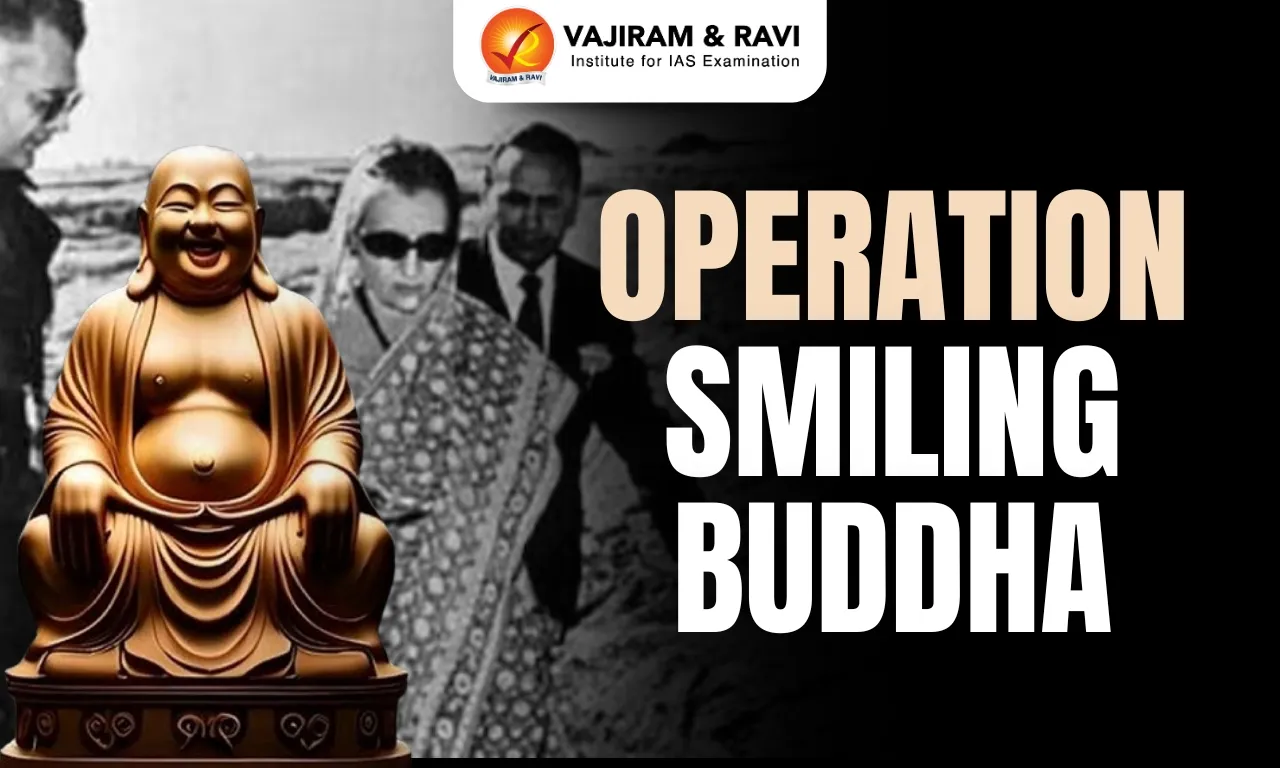
Operation Smiling Buddha was India’s first confirmed nuclear test, conducted on 18 May 1974 at the Pokhran Test Range in Rajasthan. Officially described by the Government of India as a peaceful nuclear explosion, it marked India’s entry into the nuclear capable states outside the five permanent members of the United Nations Security Council. The test was executed under extreme secrecy and demonstrated India’s indigenous scientific and technological capability in nuclear weapon design, plutonium production, and controlled detonation.
Operation Smiling Buddha
Operation Smiling Buddha, designated as Pokhran I by the Ministry of External Affairs, was the code name for India’s first nuclear weapon test. Conducted at 8:05 IST on 18 May 1974, the test involved a plutonium based implosion device developed entirely by Indian scientists. The operation was tightly supervised by Prime Minister Indira Gandhi and involved coordinated efforts of BARC, DRDO, the Atomic Energy Commission, and the Indian Army, establishing India’s strategic autonomy in nuclear technology.
Pokhran I
Pokhran I refers to India’s first underground nuclear test conducted in Rajasthan using a plutonium implosion device.
- Test location: Pokhran Test Range in Rajasthan under complete military control.
- Test date: Conducted precisely on 18 May 1974 at 8:05 IST.
- Test nature: Underground nuclear explosion described officially as peaceful.
- Global status: First nuclear test by a country outside UN Security Council P-5.
- International codename: Referred to as “Happy Krishna” by US intelligence.
- Strategic secrecy: Information restricted to a small political and scientific circle.
- Military role: Indian Army managed logistics, security, and test site preparations.


Operation Smiling Buddha Historical Background
India’s nuclear journey evolved gradually from peaceful research to strategic deterrence between 1945 and 1974.
- 1945 foundation: Homi Bhabha established TIFR initiating India’s nuclear research base.
- 1948 legislation: Atomic Energy Act created the Indian Atomic Energy Commission.
- 1954 institution: Department of Atomic Energy formed for civilian nuclear development.
- 1956 milestone: APSARA reactor at Trombay became Asia’s first operational reactor.
- 1958 project: Nehru approved Project Phoenix for plutonium reprocessing using PUREX.
- 1962 conflict: Sino-Indian war accelerated India’s strategic nuclear considerations.
- 1964 transition: Shastri approved subterranean nuclear studies without weapon testing.
- 1966 shift: Indira Gandhi resumed nuclear weapons development after leadership changes.
- 1969 capability: Sufficient plutonium accumulated for a single nuclear device.
- 1972 authorization: Formal approval granted for nuclear test device development.
Operation Smiling Buddha Development
Scientific, engineering, and material development progressed secretly over a decade using indigenous expertise. The key highlights of the operation are given here:
- Project leadership: Raja Ramanna led weapon design with P.K. Iyengar as deputy.
- Plutonium control: Homi Sethna supervised fissile material production at BARC.
- Reactor source: CIRUS reactor supplied plutonium using heavy water moderation.
- Fuel processing: Indigenous PUREX reprocessing enabled plutonium separation.
- Implosion research: V.S. Ramamurthy led implosion geometry development.
- Explosive lenses: DRDO’s TBRL developed precise high explosive lens systems.
- Detonation system: HEMRL Pune engineered synchronized firing mechanisms.
- Neutron initiator: Polonium beryllium initiator code named “Flower” was used.
- Scientific workforce: Only 75 scientists involved to maintain extreme secrecy.
- 1971 catalyst: USS Enterprise deployment during Indo-Pak war reinforced urgency.
Operation Smiling Buddha Nuclear Test
The nuclear device was detonated underground using controlled implosion technology with variable yield estimates. The major features of the Nuclear Test Device used in Operation Smiling Buddha has been highlighted below:
- Device type: Implosion type plutonium fission bomb similar to Fat Man design.
- Plutonium mass: Approximately 6 kg plutonium sourced from CIRUS reactor.
- Device dimensions: Hexagonal structure measuring 1.25 meters in diameter.
- Device weight: Total mass approximately 1,400 kilograms.
- Transport method: Rail mounted transport concealed under sand by army engineers.
- Test execution: Detonation triggered by Pranab Dastidar pressing firing switch.
- Yield claims: Official yield initially stated as 12 kilotons.
- Independent estimates: Seismic data suggested 4 – 6 kiloton explosive yield.
- Later admissions: Sethna and Iyengar acknowledged actual yield near 8 kilotons.
- Containment: Underground shaft prevented atmospheric radioactive release.
Operation Smiling Buddha Significance
The test established India’s technological independence and strategic credibility in nuclear science.
- Strategic autonomy: Demonstrated indigenous nuclear weapon design capability.
- Scientific confidence: Validated decades of Indian nuclear research investments.
- Deterrence message: Signaled India’s ability to develop nuclear weapons independently.
- Global recognition: Positioned India among advanced nuclear capable nations.
- Policy leverage: Strengthened India’s bargaining power in global nuclear negotiations.
- Technological spin offs: Advanced metallurgy, explosives, and reactor engineering.
- Political impact: Reinforced executive authority over strategic defence decisions.
Also Read: Military Operations of India
Operation Smiling Buddha Impact
The test produced major domestic political gains and significant international policy consequences. The aftermath and impact of the Operation Smiling Buddha is given below:
- Domestic response: Boosted Indira Gandhi’s popularity post 1971 war.
- Parliament reaction: Broad political approval across party lines.
- National honours: Padma Vibhushan awarded to Sethna, Ramanna, Nagchaudhuri.
- Scientific recognition: Five scientists received Padma Shri awards.
- International backlash: Triggered formation of Nuclear Suppliers Group.
- NSG restrictions: Nuclear exports tied to full scope IAEA safeguards.
- Canada response: Froze nuclear assistance citing violation of 1971 understanding.
- US stance: Continued Tarapur fuel supply despite expressing concern.
- Pakistan reaction: Cancelled talks; perceived test as strategic intimidation.
- Regional impact: Encouraged Pakistan’s pursuit of nuclear weapons capability.
Pokhran II
Pokhran II represented India’s second series of nuclear tests conducted in May 1998 after 24 years, carried out after the Operation Smiling Buddha.
- Operation name: Code named Operation Shakti by Indian authorities.
- Test period: Conducted between 11 – 13 May 1998 at Pokhran.
- Technological evolution: Built on two decades of weapons research.
- Test devices: Included thermonuclear and boosted fission designs.
- Strategic doctrine: Established credible minimum nuclear deterrence.
- Policy clarity: India openly declared itself a nuclear weapon state.
- Continuity link: Pokhran II directly traced scientific lineage to Smiling Buddha.

 Last updated on Oct, 2026
→ UPSC 2027 Notification will be released on 13 January 2027 at upsconline.nic.in.
→ Check Nobel Prize 2026 Winners List here.
→ Download PIB PRiSM Monthly Magazine 2026 here.
→ Check UPSC Monthly Current Affairs Magazine The Recitals here.
→ Check out the latest UPSC Syllabus here.
→ Download UPSC Model Answers for Mains 2026
→ UPSC Mains Question Paper 2026 is out now for Essay & GS Paper 1, 2, 3 & 4.
→ UPSC Calendar 2027 has been released.
→ Enroll in Vajiram & Ravi’s UPSC Mains Test Series 2027 for structured answer writing practice, expert evaluation, and exam-oriented feedback.
→ Join Vajiram & Ravi’s UPSC Mentorship Program 2027 for personalized guidance, strategy planning, and one-to-one support from experienced mentors.
→ Go through the UPSC Mains Previous Year Papers to enhance your preparation.
→ UPSC has released UPSC Toppers List 2025 with the Civil Services final result on its official website.
→ Also check Best UPSC Coaching in India
Operation Smiling Buddha FAQs
Q1. What was Operation Smiling Buddha?+
Q2. Why was Operation Smiling Buddha conducted?+
Q3. Who led Operation Smiling Buddha?+
Q4. What type of nuclear device was used in Operation Smiling Buddha?+
Q5. What was the global impact of Operation Smiling Buddha?+
Tags: operation smiling buddha