Great Indian Bustard Latest News
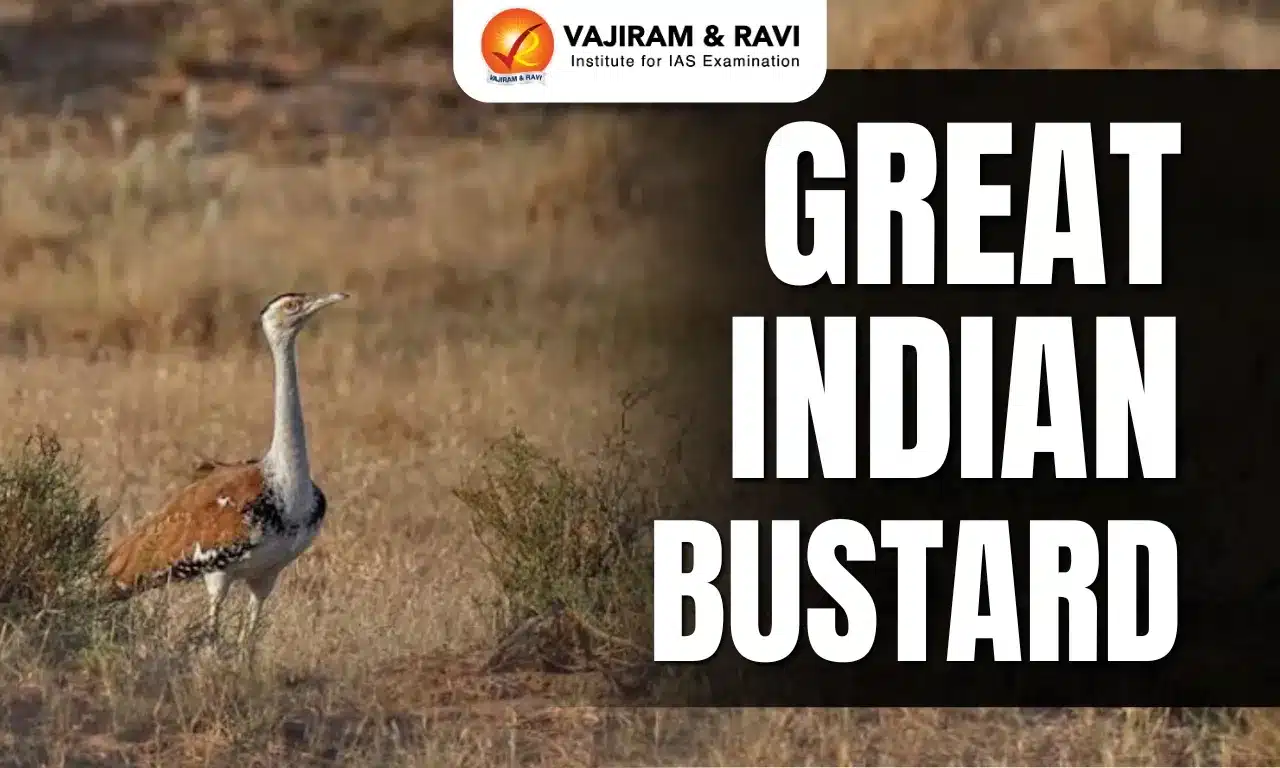
- Recently, the Supreme Court of India delivered a landmark judgment to strengthen conservation of the Great Indian Bustard, focusing on preventing bird deaths caused by collisions with overhead power lines linked to renewable energy projects.
- Acting on recommendations from an expert committee, the Court demarcated priority conservation areas for the critically endangered species and laid down a mechanism to reroute or manage overhead power lines in these zones.
Background: What the Supreme Court Was Examining
- A retired bureaucrat and environmentalist approached the Supreme Court of India seeking urgent protection for the Great Indian Bustard (GIB).
- The petition flagged rising fatal collisions with renewable energy transmission lines in Rajasthan and Gujarat.
- Poor frontal vision and heavy body make GIBs highly vulnerable to overhead wires.
Key Supreme Court Directions (2021–2024)
- 2021 order – Ban on new overhead power lines across ~99,000 sq km of GIB habitat; Assessment of undergrounding high-voltage lines; Mandatory bird diverters
- March 2024 modification – Withdrawal of blanket ban on overhead lines; Following concerns raised by the Ministry of Power, MNRE, and MoEFCC over feasibility and sector-wide impact.
Balancing Conservation and Clean Energy
- Court acknowledged the need to balance:
- Climate commitments and renewable energy expansion, and
- Protection of a critically endangered species
- Held that undergrounding alone is insufficient for conservation.
- It constituted an expert committee of wildlife and power-sector specialists.
Basis of the Final Judgment
- Expert committee recommendations guided the Court’s latest ruling.
- The judgment introduced targeted safeguards for the GIB while accommodating India’s renewable energy goals.


Measures Ordered by the Supreme Court
- Acting on recommendations from an expert committee, the Supreme Court of India approved a package of measures across three pillars:
- redrawing conservation zones;
- voltage-based mitigation for power lines (rerouting or undergrounding);
- creation of dedicated powerline corridors to reduce collision risk.
Revised Priority Conservation Areas
- Rajasthan: Priority areas expanded from 13,163 sq km to 14,013 sq km.
- Gujarat: Priority areas increased from 500 sq km to 740 sq km.
- These zones represent core habitats and breeding areas identified by the Rajasthan Forest Department and the Wildlife Institute of India (WII).
- Contestation: Petitioners opposed the exclusion of 657 sq km (eastern Rasla–Degray Oran), arguing it is a vital wintering and stopover corridor between Pokhran and Desert National Park.
- Critical sites prioritised include: Desert National Park; Salkha–Kuchri; Sanu–Mokla–Parewar; Pokhran Field Firing Range (PFFR) and its buffer/eastern periphery; Dholiya; Khetolai; and Chacha.
Dedicated Powerline Corridors
- Rajasthan: New powerline corridors up to 5 km wide, placed ≥5 km south of Desert National Park, to carry rerouted overhead lines.
- Gujarat: Dedicated corridors of 1–2 km width to evacuate power from wind/solar projects in coastal Kutch.
- Route optimisation mandate: Where multiple green-energy pooling stations terminate at a common grid station, authorities must converge routes into a common stretch wherever feasible.
Project Restrictions in Priority Areas
- No new overhead power lines within revised priority areas except via designated corridors (lines ≤11 kV exempt).
- No new wind turbines in priority areas.
- No new solar parks/plants >2 MW, and no expansion of existing solar parks, within priority areas.
Voltage-Based Mitigation (Undergrounding & Timelines)
- Rajasthan:
- Immediate undergrounding of 80 km of 33 kV lines (of 104 km identified earlier).
- All burying/rerouting to start immediately and finish before 2028.
- Gujarat:
- Immediate undergrounding of 79.2 km of 33 kV lines in priority areas.
- 64.9 km of 66 kV lines earmarked for immediate undergrounding.
- WII-identified 250 km of critical lines to be buried within 2 years.
Bird Flight Diverters: Evidence-Based Pause
- The Court did not issue blanket directions on installing bird flight diverters.
- Instead, it directed the committee to assess their effectiveness in reducing collision mortality and submit findings to the Centre.
Conservation Measures Directed by the Supreme Court
- The apex court endorsed a mix of general and State-specific measures to strengthen conservation of the Great Indian Bustard (GIB), alongside the ongoing Project GIB.
Measures for Rajasthan
- Grassland Restoration and Consolidation – Priority on restoration, conservation, and consolidation of grassland ecosystems, the GIB’s primary habitat.
- In-situ Habitat Management
- To support survival in the wild, the Court directed:
- Enclosure improvements to secure breeding and foraging areas
- Predator management, including control of free-ranging dogs and reptiles that prey on eggs
- Food and water management to stabilise resources
- Community engagement to reduce human-wildlife conflict and support local stewardship
Measures for Gujarat
- ‘Jump-Start’ Breeding in the Wild
- Adoption of a ‘jump-start’ method: transferring fertile eggs from Rajasthan to Gujarat.
- Technique involves swapping an infertile egg with a fertile one, enabling the female to incubate and raise the chick in natural conditions.
- Technology-Enabled Monitoring
- GPS tagging of birds to track movements and support the jump-start breeding process and post-release monitoring.
Source: IE

 Last updated on Oct, 2026
→ UPSC 2027 Notification will be released on 13 January 2027 at upsconline.nic.in.
→ Check Nobel Prize 2026 Winners List here.
→ Download PIB PRiSM Monthly Magazine 2026 here.
→ Check UPSC Monthly Current Affairs Magazine The Recitals here.
→ Check out the latest UPSC Syllabus here.
→ Download UPSC Model Answers for Mains 2026
→ UPSC Mains Question Paper 2026 is out now for Essay & GS Paper 1, 2, 3 & 4.
→ UPSC Calendar 2027 has been released.
→ Enroll in Vajiram & Ravi’s UPSC Mains Test Series 2027 for structured answer writing practice, expert evaluation, and exam-oriented feedback.
→ Join Vajiram & Ravi’s UPSC Mentorship Program 2027 for personalized guidance, strategy planning, and one-to-one support from experienced mentors.
→ Go through the UPSC Mains Previous Year Papers to enhance your preparation.
→ UPSC has released UPSC Toppers List 2025 with the Civil Services final result on its official website.
→ Also check Best UPSC Coaching in India
Great Indian Bustard FAQs
Q1. Why did the Supreme Court intervene in Great Indian Bustard conservation?+
Q2. What threat do power lines pose to the Great Indian Bustard?+
Q3. What key measures did the Supreme Court order for GIB protection?+
Q4. How did the Court balance conservation with renewable energy goals?+
Q5. What conservation actions were directed beyond power line mitigation?+
Tags: Great Indian Bustard mains articles upsc current affairs upsc mains current affairs