Plants are multicellular organisms that show a clear division of labour, where groups of similar cells work together to perform specific functions efficiently. Since plants are fixed in one place and cannot move, they require strong supportive structures to remain upright while carrying out processes like transport, storage, protection, and growth. These specialised cell groups are organised at specific locations in the plant body to maximise functional efficiency. This organised grouping of cells forms the basis of Plant Tissues, enabling survival, growth, and adaptation in diverse environments.
Plant Tissue
Plant Tissue refers to a group of structurally similar cells that work together to perform a particular function within the plant body. These cells originate from common meristematic regions and become specialised through differentiation. Unlike animals, plant growth is restricted to specific regions, making tissue organisation crucial for transport, support, protection, and food production. Examples of plant tissues include meristematic tissue, parenchyma, collenchyma, sclerenchyma, xylem, and phloem.
Also Read: Plant Kingdom
Plant Tissue Features
Plant Tissue reflects sedentary adaptation, growth localisation, and functional efficiency across organs like roots, stems, and leaves, ensuring survival in terrestrial environments.
- Cell Specialisation: Plant tissues consist of cells specialised for functions such as transport, storage, support, and protection, improving efficiency and reducing energy loss.
- Localized Growth: Growth occurs only in specific regions due to the presence of meristematic tissues, unlike animals where growth is more uniform.
- Supportive Dominance: A large proportion of plant tissues provide mechanical support, often composed of dead cells with thickened walls.
- Division of Labour: Different tissues perform distinct roles like conduction, protection, and photosynthesis, preventing functional overlap.
- Adaptation to Stationary Life: Tissue organisation supports upright growth, water transport against gravity, and reduced energy consumption.


Plant Tissue Structure
The structure of a Plant Tissue varies with function, cell type, and location, enabling efficient transport, support, protection, and metabolic activities.
- Cell Wall Presence: Most plant tissues have cellulose rich cell walls, providing rigidity and resistance against mechanical stress.
- Intercellular Spaces: Simple tissues like parenchyma possess large intercellular spaces facilitating gas exchange and storage.
- Wall Thickening: Supportive tissues show uneven or lignin based wall thickening for flexibility or rigidity.
- Living and Dead Cells: Some tissues remain living for metabolic activity, while others consist of dead cells for structural strength.
- Vascular Organisation: Conducting tissues are arranged as vascular bundles, ensuring efficient internal transport.
Plant Tissue Classification
Plant Tissues are classified based on their ability to divide and the level of cellular specialisation. Majorly these are of two types:
- Meristematic Plant Tissue (Growing)
- Permanent Plant Tissue (Mature)
- Simple Permanent Plant Tissue
- Complex Permanent Plant Tissue
Meristematic Plant Tissue
Meristematic Plant Tissue consists of actively dividing cells responsible for continuous plant growth at specific regions. The figure of Meristematic Tissue has been given below for reference:

- Apical Meristem: Located at root and shoot tips, it increases plant length by producing new cells for primary growth.
- Lateral Meristem: Present as cambium, it increases stem and root thickness through secondary growth.
- Intercalary Meristem: Found near nodes, it enables rapid elongation in plants like grasses.
- Cell Characteristics: Cells are small, thin walled, dense in cytoplasm, have prominent nuclei, and lack vacuoles.
Permanent Plant Tissue
Permanent Plant Tissue arises when meristematic cells differentiate, lose the ability to divide, and acquire specific structures and functions. On the basis of functions, Permanent Tissues are classified as:
- Dermal Tissue: It forms the outer layer of the plant. Eg: Epidermis.
- Vascular Tissue: It performs the transportation of water and nutrients within the plant. Eg: Xylem and Phloem.
- Ground Tissue: It forms the basic structure of the plant. Eg: Parenchyma, Chlorenchyma, Aerenchyma, Collenchyma and Sclerenchyma.
On the basis of structure, the Permanent Plant Tissue can be classified as: Simple and Complex Tissues as given below:
1. Simple Permanent Plant Tissue
Simple Permanent Plant Tissues consist of one type of cell performing a single major function.
The figure of simple permanent tissue has been given here:
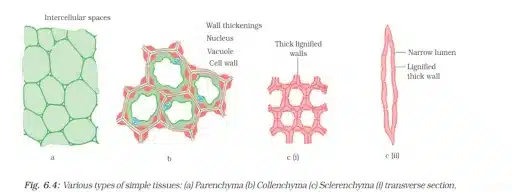
- Parenchyma: Living, thin walled cells with large spaces, primarily involved in food storage and basic metabolism.
- Chlorenchyma: Parenchyma containing chlorophyll, enabling photosynthesis in leaves and green stems.
- Aerenchyma: Parenchyma with large air cavities that aid buoyancy in aquatic plants.
- Collenchyma: Living cells with unevenly thickened corners, providing flexibility and mechanical support.
- Sclerenchyma: Dead cells with lignified walls, imparting hardness and strength to seeds, stems, and husks.
- Epidermis: Single layered protective tissue preventing water loss, mechanical injury, and pathogen entry.
- Stomata: Epidermal pores regulated by guard cells for gas exchange and transpiration.
- Root Hairs: Epidermal extensions increasing surface area for water and mineral absorption.
- Cork Tissue: Dead, compact cells with suberin, forming an impermeable protective layer in older stems.
2. Complex Permanent Plant Tissue
Complex Permanent Plant Tissues consist of different cell types working together for a common function. The diagram representing the Complex Permanent Tissue has been given here:

- Xylem: Conducts water and minerals upward using tracheids, vessels, parenchyma, and fibres.
- Tracheids and Vessels: Thick walled tubular cells that enable vertical water transport.
- Xylem Parenchyma: Stores food and assists lateral conduction.
- Xylem Fibres: Provide mechanical strength to vascular bundles.
- Phloem: Transports food from leaves to other plant parts.
- Sieve Tubes: Tubular cells with perforated walls allowing nutrient flow.
- Companion Cells: Regulate sieve tube function and metabolic control.
- Phloem Parenchyma: Stores food and supports transport processes.
- Phloem Fibres: Provide structural support and are the only dead cells in phloem.
Plant Tissue Functions
Plant Tissues collectively support growth, transport, protection, and metabolic efficiency essential for plant survival.
- Growth Regulation: Meristematic tissues ensure continuous growth throughout the plant’s life.
- Transport System: Xylem and phloem maintain internal circulation of water, minerals, and food.
- Mechanical Support: Collenchyma and sclerenchyma maintain plant posture and resistance.
- Photosynthesis: Chlorenchyma enables food production using sunlight.
- Protection: Epidermis and cork prevent dehydration and pathogen invasion.
- Storage: Parenchyma stores food, water, and metabolic products.

 Last updated on Sep, 2026
→ UPSC 2027 Notification will be released on 13 January 2027 at upsconline.nic.in.
→ Check out the latest UPSC Syllabus here.
→ Download UPSC Model Answers for Mains 2026
→ UPSC Mains Question Paper 2026 is out now for Essay & GS Paper 1, 2, 3 & 4.
→ UPSC Calendar 2027 has been released.
→ Enroll in Vajiram & Ravi’s UPSC Mains Test Series 2027 for structured answer writing practice, expert evaluation, and exam-oriented feedback.
→ Join Vajiram & Ravi’s UPSC Mentorship Program 2027 for personalized guidance, strategy planning, and one-to-one support from experienced mentors.
→ Go through the UPSC Mains Previous Year Papers to enhance your preparation.
→ UPSC has released UPSC Toppers List 2025 with the Civil Services final result on its official website.
→ Also check Best UPSC Coaching in India
Plant Tissue FAQs
Q1. What is Plant Tissue?+
Q2. Why are Plant Tissues important?+
Q3. What are the main types of Plant Tissues?+
Q4. Which Plant Tissue is responsible for growth?+
Q5. What is the function of Vascular Plant Tissues?+
Tags: plant tissue