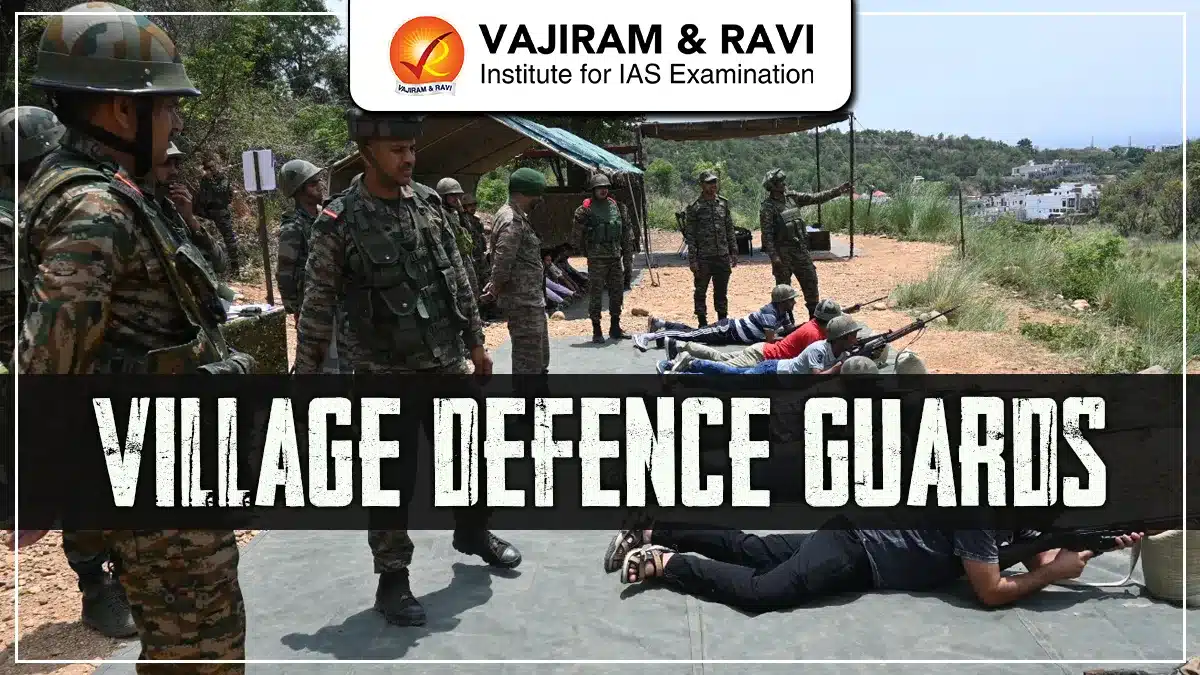
Village Defence Guards (VDGs) are community-based security volunteers deployed primarily in vulnerable and border regions to assist formal security forces. They act as the first line of defence against terrorism, infiltration, and local security threats. VDGs strengthen grassroots security by involving local citizens in safeguarding their villages. The concept has gained renewed importance in India’s internal security framework, especially in Jammu & Kashmir.
What are Village Defence Guards?
Village Defence Guards are trained civilian volunteers authorized to support police and security forces in maintaining law and order at the village level. They are usually provided with basic arms and security training to counter terrorist threats. VDGs function as an auxiliary force, not as a replacement for the police or armed forces. Their role is preventive, defensive, and intelligence-oriented.
Village Defence Guards Objectives
- Protection of Villages: Safeguard villages, especially in border and remote areas, from terrorist attacks, infiltration, and criminal activities.
- Early Warning Mechanism: Act as the first responders by identifying and reporting suspicious movements or security threats at the local level.
- Support to Security Forces: Assist police, Army, and paramilitary forces during search operations, patrols, and emergencies.
- Community Participation in Security: Encourage active involvement of local residents in maintaining law and order and village security.
- Intelligence Gathering: Provide ground-level intelligence due to their familiarity with local terrain, routes, and population.
- Deterrence Against Terrorism: Create a psychological deterrent against terrorists and anti-national elements through local vigilance.
- Strengthening Internal Security: Act as force multipliers to enhance the overall internal security framework of the region.


Village Defence Guards Composition
- Local Civilians: Mainly villagers from identified vulnerable areas who are familiar with the terrain and local population.
- Ex-Servicemen: Retired personnel from the Army, Central Paramilitary Forces (CPMF), or J&K Police to provide experience and leadership.
- Group Size: Each Village Defence Group consists of up to 15 members.
- Leadership: Each group is headed by a retired officer from the Army, CPMF, or J&K Police.
- Selection Process: Members are selected at the panchayat level based on recommendations and law enforcement assessment.
- Training: Members receive basic arms training and security skills from the CRPF or Army.
- Operational Control: VDGs function under the supervision of the District SP or SSP, ensuring coordination with formal security forces.
- Eligibility for Remuneration: All members, including the group head, are paid monthly to maintain motivation and continuity.
Role of VDGs in Internal Security and Counter-Terrorism
- First Line of Local Defence: VDGs act as the first responders in vulnerable villages where quick police or army deployment is difficult due to terrain or distance, helping deter surprise terrorist attacks.
- Intelligence Gathering: Their familiarity with local terrain and population enables them to identify and report suspicious movements and infiltration attempts, aiding security forces with timely information.
- Supporting Security Operations: They assist police and paramilitary units in search‑and‑cordon operations, perimeter security, and coordinated responses, acting as force multipliers.
- Enhanced Armed Capability: VDGs are equipped with modern weapons such as Self‑Loading Rifles (SLRs) instead of outdated .303 rifles, strengthening their capability to counter armed threats.
- Training by Security Forces: Members receive training from the Indian Army and CRPF in weapon handling, tactics, and surveillance to improve operational readiness in counter‑terrorism contexts.
- Data on Engagement: As per the Ministry of Home Affairs report, there are 4,153 Village Defence Groups (VDGs) active in Jammu & Kashmir, working alongside 32,355 Special Police Officers (SPOs) in varied roles including anti‑terror protection.
VDGs in Jammu & Kashmir Strategic Significance
- Border and Remote Area Security: VDGs protect villages located near the Line of Control (LoC) and other vulnerable border regions, acting as the first line of defence against infiltration and militant attacks.
- Force Multiplier for Security Forces: By assisting police, CRPF, and Army units in patrols, search-and-cordon operations, and emergency response, VDGs extend the operational reach of formal security forces in difficult terrains.
- Rapid Intelligence Gathering: Being locals, VDGs provide timely intelligence about suspicious movements, weapons smuggling, or potential threats, improving counter-terrorism efficiency.
- Community Integration and Trust: Their presence strengthens civilian cooperation with security agencies, fostering community-based vigilance and resilience against extremist elements.
- Protection of Key Infrastructure: VDGs safeguard villages, religious sites, schools, and critical public infrastructure, reducing the risk of sabotage or attacks on civilians.
- Psychological Deterrence: The visible deployment of VDGs discourages militants and anti-national actors from operating freely in remote areas.
Way Forward
To enhance the effectiveness of Village Defence Guards and strengthen grassroots security, several measures can be considered:
- Enhanced Training: Regular and advanced training programs should be provided, including modern counter-terrorism techniques, surveillance, and digital reporting tools, to improve operational readiness.
- Modern Equipment and Arms: VDGs should be equipped with modern firearms, protective gear, and communication devices to handle evolving security threats effectively.
- Welfare and Remuneration: Timely payment of salaries, insurance coverage, and other welfare measures will boost morale, retention, and professionalism among VDG members.
- Clear Standard Operating Procedures (SOPs): Well-defined operational guidelines and coordination mechanisms with police and paramilitary forces will ensure accountability and efficiency during operations.
- Community Engagement: Continuous awareness campaigns and local cooperation can strengthen community-based vigilance and improve intelligence inputs.
Technology Integration: Use of drones, surveillance cameras, and GIS-based monitoring can enhance real-time intelligence and response capabilities.

 Last updated on Sep, 2026
→ UPSC 2027 Notification will be released on 13 January 2027 at upsconline.nic.in.
→ Check out the latest UPSC Syllabus here.
→ Download UPSC Model Answers for Mains 2026
→ UPSC Mains Question Paper 2026 is out now for Essay & GS Paper 1, 2, 3 & 4.
→ UPSC Calendar 2027 has been released.
→ Enroll in Vajiram & Ravi’s UPSC Mains Test Series 2027 for structured answer writing practice, expert evaluation, and exam-oriented feedback.
→ Join Vajiram & Ravi’s UPSC Mentorship Program 2027 for personalized guidance, strategy planning, and one-to-one support from experienced mentors.
→ Go through the UPSC Mains Previous Year Papers to enhance your preparation.
→ UPSC has released UPSC Toppers List 2025 with the Civil Services final result on its official website.
→ Also check Best UPSC Coaching in India
Village Defence Guards FAQs
Q1. What are Village Defence Guards (VDGs)?+
Q2. When were VDGs launched?+
Q3. What is the composition of a Village Defence Group?+
Q4. What are the primary roles of VDGs?+
Q5. Under whose supervision do VDGs operate?+
Tags: village defence guards