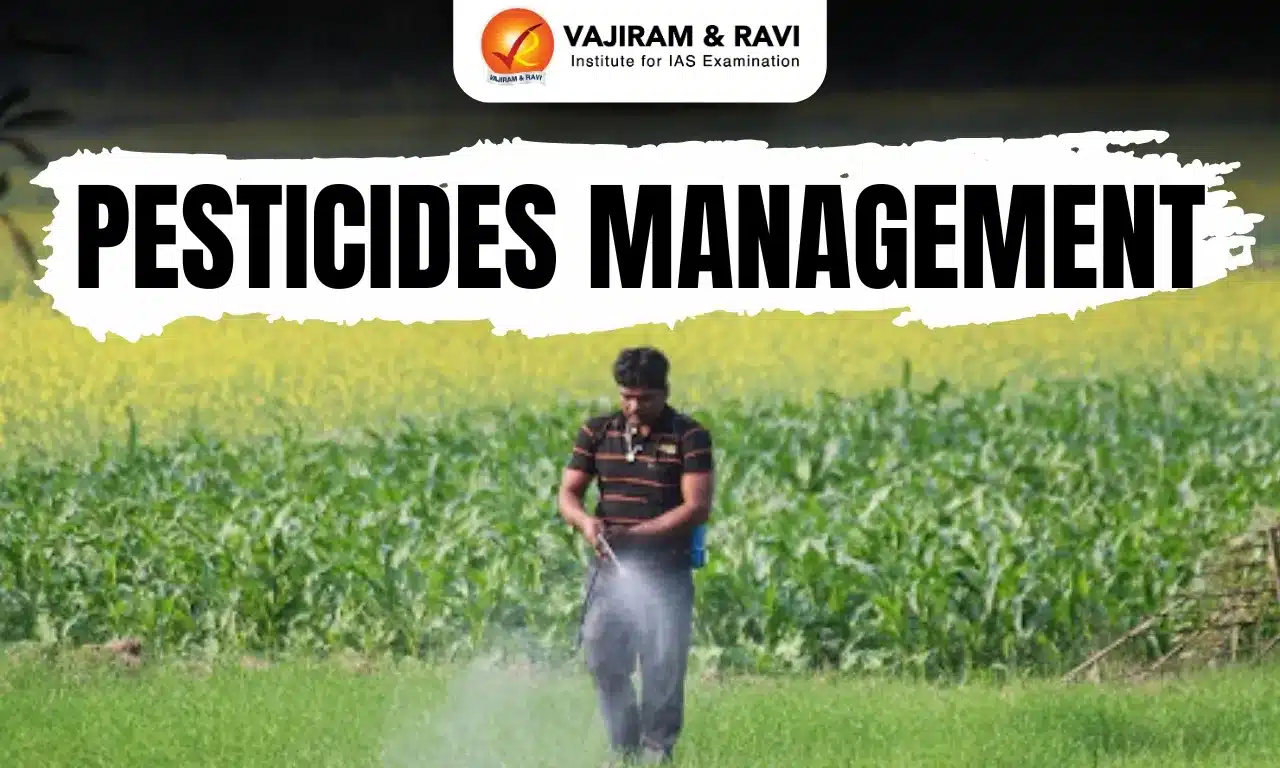
Pesticides Management Latest News
- The Union government has released a revised draft of the Pesticides Management Bill, 2025 and invited public feedback to modernise India’s pesticide regulation regime.
Background: Pesticide Regulation in India
- India’s pesticide regulation is currently governed by the Insecticides Act, 1968 and its accompanying rules, framed over five decades ago.
- This framework was designed at a time when chemical pest control was central to agricultural productivity, with limited awareness of environmental and health externalities. Over time, concerns have emerged regarding:
- Rising incidents of spurious and substandard pesticides
- Human health impacts, including farmer exposure and poisoning
- Environmental damage, especially contamination of soil and water bodies
- Weak enforcement and outdated regulatory mechanisms
- Recognising these challenges, successive governments have attempted to introduce comprehensive legislation to replace the Insecticides Act.
- Draft Bills were introduced in 2008, 2018, and 2020, but none could be enacted into law.


Overview of the Pesticides Management Bill, 2025
- The Pesticides Management Bill, 2025, is the latest attempt to overhaul India’s pesticide governance framework.
- It aims to regulate the manufacture, import, export, storage, sale, distribution, and use of pesticides in the country. Key stated objectives of the Bill include:
- Minimising risks to human beings, animals, and the environment
- Ensuring safe and effective use of pesticides
- Promoting transparency, traceability, and accountability
- Improving service delivery to farmers and enhancing ease of living
- The Bill proposes to repeal the Insecticides Act, 1968, thereby consolidating pesticide regulation under a modern legislative framework.
Institutional Architecture Under the Bill
- Registration Committee
- The Bill provides for a committee constituted by the Union government. It includes representatives from:
- Indian Council of Agricultural Research (ICAR)
- Drugs Controller General of India
- Ministry of Environment, Forest and Climate Change
- Department of Chemicals and Petrochemicals
- A national-level toxicology research institution
- This Committee is responsible for the registration of pesticides, reviewing safety concerns and examining temporary bans imposed by States
- The Bill provides for a committee constituted by the Union government. It includes representatives from:
- Central Pesticides Board
-
- A Central Pesticides Board is also envisaged to:
- Recommend pesticides for inclusion under the law
- Prescribe good manufacturing practices
- Frame protocols for pesticide recall
- Develop standard operating procedures for poisoning cases
- Lay down guidelines for the safe disposal of pesticides and packaging
- A Central Pesticides Board is also envisaged to:
Role of State Governments
- Under the proposed Bill, State governments have limited regulatory powers. They may:
- Temporarily prohibit the sale, distribution, or use of a pesticide or a specific batch
- Impose such a prohibition for a maximum period of one year
- However, any such notification must be reviewed by the Registration Committee, and States do not have independent long-term prohibition or punitive powers.
- This aspect has attracted criticism from experts and civil society groups.
Key Gaps and Concerns in the 2025 Draft
- Despite being labelled as a revised version, the 2025 draft introduces limited substantive changes compared to the 2020 draft. Major concerns include:
- Weakened legislative language: The Bill states it will “strive to minimise risk” instead of committing to “minimise risk”.
- Absence of criminal liability provisions: There are no clear provisions fixing criminal liability on manufacturers or distributors in cases of misuse, poisoning, or environmental damage.
- Limited State enforcement powers: States cannot permanently ban hazardous pesticides.
- No price regulation mechanism: The Bill does not address high pesticide pricing or farmer affordability.
- Weak grievance redressal framework: Clear compensation and liability mechanisms for affected farmers are missing.
- Experts argue that without strong enforcement and accountability, regulatory effectiveness may remain limited.
Consultation Process and Way Forward
- The government has invited public comments and stakeholder feedback on the draft Bill until February 2, 2026.
- This consultation phase is crucial given the Bill’s long legislative history and the persistent concerns raised by farmer groups, public health experts, and environmental organisations.
- The Bill also aligns with broader policy goals such as:
- Encouraging biological and traditional pest control methods
- Reducing dependence on hazardous chemical pesticides
- Strengthening farmer confidence through regulatory transparency
Source: TH | Down to Earth

 Last updated on Sep, 2026
→ UPSC 2027 Notification will be released on 13 January 2027 at upsconline.nic.in.
→ Asian Games 2026 are being held in Aichi-Nagoya, Japan, from 19 September to 4 October.
→ Check out the latest UPSC Syllabus here.
→ Download UPSC Model Answers for Mains 2026
→ UPSC Mains Question Paper 2026 is out now for Essay & GS Paper 1, 2, 3 & 4.
→ UPSC Calendar 2027 has been released.
→ Enroll in Vajiram & Ravi’s UPSC Mains Test Series 2027 for structured answer writing practice, expert evaluation, and exam-oriented feedback.
→ Join Vajiram & Ravi’s UPSC Mentorship Program 2027 for personalized guidance, strategy planning, and one-to-one support from experienced mentors.
→ Go through the UPSC Mains Previous Year Papers to enhance your preparation.
→ UPSC has released UPSC Toppers List 2025 with the Civil Services final result on its official website.
→ Also check Best UPSC Coaching in India
Pesticide Management FAQs
Q1. What law will the Pesticides Management Bill, 2025 replace?+
Q2. What is the primary objective of the Bill?+
Q3. Do State governments have full powers to ban pesticides under the Bill?+
Q4. Which bodies oversee pesticide regulation under the Bill?+
Q5. Why has the Bill attracted criticism?+
Tags: mains articles pesticides management upsc current affairs upsc mains current affairs