Age of Consent Latest News
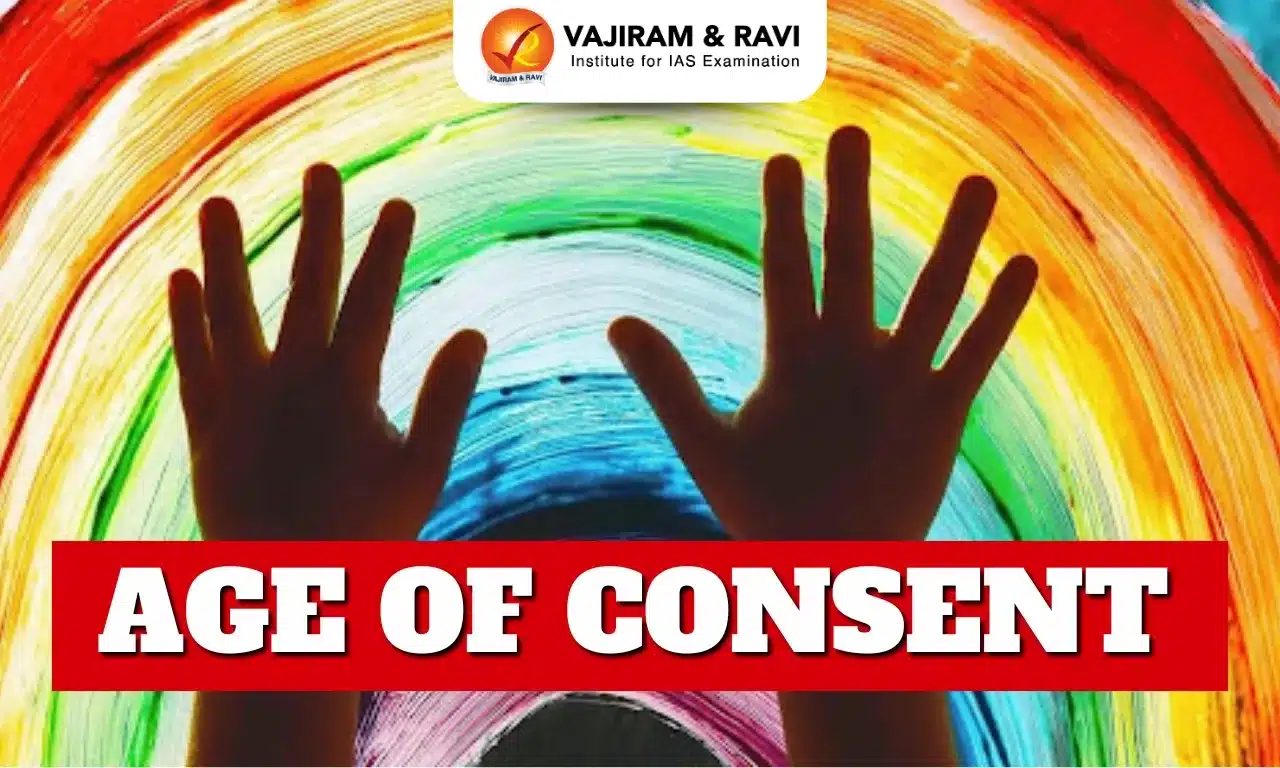
- The Supreme Court has flagged the misuse of the POCSO Act in consensual adolescent relationships, reopening the debate on India’s age of consent.
Legal Framework Governing the Age of Consent in India
- The age of consent refers to the legally defined age at which an individual is considered capable of giving valid consent for sexual activity.
- In India, this age is 18 years, as stipulated under the Protection of Children from Sexual Offences (POCSO) Act, 2012, which classifies anyone below 18 as a “child.”
- Consequently, any sexual activity involving a minor is treated as statutory rape, irrespective of consent.
- This position was reinforced by the Criminal Law (Amendment) Act, 2013, which aligned Section 375 of the Indian Penal Code with the POCSO threshold.
- The Bharatiya Nyaya Sanhita (BNS), 2023, has retained this framework, reaffirming that consent is legally irrelevant if the individual is below 18.
- Historically, India’s age of consent has evolved from 10 years (IPC, 1860) to 12 years (1891), then 14 and 16 years, before being raised to 18 years in 2012.
- It is distinct from the minimum age of marriage, which is 18 years for women and 21 years for men under the Prohibition of Child Marriage Act, 2006.


Arguments Supporting a Review of the Age of Consent
- A key driver of the current debate is the sharp rise in POCSO cases involving adolescents aged 16-18 years, often arising from consensual romantic relationships.
- In many such cases, the minor involved testifies that the relationship was voluntary, yet the law mandates criminal prosecution.
- Empirical data strengthen this concern. The NFHS-4 (2015-16) indicates that 39% of girls reported sexual debut before the age of 18.
- Further, studies by civil society organisations analysing thousands of POCSO judgments show that nearly one-fourth of cases involve consensual adolescent relationships, with a large majority of victims refusing to testify against the accused.
- Supporters of reform argue that the current law fails to acknowledge adolescent sexuality and autonomy, leading to the criminalisation of normal teenage relationships.
- They point out that the original intent of POCSO was to combat sexual abuse and exploitation, not to penalise peer relationships.
- Many also cite international practices, where several countries fix the age of consent at 16 years, often coupled with “close-in-age” or “Romeo-Juliet” exemptions to prevent misuse.
Concerns Against Lowering the Age of Consent
- Opponents of lowering the age of consent emphasise that the existing bright-line rule provides an unambiguous and uniform standard for child protection.
- Any dilution, they argue, risks creating loopholes that could be exploited by traffickers, abusers, and those in positions of trust.
- Evidence suggests that child sexual abuse is frequently perpetrated by known persons, family members, neighbours, teachers, or caregivers.
- A Ministry of Women and Child Development study (2007) found that over 50% of abusers were known to the child, raising concerns that claims of consent in such contexts may mask coercion or manipulation.
- Parliament has consistently upheld this protective approach.
- Multiple parliamentary committees and the Law Commission of India (283rd Report, 2023) have warned that reducing the age of consent could weaken POCSO and undermine efforts against child marriage, trafficking, and exploitation.
Judicial Responses and Emerging Nuances
- Courts have increasingly struggled to balance the letter of the law with the real-life consequences of its application.
- While several High Courts have acknowledged the need to view consensual adolescent relationships differently, they have also reiterated that, under POCSO, consent of a minor has no legal validity.
- The Supreme Court has reaffirmed this position, even while exercising extraordinary powers in select cases to mitigate harsh outcomes.
- Recent judicial observations suggest growing recognition of the trauma caused when consensual relationships are prosecuted, but without altering the statutory framework.
Way Forward
- The debate underscores the need for a calibrated legal response, rather than a binary choice between protection and autonomy.
- Many experts advocate limited close-in-age exemptions for adolescents aged 16-18, combined with judicial oversight to detect coercion or abuse.
- Beyond legal reform, long-term solutions lie in comprehensive sex education, accessible adolescent health services, and gender-sensitive policing.
- Strengthening social support systems can reduce misuse of the law while ensuring that genuine cases of abuse are addressed effectively.
Source: TH

 Last updated on August, 2026
→ UPSC Mains Question Paper 2026 is out now for Essay & GS Paper 1, 2, 3 & 4.
→ UPSC Mains GS Paper 1 2026 is out now.
→ UPSC Mains GS Paper 2 2026 is out now.
→ UPSC Mains GS Paper 3 2026 is out now.
→ UPSC Mains GS Paper 4 2026 is out now.
→ UPSC Mains Indian Language Paper & English Compulsory Paper are out now.
→ Check out the latest UPSC Syllabus 2026 here.
→ UPSC Mains Admit Card 2026 is now out.
→ Enroll in Vajiram & Ravi’s UPSC Mains Test Series 2027 for structured answer writing practice, expert evaluation, and exam-oriented feedback.
→ Join Vajiram & Ravi’s UPSC Mentorship Program 2027 for personalized guidance, strategy planning, and one-to-one support from experienced mentors.
→ Go through the UPSC Mains Previous Year Papers to enhance your preparation.
→ Download UPSC Mains Essay Paper 2025, UPSC Mains GS Paper-I 2025, UPSC Mains GS Paper-II 2025, UPSC Mains GS Paper-III 2025, UPSC Mains GS Paper-IV 2025, UPSC Mains English (Compulsory) Paper 2025, UPSC Mains Hindi (Qualifying) Paper 2025 here.
→ UPSC has released UPSC Toppers List 2025 with the Civil Services final result on its official website.
→ UPSC Calendar 2027 has been released.
→ Also check Best UPSC Coaching in India
Age of Consent FAQs
Q1. What is the current age of consent in India?+
Q2. Why has the age of consent debate resurfaced?+
Q3. Does Indian law recognise consent of minors?+
Q4. What are ‘close-in-age’ exemptions?+
Q5. Who has the authority to change the age of consent?+
Tags: age of consent mains articles upsc current affairs upsc mains current affairs