India-Germany Strategic Partnership Latest News
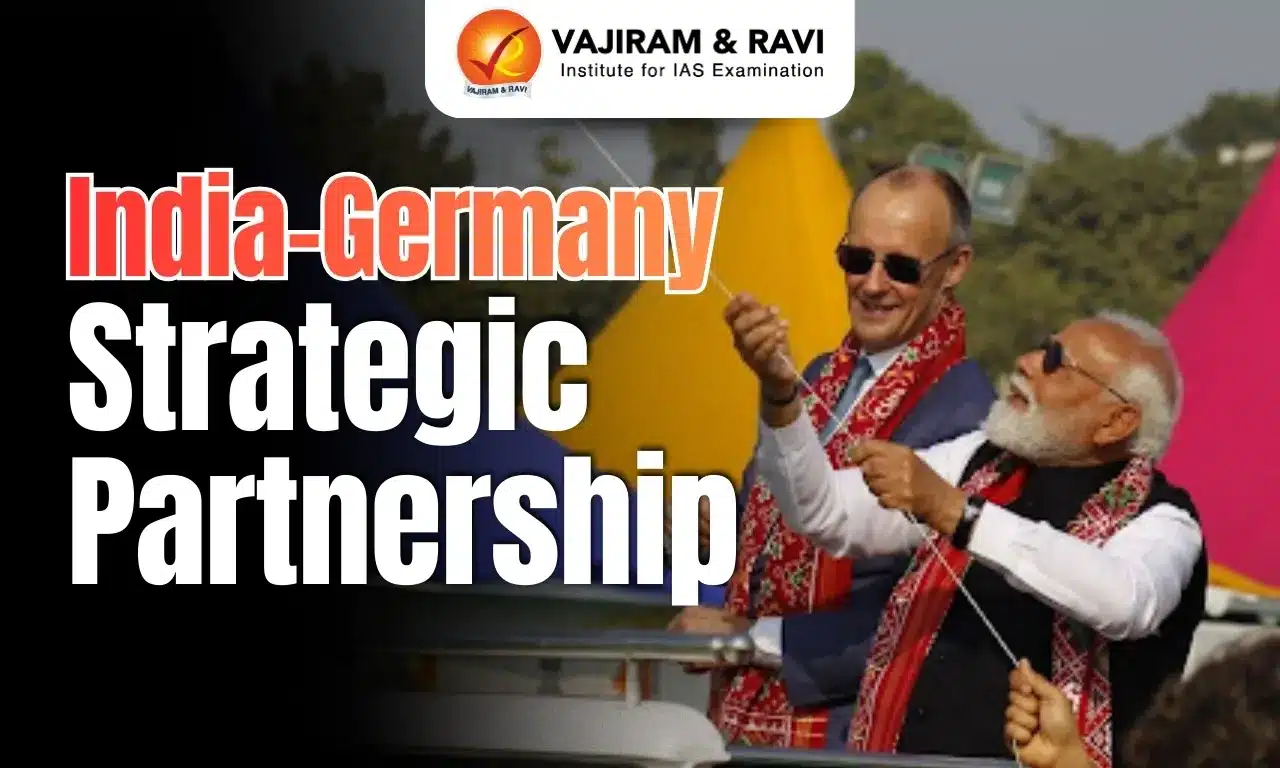
- German Chancellor Friedrich Merz’s first visit to India and Asia coincides with 25 years of India–Germany Strategic Partnership and 75 years of diplomatic relations.
- The visit precedes the EU leaders’ visit for India’s Republic Day and the India–EU Summit.
- Outcome-driven diplomacy with the signing of 19 agreements/MoUs, signalling deepening strategic, economic and geopolitical convergence.
Key Outcomes of the Visit
- 19 bilateral pacts signed, covering:
- Defence industrial cooperation
- Higher education and global skills
- Critical minerals and semiconductors
- Indo-Pacific dialogue
- Renewable energy and green hydrogen
- Visa-free transit regime for Indian passport holders transiting through German airports.
- Announcement of a new bilateral Indo-Pacific consultation mechanism.


Major Areas of Cooperation
- Strategic and defence cooperation:
- Key developments:
- Joint Declaration of Intent (JDoI) on a Defence Industrial Cooperation Roadmap.
- Focus on: Co-development and co-production, technology partnerships, and faster defence export clearances from Germany.
- Ongoing defence collaboration: Submarines, obstacle avoidance systems for helicopters, Counter-Unmanned Aerial Systems (C-UAS), joint Air Force and Naval exercises, port visits and new security consultation formats.
- Strategic significance:
- Defence indigenisation, Atmanirbhar Bharat, strategic autonomy, and co-production.
- Reduces India’s defence dependence on Russia, and leverages –
- India’s skilled workforce and cost advantage
- Germany’s advanced technology and capital
- Key developments:
- Higher education and global skills partnership: It focuses on human capital, skill mobility, aligning with NEP 2020, and demographic dividend, with following initiatives –
- Comprehensive roadmap on higher education: India invited German universities to open campuses in India.
- Global skills partnership (JDoI): Facilitates mobility of healthcare professionals.
- Proposal to expand German language teaching in: Schools, Universities, and Vocational institutions.
- New initiative: Indo-German Centre of Excellence for Skilling in Renewable Energy – curriculum development, industry collaboration, job-market-oriented training.
- Economic and trade relations:
- It focuses on supply chain resilience, Trade diversification, and FTA diplomacy. Bilateral trade between India and Germany crossed USD 50 billion in 2024 (over 25% of India–EU trade).
- Strong two-way investments supporting supply chain diversification, SMEs, startups, digitalisation, AI, and innovation.
- Institutional mechanism – Strengthening cooperation via the German–Indian CEO Forum.
- FTA push: Strong support for concluding the India–EU Free Trade Agreement, seen as a key deliverable of the upcoming EU–India Summit.
- Critical and emerging technologies:
- Focus areas: Semiconductors, critical minerals, telecommunications, digitalisation and AI, health and bioeconomy.
- Key institutional steps: JDoI on Semiconductor Ecosystem Partnership, JDoI on Critical Minerals Cooperation, Indo-German Digital Dialogue Work Plan (2026–27), and JDoI on Telecommunications.
- Strategic importance:
- Trusted supply chains, critical technologies, and digital sovereignty – reducing dependence on China-dominated supply chains.
- Supporting India’s ambitions in electronics manufacturing and Industry 4.0.
- Climate, energy and sustainability:
- Establishment of India–Germany Centre of Excellence in Renewable Energy.
- Joint projects in climate action, urban development and mobility, and green hydrogen (mega project).
- Strategic alignment – Clean energy transition, climate diplomacy (climate finance and technology transfer), and long-term energy security.
- Indo-Pacific and global geopolitics:
- Reaffirmed commitment to Free and Open Indo-Pacific, UNCLOS and international law.
- Germany’s growing engagement under the Indo-Pacific Oceans Initiative (IPOI) (co-led by India & Germany).
- Global Issues discussed:
- Ukraine war: Support for a just and lasting peace under the UN Charter.
- Gaza conflict: Support for a negotiated two-state solution.
- Strong condemnation of terrorist attacks in Pahalgam and Delhi.
- Multilateral cooperation (Global governance reforms, Multilateralism, G4): Renewed commitment to UN Security Council (UNSC) reforms. Continued coordination through the G4 group (India, Germany, Japan, Brazil).
Current State of India-Germany Relations
- Institutional architecture: The Inter-Governmental Consultations (IGC) mechanism—used by Germany with only a few select partners—anchors policy coordination and makes India–Germany ties among the most institutionalised in Europe–India relations.
- Trade and investment depth: While over 2,000 German companies operate in India, supporting around 4 lakh jobs; Indian investments in Germany have crossed €6.5 billion, reflecting two-way economic interdependence.
- Project 75I Submarine Programme: The project involves AIP-enabled submarines, over 60% indigenisation, major technology transfer, and is central to India’s Indian Ocean deterrence strategy amid China’s naval expansion.
- Science & technology legacy: India and Germany marked 50 years of formal S&T cooperation in 2024, which is now being scaled up to strategic domains such as quantum tech, cybersecurity, biotech and AI.
- Green financing commitment: Under the Green and Sustainable Development Partnership (2022), Germany has committed up to €10 billion till 2030 for India’s green transition.
- Mobility and migration framework: The Comprehensive Migration and Mobility Partnership (2022) and Germany’s Skilled Immigration Act have made Germany a major destination for Indian talent, with –
- Around 2.8 lakh Indians residing in Germany (2025)
- India as the largest source of international students in Germany (over 42,000 students)
- Special focus on healthcare, STEM and technical professionals
- Essence of India–Germany relations today: It rests on a deeply institutionalised, multi-layered partnership, positioning Germany as India’s most consequential partner within the European Union.
Challenges and Way Ahead
- No concrete breakthrough yet on submarine deal: Operationalise defence industrial roadmap with flagship co-production projects.
- Divergences on some geopolitical issues persist: Deepen Indo-Pacific coordination amid rising great power competition.
- Translating MoUs into time-bound implementation: Institutionalise semiconductor and critical minerals cooperation.
- Aligning EU regulatory standards with Indian market realities: Fast-track India–EU FTA conclusion.
- Slow education and skills partnership: Expand German educational presence under NEP 2020. Ensure skill mobility agreements are mutually beneficial and ethical.
Conclusion
- The Merz–Modi summit marks a qualitative upgrade of the India–Germany Strategic Partnership, moving beyond trade to encompass strategic sectors like defence manufacturing.
- As global geopolitics undergoes rapid realignment, India and Germany emerge as natural partners anchored in shared democratic values, economic complementarities and a commitment to a rules-based international order—making this partnership a key pillar of India’s Europe and Indo-Pacific strategy.

 Last updated on Oct, 2026
→ UPSC 2027 Notification will be released on 13 January 2027 at upsconline.nic.in.
→ Check Nobel Prize 2026 Winners List here.
→ Download PIB PRiSM Monthly Magazine 2026 here.
→ Check UPSC Monthly Current Affairs Magazine The Recitals here.
→ Check out the latest UPSC Syllabus here.
→ Download UPSC Model Answers for Mains 2026
→ UPSC Mains Question Paper 2026 is out now for Essay & GS Paper 1, 2, 3 & 4.
→ UPSC Calendar 2027 has been released.
→ Enroll in Vajiram & Ravi’s UPSC Mains Test Series 2027 for structured answer writing practice, expert evaluation, and exam-oriented feedback.
→ Join Vajiram & Ravi’s UPSC Mentorship Program 2027 for personalized guidance, strategy planning, and one-to-one support from experienced mentors.
→ Go through the UPSC Mains Previous Year Papers to enhance your preparation.
→ UPSC has released UPSC Toppers List 2025 with the Civil Services final result on its official website.
→ Also check Best UPSC Coaching in India
India–Germany Strategic Partnership FAQs
Q1. How does the India–Germany defence industrial cooperation roadmap support India’s strategic autonomy?+
Q2. What is the significance of the India–Germany Global Skills Partnership?+
Q3. Why is cooperation on critical minerals and semiconductors strategically important for India–Germany relations?+
Q4. In what ways does India–Germany cooperation contribute to a free and open Indo-Pacific?+
Q5. How does the deepening India–Germany partnership strengthen India–EU economic relations?+
Tags: India-Germany Strategic Partnership mains articles upsc current affairs upsc mains current affairs