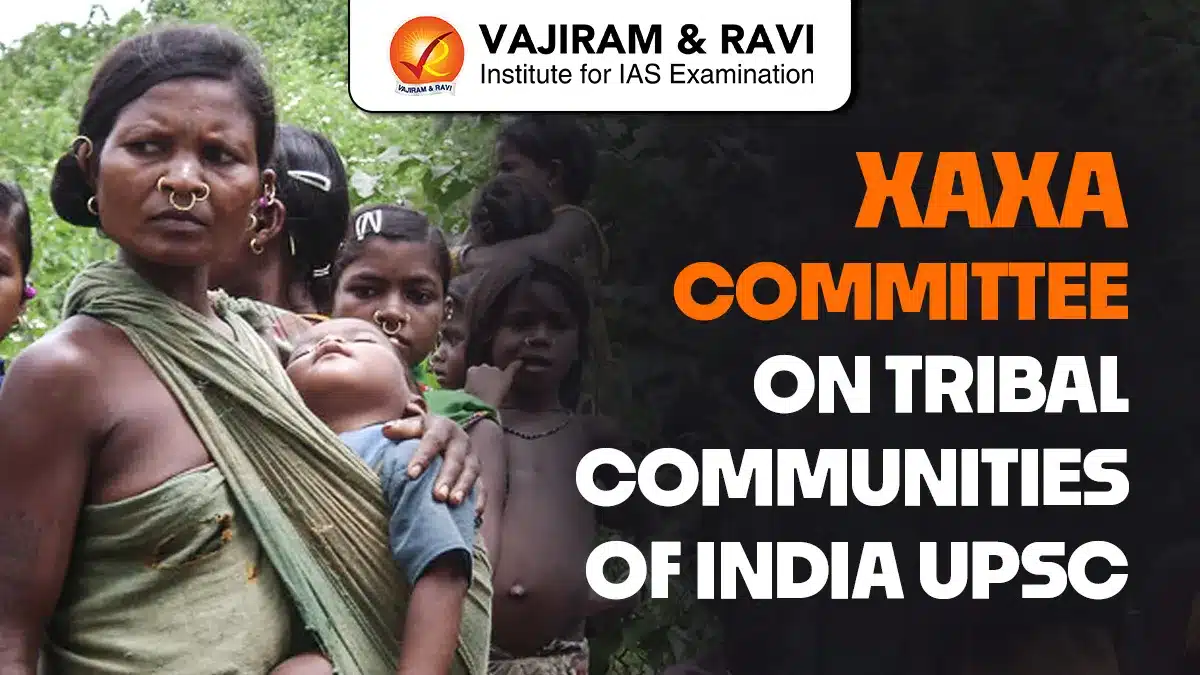
The Xaxa Committee on Tribal Communities of India was a High Level Committee constituted by the Prime Minister’s Office on 14 August 2013 under the chairmanship of Prof. Virginius Xaxa to comprehensively examine the socio-economic, educational and health status of Scheduled Tribes in India. The Committee was mandated to assess persistent development gaps, analyse constitutional and legal safeguards, study livelihood patterns, displacement, governance failures and public service delivery and to recommend concrete, outcome oriented measures. It submitted its detailed report on 29 May 2014 after extensive consultations, multiple meetings and sector wise analysis, highlighting why tribal communities, constituting 8.6% of India’s population as per Census 2011, remain among the most disadvantaged despite decades of planned development.
Xaxa Committee on Tribal Communities of India Organization Structure
The Xaxa Committee on Tribal Communities of India was structured as a multidisciplinary expert body combining academic, legal, health and administrative expertise to ensure a holistic assessment of tribal issues.
- Chairmanship by Prof. Virginius Xaxa: Renowned sociologist and tribal studies scholar, he provided academic leadership and ensured sociological depth in analysing tribal marginalisation.
- Academic and Legal Members: Dr. Usha Ramanathan and Dr. Kamal K. Misra contributed constitutional, legal and anthropological perspectives on tribal rights and governance.
- Social and Development Experts: Dr. Joseph Bara and Ms. Sunila Basant added insights on development administration, social justice and policy implementation.
- Public Health Expertise: Dr. Abhay Bang brought ground level understanding of tribal health challenges, malnutrition, mortality and healthcare delivery gaps.
- Administrative Coordination: Secretary, Ministry of Tribal Affairs acted as Member Secretary, ensuring data access, inter-ministerial coordination and official facilitation.
- Working Modality: The Committee conducted eleven formal meetings between September 2013 and May 2014, enabling sector wise discussions and consensus building.
Xaxa Committee on Tribal Communities of India Objectives
The objectives of Xaxa Committee on Tribal Communities of India focused on preparing an evidence based position paper and proposing actionable reforms for tribal development.
- Assessment of Socio-Economic Status: To analyse livelihood patterns, poverty levels and employment conditions of Scheduled Tribes across regions.
- Evaluation of Education and Health Indicators: To study literacy, dropout rates, fertility, mortality, disease burden and healthcare access among tribal populations.
- Review of Legal and Constitutional Safeguards: To examine implementation gaps in Fifth Schedule, Sixth Schedule, PESA 1996 and Forest Rights Act 2006.
- Analysis of Displacement and Migration: To assess the impact of mining, dams, industries and infrastructure on tribal land alienation and forced migration.
- Strengthening Public Service Delivery: To suggest policy initiatives and institutional reforms for effective, participatory and outcome oriented governance.


Xaxa Committee on Tribal Communities of India Historical Background
The Xaxa Committee on Tribal Communities of India had emerged from a long history of tribal marginalisation rooted in colonial and post independence development trajectories.
- Colonial Legacy: British policies such as Regulation XIII of 1833 and Inner Line Regulation 1873 isolated tribal areas while facilitating resource extraction.
- Constitutional Recognition: After independence, tribes were reclassified as Scheduled Tribes under Article 342, with special protections under Fifth and Sixth Schedules.
- Committee Based Reforms: Earlier bodies like Dhebar, Lokur and Bhuria Committees addressed land alienation, development and governance, with mixed outcomes.
- Persistent Development Gaps: Despite Tribal Sub-Plan and welfare schemes, poverty, displacement and exclusion continued in tribal dominated regions.
- Need for Reassessment: By 2013, rising conflicts, Left Wing Extremism and failure of service delivery necessitated a fresh, comprehensive review.
Xaxa Committee on Tribal Communities of India Observations
The Xaxa Committee on Tribal Communities of India made extensive observations across demographic, economic, social, legal and governance dimensions.
- Demographic Profile: Scheduled Tribes numbered 10.42 crore in Census 2011, forming 8.6% of India’s population and living across 15% of land area.
- Regional Concentration: Over 55% of tribals reside in central and eastern states like Madhya Pradesh, Maharashtra, Odisha, Jharkhand and Chhattisgarh.
- Livelihood Dependence: More than 80% of tribal workers are engaged in the primary sector, compared to 53% of the general population.
- Poverty Levels: In 2011-12, 45.3% of Scheduled Tribes lived below the poverty line, significantly higher than the national average.
- Resource Rich but Poor Regions: States like Odisha and Jharkhand hold 60-80% of key minerals yet record the highest tribal poverty ratios.
- Displacement Burden: Around 40% of people displaced by dams belong to Scheduled Tribes, despite forming only eight% of the population.
- Forest Alienation: Nearly 60% of India’s forest cover lies in tribal areas, yet tribals were treated as encroachers before FRA 2006.
- Education Deficits: Tribal literacy was just 3.46% in 1951 and dropout rates at secondary levels exceeded 70% by 2010-11.
- Language Barriers: Less than one% of tribal children receive education in their mother tongue, affecting learning outcomes and retention.
- Health Inequalities: Despite a favourable sex ratio of 990, tribals suffer higher malnutrition, IMR, malaria, tuberculosis and sickle cell prevalence.
- PVTG Vulnerability: Seventy five PVTGs, including Sentinelese and Dongria Khond, face declining populations and extreme livelihood insecurity.
- Governance Failures: Tribes Advisory Councils under Fifth Schedule function as advisory bodies without real decision making power or accountability.
- Conflict and LWE: Forty two of 83 LWE affected districts fall in Scheduled Areas, reflecting neglect, displacement and trust deficit with the State.
- Legal Subversion: Laws protecting tribal land and forests are frequently bypassed to facilitate corporate mining and infrastructure projects.
- Assimilation over Integration: The State’s approach often erodes tribal identity instead of supporting constitutionally promised integration with safeguards.
Xaxa Committee on Tribal Communities of India Recommendations
The Xaxa Committee on Tribal Communities of India proposed detailed, rights based and participatory recommendations across sectors.
- Livelihood Diversification: Establish agro-based training institutes and labour intensive processing units in tribal regions to reduce distress migration.
- Forest Based Economy: Promote eco-forestry, organic farming and use of traditional knowledge to generate sustainable incomes for tribal households.
- Land Protection: Strictly enforce land transfer laws, restore alienated land and ensure Gram Sabha consent under PESA and FRA provisions.
- Displacement Minimisation: Adopt a rights based rehabilitation approach and return unutilised acquired land to original tribal owners.
- Education Reform: Implement multilingual education, recruit local teachers and integrate tribal culture, folklore and history into curricula.
- Residential School Oversight: Expand Ashram Schools and Eklavya Model Schools while enforcing strong safeguards against abuse and neglect.
- Health Governance: Establish Tribal Health Assemblies and Councils from village to national level for participatory planning and monitoring.
- Local Health Workforce: Recruit and train tribal youth as healthcare workers committed to serving Scheduled Areas for long durations.
- PVTG Protection: Grant habitat rights under FRA, clarify procedures and extend Fifth Schedule protections to PVTG dominated regions.
- Strengthening Gram Sabhas: Empower Gram Sabhas as core institutions for decision making, consent, monitoring and social accountability.
- Autonomous Governance: Extend Sixth Schedule like autonomous councils to Fifth Schedule areas for genuine self governance.
- Resource Allocation: Allocate at least 8.6% of health and development budgets proportionate to tribal population share.
- Conflict Resolution: Address historical injustices, ensure justice delivery and rebuild trust to counter Left Wing Extremism sustainably.
- Women’s Representation: Ensure effective participation of tribal women in Gram Sabhas, land decisions and forest governance.
- Institutional Accountability: Strengthen monitoring mechanisms, independent evaluation and transparency in tribal development programmes.

 Last updated on Sep, 2026
→ UPSC 2027 Notification will be released on 13 January 2027 at upsconline.nic.in.
→ Check out the latest UPSC Syllabus here.
→ Download UPSC Model Answers for Mains 2026
→ UPSC Mains Question Paper 2026 is out now for Essay & GS Paper 1, 2, 3 & 4.
→ UPSC Calendar 2027 has been released.
→ Enroll in Vajiram & Ravi’s UPSC Mains Test Series 2027 for structured answer writing practice, expert evaluation, and exam-oriented feedback.
→ Join Vajiram & Ravi’s UPSC Mentorship Program 2027 for personalized guidance, strategy planning, and one-to-one support from experienced mentors.
→ Go through the UPSC Mains Previous Year Papers to enhance your preparation.
→ UPSC has released UPSC Toppers List 2025 with the Civil Services final result on its official website.
→ Also check Best UPSC Coaching in India
Xaxa Committee on Tribal Communities of India FAQs
Q1. When was the Xaxa Committee on Tribal Communities of India constituted?+
Q2. Who chaired the Xaxa Committee on Tribal Communities of India?+
Q3. What was the main purpose of the Xaxa Committee on Tribal Communities of India?+
Q4. When did the Xaxa Committee on Tribal Communities of India submit its report?+
Q5. Why is the Xaxa Committee on Tribal Communities of India report important?+
Tags: xaxa committee on tribal communities of india