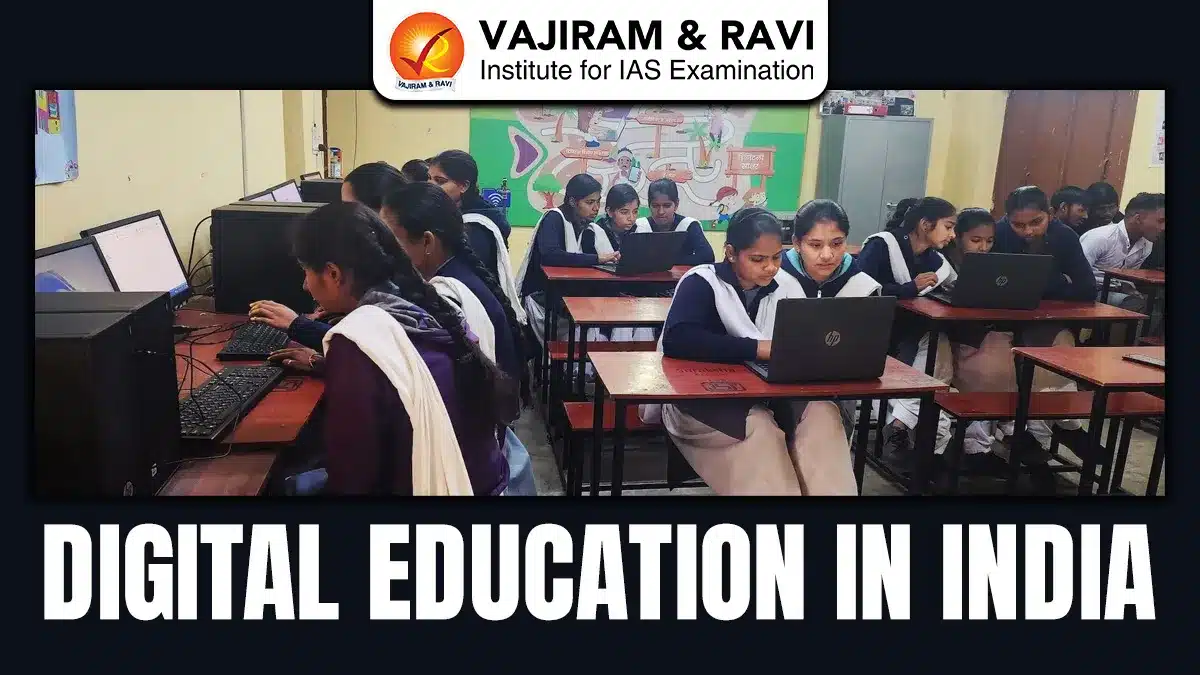
Digital Education in India has emerged as a transformative force reshaping how knowledge is delivered, accessed and consumed across the country. Driven by the Digital India campaign and accelerated by the COVID 19 pandemic, education has moved beyond physical classrooms into virtual, technology enabled spaces. With rising mobile penetration, expanding internet infrastructure and government led digital platforms, learning has become more flexible and scalable. However, deep structural challenges like digital divide, infrastructure gaps and lack of standardisation continue to influence outcomes, making reforms and inclusive strategies essential.
Digital Education in India Features
Digital Education in India refers to technology enabled teaching learning systems using internet, ICT tools and digital platforms to deliver education beyond classrooms.
- Concept and Scope: Digital education includes online classes, virtual labs, e-content, MOOCs and digital repositories using internet enabled devices for teaching and learning at all levels.
- Growth After Pandemic: School and higher education institutions rapidly adopted online platforms during COVID 19, making digital learning a necessity rather than an option nationwide.
- Mobile Based Learning: High mobile phone penetration enabled students to access educational content through smartphones, especially via government platforms like DIKSHA and SWAYAM.
- Role of Digital India: The Digital India programme provided policy backing and infrastructure focus, integrating education with digital governance and service delivery mechanisms.
- Integration with NEP 2020: The National Education Policy 2020 formally recognised technology as a key enabler for access, equity and quality in education.
- Urban Rural Divide: While urban learners benefited faster due to better connectivity, rural adoption remains uneven due to infrastructure and affordability constraints.
- Shift in Pedagogy: Teaching moved from chalk and talk methods to multimedia based learning using videos, simulations, quizzes and interactive digital tools.
- Platform Based Learning: Government supported platforms reduced dependence on private providers and ensured free access to standardised, curriculum aligned content.
Digital Education in India Significance
Digital Education in India is significant because it expands access, improves flexibility, reduces costs and supports inclusive learning across diverse socio-economic groups.
- Expanding Accessibility: Digital platforms help overcome geographical barriers, enabling students in remote and rural areas to access quality educational resources.
- Flexible Learning Models: Students can learn at their own pace and time, benefiting working professionals and learners with non traditional educational pathways.
- Cost Reduction: Digital resources reduce expenditure on physical infrastructure, travel and printed materials, making education more affordable.
- Mass Outreach Capacity: Online platforms can reach millions of learners simultaneously, addressing shortages of teachers and institutions.
- Inclusive Education: Digital tools support learners with disabilities through audio content, screen readers, subtitles and adaptive learning formats.
- Skill Oriented Learning: Technology supports Education 4.0 by aligning learning with skills required for automation, AI and digital economy.
- Teacher Capacity Building: Platforms like DIKSHA enable continuous professional development and nationwide teacher training at scale.
- Knowledge Democratisation: Open access digital libraries and MOOCs ensure equal availability of learning materials irrespective of socio-economic background.


Digital Education in India Initiatives
The government has launched multiple digital initiatives to ensure equitable access, quality content and nationwide reach of Digital Education in India.
- DIKSHA Platform: A national digital infrastructure providing curriculum aligned content for teachers and students, supporting multilingual and interactive learning.
- SWAYAM Portal: Offers free MOOCs from school to postgraduate level, developed by premier institutions, allowing certification through proctored examinations.
- SWAYAM Prabha: Uses 34 DTH television channels to broadcast educational content, supporting learners without internet connectivity.
- PM eVidya Programme: A multimodal initiative integrating digital platforms, TV, radio and podcasts to ensure uninterrupted learning nationwide.
- National Digital Library: Hosts millions of books, articles, videos and learning materials accessible to students across disciplines and levels.
- Virtual Labs: Enables students to perform simulated experiments remotely, especially beneficial for institutions lacking physical laboratory infrastructure.
- NPTEL: Provides engineering, science and management courses through IITs and IISc, enhancing quality higher education access.
- NKN Network: A multi gigabit research and education network connecting universities and research institutions for collaborative knowledge creation.
Digital Education in India Challenges
Digital education faces structural, social and infrastructural challenges that limit its reach, quality and inclusiveness.
- Lack of Proper Study Space: Census 2011 shows 71% households with three or more members have two rooms or less, affecting learning environment.
- Low Internet Penetration: NSS 2017-18 reports only 42% urban and 15% rural households had internet access, excluding two-thirds children.
- Usage Gap: Only 34% urban and 11% rural individuals used the internet recently, limiting effective participation in online education.
- Slow Internet Speed: Online classes require stable high speed internet, absence of which disrupted learning, as seen in Jammu and Kashmir protests.
- Digital Divide: Marginalised, rural and poor populations remain disproportionately excluded from digital education benefits.
- Absence of Standard Policy: India lacks a comprehensive policy covering platforms, pedagogy, content curation, multilingual delivery and interactivity.
- Teacher Training Gaps: Teachers are insufficiently trained in online pedagogy and digital tools, affecting instructional quality.
- Loss of Social Cohesion: Schools promote social inclusion and equality, which purely online education struggles to replicate effectively.
- Parenting Challenges: Working parents face difficulties ensuring child safety, discipline and learning continuity at home.
- Emotional Development Issues: Online education limits emotional, social and behavioural learning traditionally supported by physical schooling.
Digital Education in India Reforms
Strategic investments, inclusive policies and institutional reforms are essential to make Digital Education in India equitable, effective and sustainable.
- BharatNet Expansion: BharatNet aims to connect 2.5 lakh Gram Panchayats with 100 Mbps bandwidth, enabling rural access to e-learning services.
- National Knowledge Network Integration: NKN should be mainstreamed under Digital India to deliver education services to economically weaker sections.
- Increased Public Financing: NEP 2020 proposes increasing education expenditure to 6% of GDP to strengthen digital infrastructure.
- Teacher and Parent Training: Large scale digital literacy programmes are needed to equip teachers and parents with essential technological skills.
- Device Accessibility: Government support for smartphones, tablets and laptops is necessary to ensure universal access to online education.
- Inclusive Design: Digital platforms must address needs of disabled learners, low income groups and regional language users.
- Blended Learning Models: Combining online tools with face to face teaching can preserve social learning while leveraging technology benefits.
- Free Public Platforms: Government must ensure free, high quality digital content to prevent commercial exclusion and inequality.
- Policy Standardisation: A national digital education policy covering curriculum, pedagogy, quality assurance and multilingual delivery is essential.
- Long Term Transition Strategy: Digital education should supplement classroom teaching gradually through multi pronged, inclusive reforms.

 Last updated on Oct, 2026
→ UPSC 2027 Notification will be released on 13 January 2027 at upsconline.nic.in.
→ Check Nobel Prize 2026 Winners List here.
→ Download PIB PRiSM Monthly Magazine 2026 here.
→ Check UPSC Monthly Current Affairs Magazine The Recitals here.
→ Check out the latest UPSC Syllabus here.
→ Download UPSC Model Answers for Mains 2026
→ UPSC Mains Question Paper 2026 is out now for Essay & GS Paper 1, 2, 3 & 4.
→ UPSC Calendar 2027 has been released.
→ Enroll in Vajiram & Ravi’s UPSC Mains Test Series 2027 for structured answer writing practice, expert evaluation, and exam-oriented feedback.
→ Join Vajiram & Ravi’s UPSC Mentorship Program 2027 for personalized guidance, strategy planning, and one-to-one support from experienced mentors.
→ Go through the UPSC Mains Previous Year Papers to enhance your preparation.
→ UPSC has released UPSC Toppers List 2025 with the Civil Services final result on its official website.
→ Also check Best UPSC Coaching in India
Digital Education in India FAQs
Q1. What is Digital Education in India?+
Q2. Why is Digital Education important for India?+
Q3. Which government platforms support Digital Education in India?+
Q4. What is the biggest challenge of Digital Education in India?+
Q5. How can Digital Education be improved in India?+
Tags: digital education digital education in india