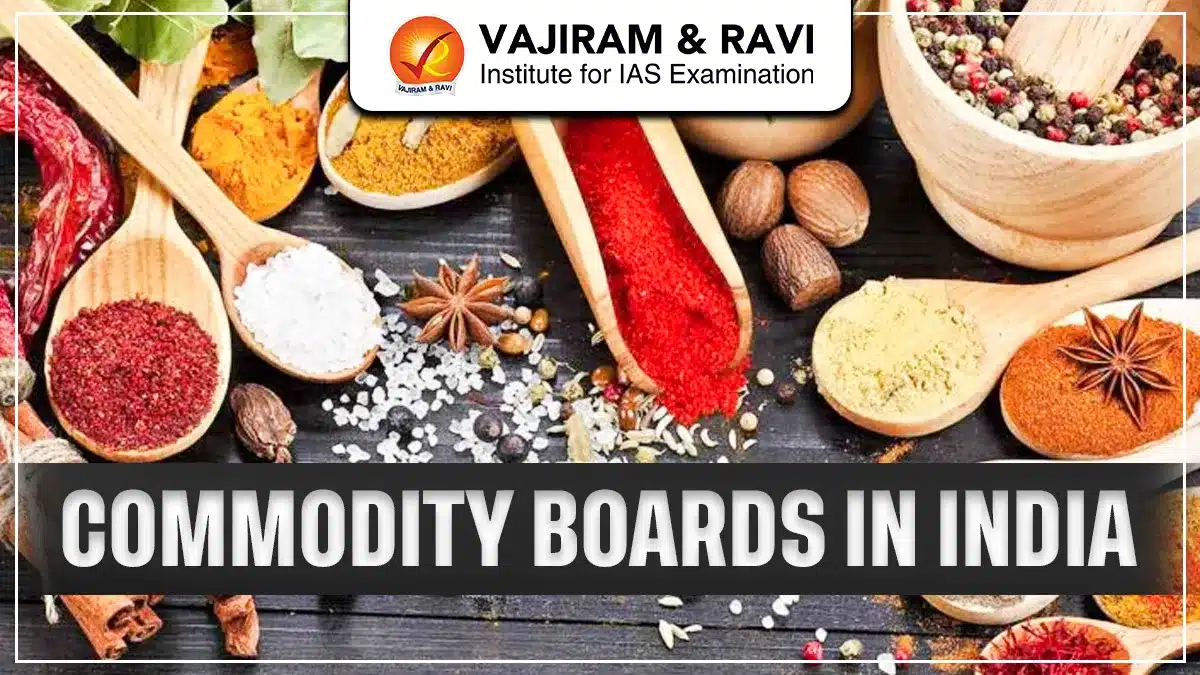
Commodity Boards in India are specialised institutions set up to promote and regulate agricultural and plantation commodities. Their main objectives are to support farmers, improve quality, and enhance exports of Indian products.
These boards work closely with farmers, processors, traders, and exporters. They provide technical guidance, financial assistance, and market intelligence so that Indian commodities can compete effectively in global markets.
What are Commodity Boards in India?
Commodity Boards in India are autonomous organizations set up to look after the overall growth of specific agricultural and plantation crops. They operate mainly under the Ministry of Commerce and Industry and are responsible for promoting production, regulating quality, supporting marketing, and expanding exports.
Commodity Boards in India Objectives
Commodity Boards in India aim to promote the balanced growth, quality improvement, and global competitiveness of India’s key agricultural and plantation commodities.
- To increase the production and productivity of specific crops through modern farming practices
- To promote exports and enhance India’s share in global agricultural markets
- To maintain and improve quality standards for domestic and international trade
- To support research, development, and innovation in crop cultivation and processing
- To provide technical and financial assistance to farmers and growers
- To create better market linkages between producers, processors, and exporters
- To ensure fair and remunerative prices for farmers
- To encourage value addition and branding of Indian agricultural products


Major Commodity Boards in India
India has several Commodity Boards that focus on the development, promotion, and export of important agricultural and plantation crops. These boards support farmers, improve quality, and help Indian products compete in global markets. Major Commodity Boards in India have been discussed below in detail.
1. Tea Board of India
- The Tea Board of India was established in 1954 under the provisions of the Tea Act, 1953.
- It is governed by a Chairman and a 30-member board, representing various stakeholders of the tea industry.
- The headquarters of the Tea Board is located in Kolkata, West Bengal.
- It has two zonal offices to manage regional operations:
- One in Jorhat, Assam for the North-Eastern tea-growing region
- One in Coonoor, Tamil Nadu for the Southern tea belt
- The Tea Board promotes Indian tea in domestic and international markets through branding and marketing initiatives.
- It provides financial and technical assistance to tea growers and tea factories.
- The Board supports research and development to improve tea varieties and productivity.
- It helps protect the interests of small tea growers by offering guidance and market support.
2. Coffee Board of India
- The Coffee Board of India is a statutory body established under the Coffee Act, 1942.
- It functions under the Ministry of Commerce and Industry, Government of India.
- The Board is responsible for the development, promotion, and export of Indian coffee.
- Its headquarters is located in Bengaluru, Karnataka.
- It supports coffee growers through research, extension services, and technical guidance.
- The Board promotes quality improvement and value addition in coffee production and processing.
- It plays a key role in marketing Indian coffee in international markets through branding and trade promotion.
- The Coffee Board also works to improve the livelihood of coffee farmers, especially small and marginal growers.
3. Rubber Board
- The Rubber Board is a statutory body established under the Rubber Act, 1947.
- It functions under the Ministry of Commerce and Industry, Government of India.
- The Board is responsible for the development, promotion, and regulation of the natural rubber industry in India.
- Its headquarters is located in Kottayam, Kerala.
- It supports rubber growers through training, financial assistance, and technical guidance.
- The Board promotes research and development to improve rubber quality and productivity.
- It helps in market development and export promotion of rubber and rubber-based products.
- The Rubber Board works to protect the interests of small and marginal rubber farmers.
4. Spices Board of India
- The Spices Board of India is a statutory body established under the Spices Board Act, 1986.
- It functions under the Ministry of Commerce and Industry, Government of India.
- The Board is responsible for the development, promotion, and export of Indian spices.
- Its headquarters is located in Kochi, Kerala.
- It covers a wide range of spices such as pepper, cardamom, ginger, turmeric, chilli, and cloves.
- The Board ensures quality control, grading, and certification of spices meant for export.
- It supports farmers through training, research, and modern cultivation practices.
- The Spices Board plays a major role in marketing Indian spices in global markets.
5. Tobacco Board
- The Tobacco Board is a statutory body established under the Tobacco Board Act, 1975.
- It functions under the Ministry of Commerce and Industry, Government of India.
- The Board is responsible for the development, regulation, and promotion of the tobacco industry in India.
- Its headquarters is located in Guntur, Andhra Pradesh.
- The Board ensures quality control and standardisation of tobacco for domestic use and export.
- It supports tobacco farmers through marketing assistance, extension services, and technical guidance.
- The Tobacco Board facilitates export promotion and trade development for Indian tobacco products.
- It works to protect the interests of tobacco growers and ensure fair prices.
6. National Turmeric Board
- The National Turmeric Board was established in 2024 to promote the cultivation, processing, and export of turmeric in India.
- Functions under the Ministry of Commerce and Industry, Government of India.
- Responsible for the development and regulation of the turmeric sector across the country.
- Supports turmeric farmers with technical guidance, improved farming practices, and market access.
- Promotes value addition, branding, and export of Indian turmeric.
- Encourages research and innovation to improve yield, quality, and pest resistance.
- Aims to enhance farmer income and strengthen India’s global position in the turmeric market.
- Headquarters located in Nizamabad, Telangana, a major turmeric-producing region, often called the “Turmeric Capital of India.”
7. National Makhana Board
- The National Makhana Board is a proposed commodity board in 2025 which aimed at promoting the cultivation, processing, and marketing of makhana (fox nut) in India.
- It will function under the Ministry of Commerce and Industry, Government of India.
- The Board aims to support makhana farmers, particularly in eastern India, including Bihar, which produces the majority of India’s makhana.
- It will focus on scientific cultivation practices to improve yield and quality.
- The Board will encourage value addition and development of processed makhana products.
- It seeks to expand domestic and international market access for makhana.
- The National Makhana Board is designed to enhance farmer income and strengthen India’s export potential for this niche crop.
Government Policies and Regulatory Framework
Commodity Boards in India operate within a well-defined policy and regulatory framework set by the Government of India to ensure orderly growth and global competitiveness of key agricultural commodities.
- Administrative Control: All major Commodity Boards function under the Ministry of Commerce and Industry, which provides guidance, oversight, and budgetary support.
- Statutory Establishment: Each board is established through an Act of Parliament or government notification, defining its powers, structure, and responsibilities.
- Export Promotion Policies: The government formulates policies to support exports, including financial assistance, market development, and participation in international trade fairs.
- Quality Standards and Certification: Commodity Boards implement grading, certification, and quality control measures to meet domestic and international standards.
- Farmer Support Programs: Policies are designed to ensure technical guidance, price support, training, and market access for farmers.
- Institutional Reforms: The government periodically undertakes reforms, including merging boards or creating new commodity-specific boards, to improve efficiency and coordination.
- Regional and State Initiatives: Some states are setting up crop-specific boards to supplement national-level boards and promote regional commodities effectively.
Impact of Commodity Boards in India
Commodity Boards in India have played a significant role in shaping India’s agricultural and export sectors. Their interventions have had a multifaceted impact on farmers, industries, and the national economy.
- Enhanced Export Competitiveness: By promoting quality standards, branding, and international marketing, Commodity Boards have strengthened India’s position in the global market for tea, coffee, spices, and other commodities.
- Support to Farmers: Boards provide technical guidance, training, and financial assistance, helping farmers improve productivity, adopt modern practices, and secure better incomes.
- Quality Improvement: Implementation of grading, certification, and quality control systems ensures that Indian commodities meet international standards, increasing global demand.
- Market Development: Commodity Boards create linkages between producers, processors, and exporters, facilitating domestic and international trade efficiently.
- Income Enhancement for Small Farmers: By reducing dependence on middlemen and ensuring fair prices, boards support small and marginal farmers.
- Promotion of Research and Innovation: Boards invest in research, development, and value addition, which improves yield, pest resistance, and product diversification.

 Last updated on Oct, 2026
→ UPSC 2027 Notification will be released on 13 January 2027 at upsconline.nic.in.
→ Check Nobel Prize 2026 Winners List here.
→ Download PIB PRiSM Monthly Magazine 2026 here.
→ Check UPSC Monthly Current Affairs Magazine The Recitals here.
→ Check out the latest UPSC Syllabus here.
→ Download UPSC Model Answers for Mains 2026
→ UPSC Mains Question Paper 2026 is out now for Essay & GS Paper 1, 2, 3 & 4.
→ UPSC Calendar 2027 has been released.
→ Enroll in Vajiram & Ravi’s UPSC Mains Test Series 2027 for structured answer writing practice, expert evaluation, and exam-oriented feedback.
→ Join Vajiram & Ravi’s UPSC Mentorship Program 2027 for personalized guidance, strategy planning, and one-to-one support from experienced mentors.
→ Go through the UPSC Mains Previous Year Papers to enhance your preparation.
→ UPSC has released UPSC Toppers List 2025 with the Civil Services final result on its official website.
→ Also check Best UPSC Coaching in India
Commodity Boards in India FAQs
Q1. What are Commodity Boards in India?+
Q2. Which ministry oversees Commodity Boards?+
Q3. Why are Commodity Boards important?+
Q4. Name some major Commodity Boards in India.+
Q5. How do Commodity Boards support farmers?+
Tags: commodity boards in india