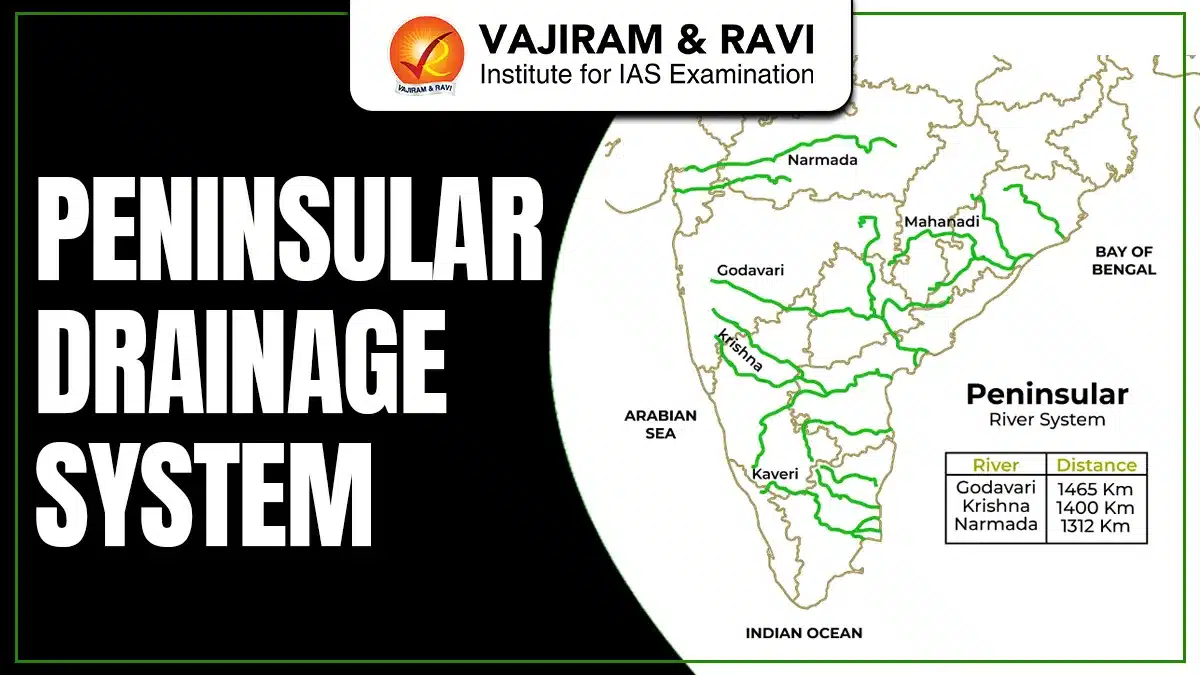
The Peninsular Drainage System is one of India’s oldest river systems, covering the southern and central plateau regions. It developed on the ancient Gondwana landmass and flows over hard, crystalline rocks. Most rivers are seasonal and rain-fed, with fixed courses and broad valleys. Key rivers include Godavari, Krishna, Cauvery, Mahanadi, Narmada, and Tapi, supporting irrigation, hydropower, and regional development.
Peninsular Drainage System
The Peninsular Drainage System is one of India’s oldest river systems, flowing across the stable Peninsular Plateau. Most rivers are rain-fed and seasonal, with well-defined and fixed courses. They have broad valleys, waterfalls, and rapids due to the hard rocky terrain. These rivers are crucial for irrigation, hydropower, and supporting regional economies.
Peninsular Drainage System Geological Evolution
The geological evolution of the Peninsular Drainage System is linked to the ancient Gondwana landmass, making it one of the oldest river systems in the world. Most peninsular rivers were formed much before the uplift of the Himalayas. Later tectonic movements, faulting, and tilting of the Peninsular Plateau modified their present courses.
- The Peninsular Plateau is composed of hard igneous and metamorphic rocks, which resisted extensive erosion.
- Rivers developed during the Pre-Cambrian period, long before the formation of young fold mountains.
- The tilting of the Peninsular block towards the east caused many rivers to flow eastward into the Bay of Bengal.
- Faulting and rifting led to the formation of rift valleys, through which the Narmada and Tapi rivers flow.
- Some rivers originally flowed westward but were later captured or diverted due to tectonic disturbances.
- Rivers are in a mature stage, showing limited vertical erosion and broad valleys.
- Long geological stability resulted in fixed river courses with minimal shifting over time.


Peninsular Drainage System Features
The Peninsular Drainage System has evolved over a long geological period, giving it stable and well-defined characteristics. The major features of the Peninsular Drainage System is given below.
- Most rivers are seasonal and receive water primarily from the southwest monsoon.
- Rivers have shorter lengths and smaller basins compared to Himalayan rivers.
- Flow over hard igneous and metamorphic rocks, resulting in shallow valleys.
- River courses are fixed and stable, with little lateral shifting.
- East-flowing rivers form extensive deltas, while west-flowing rivers form estuaries.
- Presence of waterfalls, rapids, and gorges due to uneven plateau surface.
- Limited vertical erosion as rivers are in a mature stage of development.
- Discharge varies greatly between monsoon and dry seasons.
East Flowing Rivers of the Peninsular Plateau
Most rivers of the Peninsular Plateau flow eastward and drain into the Bay of Bengal. These rivers generally have longer courses and wider drainage basins compared to west-flowing rivers. They carry large amounts of alluvium and form fertile delta regions along the eastern coast.
Mahanadi River
- The Mahanadi River originates from the Sihawa Range in Chhattisgarh and flows eastward to drain into the Bay of Bengal.
- It is known for forming a large and fertile delta in Odisha, supporting extensive rice cultivation.
- Major projects like the Hirakud Dam make it vital for irrigation, flood control, and hydroelectric power.
Godavari River
- The Godavari River, originating from Trimbakeshwar in the Western Ghats, is the longest river of the Peninsular Plateau.
- It drains a vast basin across multiple states, earning it the title “Dakshin Ganga”.
- The river forms an extensive delta in Andhra Pradesh and plays a key role in agriculture and drinking water supply.
Krishna River
- The Krishna River rises near Mahabaleshwar in Maharashtra and flows east into the Bay of Bengal.
- It supports major irrigation systems through projects like the Nagarjuna Sagar and Srisailam dams.
- The Krishna basin is crucial for agriculture and hydropower in Maharashtra, Karnataka, Telangana, and Andhra Pradesh.
Cauvery River
- The Cauvery River originates from the Brahmagiri Hills in the Western Ghats, Karnataka.
- It is the primary source of irrigation in Tamil Nadu and forms one of the most fertile deltas in India.
- The river holds immense cultural and economic importance, supporting agriculture, cities, and hydroelectric projects.
West Flowing Rivers of the Peninsular Plateau
West-flowing rivers of the Peninsular Plateau originate mainly from the Western Ghats and drain into the Arabian Sea. These rivers are comparatively short due to the steep western slope of the plateau. They generally form estuaries instead of deltas and have fast-flowing currents.
Narmada River
- The Narmada River flows through a rift valley between the Vindhya and Satpura ranges.
- One of the longest west-flowing rivers, draining into the Arabian Sea.
- Important for irrigation, hydropower, and projects like the Sardar Sarovar Dam.
Tapi (Tapti) River
- Tapi (Tapti) River originates from the Satpura Range and flows parallel to the Narmada.
- Drains into the Arabian Sea near Surat, Gujarat.
- Supports agriculture and industrial activities in central and western India.
Periyar River
- Periyar River is the longest river of Kerala, originating in the Western Ghats.
- Plays a vital role in water supply and hydropower generation.
- Supports irrigation and urban water needs in Kerala.
Sharavathi River
- Sharavathi River originates in the Thirthahalli taluk of the Shimoga district (Shivamogga) in Karnataka in the Western Ghats and flows into the Arabian Sea.
- Known for the Jog Falls, one of the highest waterfalls in India.
Major source of hydroelectric power in Karnataka.
Himalayan vs Peninsular Drainage System
The Himalayan and Peninsular drainage systems differ greatly in origin, nature, and river behavior. Himalayan rivers are young, perennial, and highly erosive due to active tectonics. In contrast, Peninsular rivers are older, seasonal, and flow through stable landforms with fixed courses.
| Himalayan vs Peninsular Drainage System | ||
| Basis | Himalayan Drainage System | Peninsular Drainage System |
|
Geological Origin |
Formed after Himalayan uplift during the Tertiary period on young fold mountains |
Developed on ancient Gondwana landmass of the Peninsular Plateau |
|
Age of Rivers |
Geologically young and actively evolving |
Very old rivers with mature stages |
|
Nature of Flow |
Perennial due to glacier, snowmelt, and monsoon rainfall |
Mostly seasonal and dependent on monsoon rainfall |
|
Course & Stability |
Long, meandering courses with frequent shifting |
Shorter, straighter, and fixed courses |
|
Erosion & Valleys |
Strong vertical and lateral erosion forming deep gorges and wide floodplains |
Limited erosion forming broad, shallow valleys |
|
Sediment & Landforms |
High sediment load leading to extensive floodplains and large deltas |
Lower sediment load; deltas in east and estuaries in west |
|
Economic Role |
Supports navigation, intensive agriculture, and dense population |
Supports irrigation, hydropower, and regional water supply |
|
Examples |
Ganga, Yamuna, Brahmaputra, Indus |
Godavari, Krishna, Cauvery, Narmada |
Impact of Monsoon on Peninsular Drainage
The Peninsular Drainage System is predominantly rain-fed, with nearly 85–90% of annual river discharge occurring during the southwest monsoon (June–September). Variations in monsoon intensity directly affect river flow, agriculture, and water security in Peninsular India.
- Seasonal Discharge Concentration: Around 80–90% of annual runoff in rivers like Godavari, Krishna, and Cauvery occurs during the monsoon months, leading to sharp seasonal contrasts in flow.
- Flood Frequency: Intense monsoon rainfall has caused repeated floods in east-flowing river basins, such as the Godavari floods (2006, 2019) and Krishna basin floods (2009, 2020), affecting millions.
- Drought Vulnerability: Nearly 50% of Peninsular India is classified as drought-prone due to monsoon variability, with weak monsoon years severely reducing river flow and reservoir levels.
- Sediment Transport & Delta Growth: Heavy monsoon runoff enables rivers like the Mahanadi and Godavari to transport large sediment loads, contributing to the formation of some of India’s most fertile delta regions.
- Reservoir Dependence: Major reservoirs such as Nagarjuna Sagar, Srisailam, and Mettur depend almost entirely on monsoon inflow, with low rainfall years reducing irrigation and hydropower output.
- Agricultural Dependence: Over 60% of irrigated agriculture in peninsular states relies on monsoon-fed rivers and reservoirs, making crop yields highly rainfall-dependent.
- Inter-State Water Disputes: Uneven monsoon rainfall intensifies disputes in basins like Cauvery, Krishna, and Godavari, especially during deficit rainfall years.
Importance of Peninsular Drainage System for Indian Economy
- Irrigation Support: Rivers like Godavari, Krishna, Cauvery, and Mahanadi irrigate millions of hectares, supporting crops such as rice, sugarcane, cotton, and pulses. Over 60% of agriculture in peninsular states depends on these rivers.
- Hydropower Generation: Major rivers provide sites for dams and hydropower projects, including Hirakud (Mahanadi), Srisailam (Krishna), Nagarjuna Sagar (Krishna), and Sharavathi (Jog Falls), contributing significantly to renewable energy production.
- Industrial Water Supply: Peninsular rivers supply water to industrial hubs in Maharashtra, Karnataka, Telangana, and Tamil Nadu, supporting manufacturing, textiles, and chemical industries.
- Fisheries and Livelihoods: Rivers support inland fisheries, providing livelihoods to millions in delta and coastal regions. The Godavari and Krishna deltas are especially rich in aquaculture.
- Urban and Domestic Water Supply: Major cities like Hyderabad, Bengaluru, Vijayawada, and Chennai depend on peninsular rivers and reservoirs for drinking water and urban needs.
- Navigation and Trade: Although limited compared to Himalayan rivers, some rivers like the Godavari support inland navigation and local trade.

 Last updated on Oct, 2026
→ UPSC 2027 Notification will be released on 13 January 2027 at upsconline.nic.in.
→ Check Nobel Prize 2026 Winners List here.
→ Download PIB PRiSM Monthly Magazine 2026 here.
→ Check UPSC Monthly Current Affairs Magazine The Recitals here.
→ Check out the latest UPSC Syllabus here.
→ Download UPSC Model Answers for Mains 2026
→ UPSC Mains Question Paper 2026 is out now for Essay & GS Paper 1, 2, 3 & 4.
→ UPSC Calendar 2027 has been released.
→ Enroll in Vajiram & Ravi’s UPSC Mains Test Series 2027 for structured answer writing practice, expert evaluation, and exam-oriented feedback.
→ Join Vajiram & Ravi’s UPSC Mentorship Program 2027 for personalized guidance, strategy planning, and one-to-one support from experienced mentors.
→ Go through the UPSC Mains Previous Year Papers to enhance your preparation.
→ UPSC has released UPSC Toppers List 2025 with the Civil Services final result on its official website.
→ Also check Best UPSC Coaching in India
Peninsular Drainage System FAQs
Q1. Why are peninsular rivers called old rivers?+
Q2. Which is the longest peninsular river?+
Q3. Why do west-flowing rivers not form deltas?+
Q4. Which rivers flow through rift valleys?+
Q5. How do Peninsular rivers differ from Himalayan rivers?+
Tags: peninsular drainage system