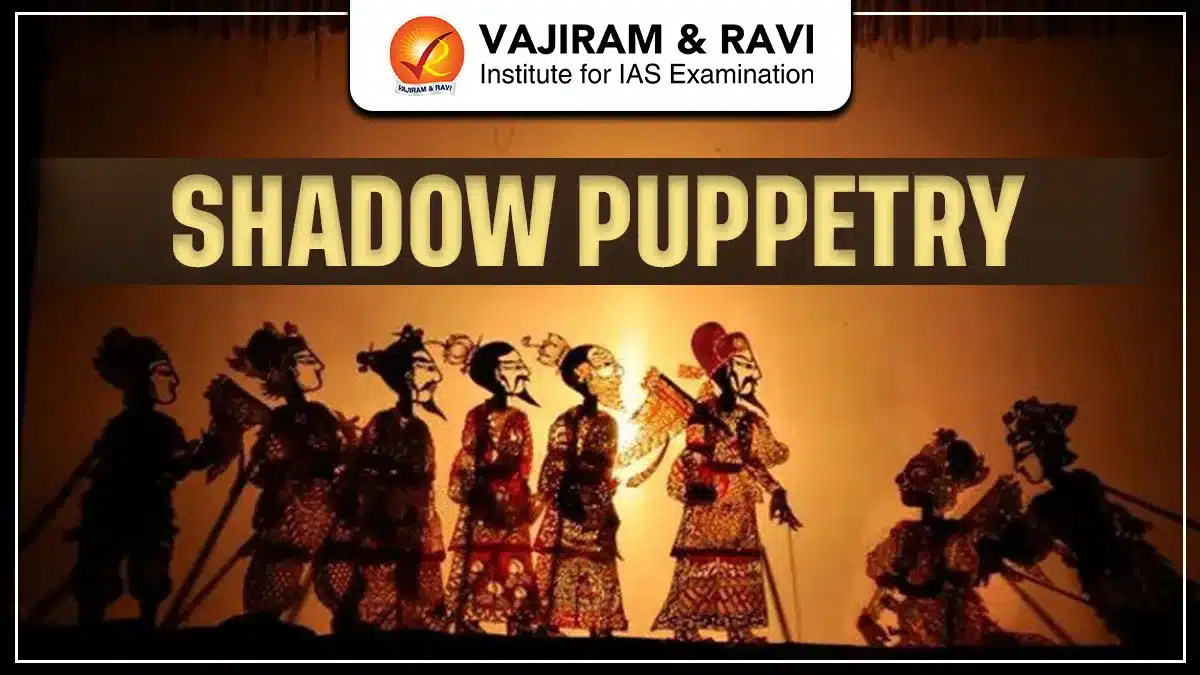
Shadow Puppetry, also called Shadow Play, is an ancient narrative art that uses flat, cut-out puppets made from leather or paper, held against a screen illuminated from behind. The movement of puppets and manipulation of light creates lifelike visual illusions such as walking, fighting, dancing or emotional gestures. Historical evidence suggests its development during the first millennium BCE, with strong roots in India and China. Shadow Puppetry later influenced projected visual arts, including slide projection and early cinema, due to its core principle of light-image-screen interaction.
Shadow Puppetry in India
Shadow Puppetry in India represents one of the richest and most continuous living traditions of this art form, deeply rooted in ritual, mythology and folk education. Evidence of puppetry appears in Harappa and Mohenjo-daro excavations, while literary references exist in the Mahabharata, Silappadikaaram and Natyashastra, where the term “Sutradhar” means the holder of strings. Indian shadow plays traditionally narrate Ramayana, Mahabharata and Puranic legends, performed during temple festivals. States like Andhra Pradesh, Karnataka, Kerala, Odisha, Maharashtra and Tamil Nadu preserve distinct regional styles using leather puppets and oil-lamp illumination.
Shadow Puppetry Types
Shadow Puppetry in India includes several region specific traditions, each distinguished by puppet size, articulation, material, performance style, music and ritual importance.
- Tholu Bommalata, Andhra Pradesh: Large translucent leather puppets, often four to five feet tall, with movable joints, painted on both sides, narrating Ramayana and Mahabharata with strong classical music influence.
- Togalu Gombeyatta, Karnataka: Small leather puppets whose size varies by social status, with kings and gods depicted larger, accompanied by folk music and flexible narrative improvisation.
- Ravanachhaya, Odisha: Opaque, single piece deer skin puppets without joints, producing bold shadows, focusing on dramatic Ramayana episodes with strong visual symbolism.
- Tholpavakoothu, Kerala: Ritual temple based shadow theatre performed in Koothumaadams, using around 160 puppets to narrate Kamba Ramayanam over performances lasting up to 41 nights.
- Charma Bahuli Natya, Maharashtra: Leather puppetry preserved by folk communities, presenting epic narratives with strong oral traditions and Marathi linguistic influence across regions.


Shadow Puppetry across World
Shadow Puppetry spread across Asia, the Middle East and Europe through trade, migration and cultural exchange, adapting local aesthetics while retaining its core visual principle.
- China: Known as Piyingxi, recognized by UNESCO in 2011, featuring colored leather puppets and regional styles like Luanzhou and Sichuan, flourishing since the Song dynasty.
- Indonesia: Famous for Wayang Kulit, designated a UNESCO Masterpiece in 2003, integrating leather puppets, gamelan music and a single master puppeteer called Dalang.
- Malaysia: Practiced as Wayang Kulit Melayu, Gedek, Jawa and Siam, combining Javanese and Thai influences with moral storytelling and leather puppets.
- Thailand: Includes Nang Yai with large figures and Nang Talung with smaller movable puppets, often performed during rituals and temple fairs with music and chants.
- Turkey: Known as Karagöz and Hacivat, a satirical Ottoman era shadow comedy tradition featuring social commentary, performed widely in coffee houses and royal courts.
- Cambodia: Practiced as Sbek Thom and Sbek Touch, using large cowhide puppets to depict Ramayana scenes during sacred ceremonies with pinpeat orchestra support.
- Europe: Introduced in the 17th century, popularized as Ombres Chinoises in France, influencing theatre, philosophy and later cinematic visual storytelling traditions.
- Modern World: Shadow Puppetry influenced silhouette animation, early cinema and contemporary visual arts, with examples in films, theatre productions and digital media worldwide.

 Last updated on Sep, 2026
→ UPSC 2027 Notification will be released on 13 January 2027 at upsconline.nic.in.
→ UPSC Mains Question Paper 2026 is out now for Essay & GS Paper 1, 2, 3 & 4.
→ UPSC Mains GS Paper 1 2026 is out now.
→ UPSC Mains GS Paper 2 2026 is out now.
→ UPSC Mains GS Paper 3 2026 is out now.
→ UPSC Mains GS Paper 4 2026 is out now.
→ UPSC Mains Indian Language Paper & English Compulsory Paper are out now.
→ Check out the latest UPSC Syllabus 2026 here.
→ UPSC Mains Admit Card 2026 is now out.
→ Enroll in Vajiram & Ravi’s UPSC Mains Test Series 2027 for structured answer writing practice, expert evaluation, and exam-oriented feedback.
→ Join Vajiram & Ravi’s UPSC Mentorship Program 2027 for personalized guidance, strategy planning, and one-to-one support from experienced mentors.
→ Go through the UPSC Mains Previous Year Papers to enhance your preparation.
→ Download UPSC Mains Essay Paper 2025, UPSC Mains GS Paper-I 2025, UPSC Mains GS Paper-II 2025, UPSC Mains GS Paper-III 2025, UPSC Mains GS Paper-IV 2025, UPSC Mains English (Compulsory) Paper 2025, UPSC Mains Hindi (Qualifying) Paper 2025 here.
→ UPSC has released UPSC Toppers List 2025 with the Civil Services final result on its official website.
→ UPSC Calendar 2027 has been released.
→ Also check Best UPSC Coaching in India
Shadow Puppetry FAQs
Q1. What is Shadow Puppetry?+
Q2. Which materials are used to make Shadow Puppets?+
Q3. Where did Shadow Puppetry originate?+
Q4. Which Indian epics are commonly performed in Shadow Puppetry?+
Q5. Why is Shadow Puppetry historically important?+
Tags: shadow puppetry