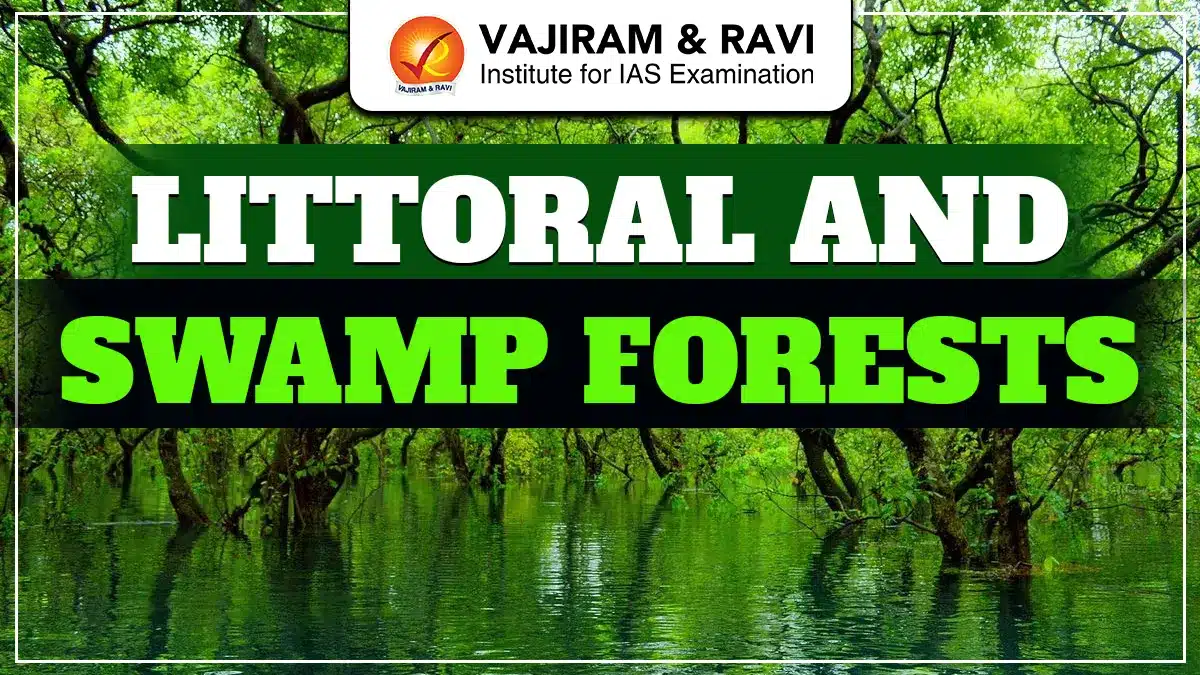
Littoral and Swamp Forests are special wetland forests found along sea coasts, river mouths, deltas, lakeshores and low lying waterlogged areas. They are also called wetland forests or tidal forests and develop where land and water constantly interact. These forests grow in saline, brackish, or freshwater conditions and are shaped by tides, floods and poor drainage. In India, they form an important part of natural vegetation, supporting rich biodiversity and protecting fragile coastal and inland wetland ecosystems.
Littoral and Swamp Forests Features
Littoral and Swamp Forests show unique physical, biological and ecological features shaped by waterlogged and saline environments.
- Waterlogged Ecosystem: These forests grow in permanently or seasonally flooded areas with poor natural drainage.
- Salinity Influence: Many regions experience saline or brackish water, especially in tidal and coastal areas.
- Soil Characteristics: Sandy or silty soils rich in lime and salts but poor in nitrogen dominate these forests.
- Evergreen Nature: Most tree species remain evergreen due to constant water availability.
- Special Root Adaptations: Trees develop stilt roots, buttress roots and pneumatophores for stability and respiration.
- High Humidity: Constant moisture and warm temperatures create humid microclimates.
- Limited Species Diversity: Extreme soil and salinity conditions restrict plant variety to highly adapted species.
Littoral and Swamp Forests Types
Littoral and Swamp Forests are broadly classified into beach forests, tidal forests and freshwater swamp forests based on water type and location.
- Beach Forests: Found along sandy shores with rainfall between 75-500 cm, these forests grow under moderate temperatures. Common species include Manilkara littoralis, Thespesia, Spinifex littoreus, Casuarina equisetifolia, Pandanus, Borassus, coconut and date palms. Beach forests support numerous climbers that stabilize sandy soils.
- Tidal Forests (Mangroves): Found in estuaries, tidal creeks and salt marshes regularly influenced by seawater. The 4 types of tidal forests are:
- Tree Mangrove Forests: Tall, dense mangroves grow along both eastern and western coastal belts.
- Low Mangrove Forests: Short mangrove species dominate soft tidal mud near estuary mouths.
- Saltwater Mangrove Forests: Located deeper in deltas, frequently flooded by saline tidal water.
- Brackish Water Forests: Develop where freshwater mixes with seawater, flooding at least once daily.
- Freshwater Swamp Forests: Found near rivers and lakes, permanently or seasonally submerged in freshwater. Species include Salix tetrasperma, Acer, Putranjiva, Holoptelia, Barringtonia, Ficus, Phoebe, Olea, Canna and grasses.


Littoral and Swamp Forests Distribution in India
Littoral and Swamp Forests in India occur in coastal belts, river deltas, floodplains, reservoirs and natural lakes influenced by tidal or stagnant water conditions.
- Deccan Plateau Reservoirs: Large man made and natural reservoirs in southern India support swamp vegetation adapted to seasonal waterlogging and fluctuating water levels.
- Gujarat and Rajasthan Saline Coasts: Saline flats and mudflats along Gujarat’s coast and parts of Rajasthan host salt tolerant littoral vegetation.
- Gulf of Kutch Region: Extensive tidal creeks and saline wetlands support mangrove dominated tidal forests.
- Eastern Coast Deltas: The deltas of the Ganga, Mahanadi, Godavari, Krishna and Cauvery contain dense swamp and mangrove forests.
- Gangetic Plain Wetlands: Freshwater marshes and swamps form along poorly drained floodplains.
- Brahmaputra Floodplains: Seasonal flooding creates large freshwater swamp forests in Assam and nearby regions.
- Kashmir Lakes and Rivers: Montane wetlands like Dal Lake and Jhelum floodplains support swamp vegetation.
- North East India Swamps: Permanently waterlogged lowlands support diverse freshwater swamp forests.
Littoral and Swamp Forests Distribution across World
Globally, Littoral and Swamp Forests occur in tropical, subtropical and some temperate regions with extensive wetlands.
- Southeast Asia: Large swamp forests exist in Borneo, New Guinea, Laos and Cambodia.
- Tropical Africa: Extensive freshwater and mangrove swamps support high biodiversity.
- Central and South America: Brazil and Argentina host vast flooded forests along major rivers.
- Central America: Coastal mangroves dominate low lying shorelines.
- United States: Southern states contain large freshwater swamp forests, especially along river floodplains.
- Central Asia: Limited swamp forests occur around inland water bodies.
Littoral and Swamp Forests Biodiversity
These forests support specialized plant and animal communities adapted to wet, saline and low oxygen environments.
- Flora Diversity: Dominant producers include mangroves like Rhizophora, Manilkara littoralis, Thespesia, Casuarina, Spinifex and Barringtonia.
- Root Adaptations: Pneumatophores and prop roots help plants survive oxygen poor soils.
- Salt Tolerance: Many species regulate salt through leaves and roots.
- Faunal Diversity: These forests support fish, amphibians, reptiles, birds and insects.
- Bird Habitat: Tidal forests act as nesting and feeding grounds for migratory birds.
- Aquatic Fauna: Mangroves serve as breeding nurseries for fish and crustaceans.
- Mammals and Reptiles: Swamps support reptiles, small mammals and semi aquatic species.
Littoral and Swamp Forests Significance
Littoral and Swamp Forests play crucial ecological, economic and protective roles at local and global levels.
- Coastal Protection: Mangroves act as natural barriers against cyclones, storm surges and tsunamis.
- Climate Regulation: These forests store large amounts of carbon, helping mitigate climate change.
- Water Purification: Freshwater swamps filter pollutants and improve water quality.
- Biodiversity Support: They provide breeding, feeding and shelter habitats for diverse species.
- Livelihood Support: Local communities depend on fisheries, fuelwood, timber and non timber products.
- Soil Stabilization: Root systems reduce coastal erosion and sediment loss.
- Scenic and Recreational Value: These ecosystems enhance natural beauty and eco tourism potential.
Littoral and Swamp Forests Challenges
These forests face growing threats but can be conserved through integrated ecological and policy measures.
- Deforestation Pressure: Clearing for settlements and industry reduces forest cover; strict protection and regulation are needed.
- Pollution Stress: Industrial effluents and agricultural runoff degrade wetlands; effective waste treatment is essential.
- Reduced Freshwater Flow: Dam construction alters natural hydrology; environmental flow maintenance is required.
- Salinity Imbalance: Excessive salinity harms vegetation; watershed based management can restore balance.
- Climate Change Impact: Rising sea levels threaten coastal swamps; mangrove restoration and climate adaptation strategies are necessary.

 Last updated on Oct, 2026
→ UPSC 2027 Notification will be released on 13 January 2027 at upsconline.nic.in.
→ Check Nobel Prize 2026 Winners List here.
→ Download PIB PRiSM Monthly Magazine 2026 here.
→ Check UPSC Monthly Current Affairs Magazine The Recitals here.
→ Check out the latest UPSC Syllabus here.
→ Download UPSC Model Answers for Mains 2026
→ UPSC Mains Question Paper 2026 is out now for Essay & GS Paper 1, 2, 3 & 4.
→ UPSC Calendar 2027 has been released.
→ Enroll in Vajiram & Ravi’s UPSC Mains Test Series 2027 for structured answer writing practice, expert evaluation, and exam-oriented feedback.
→ Join Vajiram & Ravi’s UPSC Mentorship Program 2027 for personalized guidance, strategy planning, and one-to-one support from experienced mentors.
→ Go through the UPSC Mains Previous Year Papers to enhance your preparation.
→ UPSC has released UPSC Toppers List 2025 with the Civil Services final result on its official website.
→ Also check Best UPSC Coaching in India
Littoral and Swamp Forests FAQs
Q1. What are Littoral and Swamp Forests?+
Q2. Why are mangroves important in littoral forests?+
Q3. Where are Littoral and Swamp Forests found in India?+
Q4. What type of soil supports swamp forests?+
Q5. How do plants survive in waterlogged swamp forests?+
Tags: littoral and swamp forests