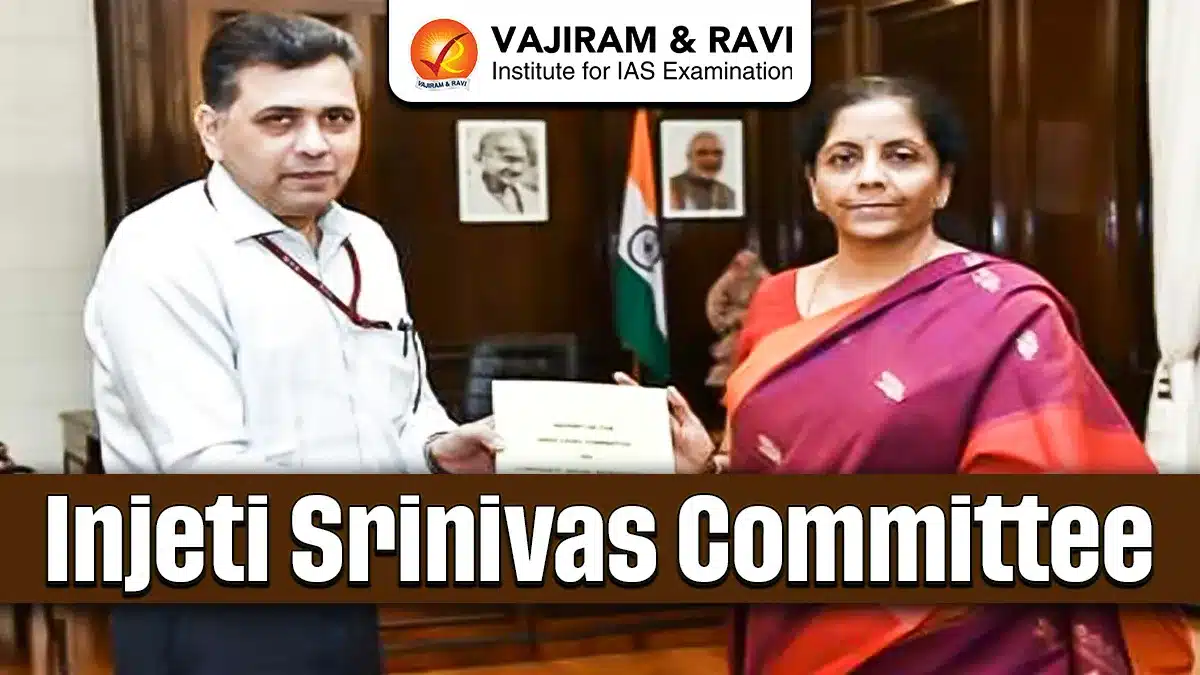
The Injeti Srinivas Committee, formally known as the High Level Committee on Corporate Social Responsibility 2018, was constituted by the Ministry of Corporate Affairs to comprehensively review India’s CSR framework under the Indian Companies Act, 2013. It was formed after nearly four years of CSR implementation, during which large scale data on company participation, sectoral spending, geographic reach and social impact became available. By FY 2016-17, CSR expenditure had reached about Rs. 38,000 crore, highlighting both achievements and structural gaps. The Committee was tasked with strengthening governance, improving monitoring, enhancing impact and ensuring CSR contributes to sustainable and inclusive development without becoming a substitute for government funding.
Injeti Srinivas Committee Objectives
The Committee aimed to review, strengthen and future proof India’s CSR framework using evidence, stakeholder feedback and implementation experience.
- The Committee examined Section 135 of the Companies Act 2013, along with related rules and circulars, to identify gaps, overlaps and enforcement challenges faced by companies and regulators.
- It analyzed four years of CSR data, including spending patterns, sectoral allocation and geographic spread, to evaluate whether CSR investments were creating measurable social impact.
- The Committee aimed to design systems for outcome based monitoring, impact assessment and social audit, especially for large CSR projects involving significant public resources.
- It sought technology driven solutions such as digital platforms and data systems to connect companies, implementing agencies and beneficiaries more transparently.
- The objective included creating a coherent, predictable CSR policy aligned with national priorities and global development frameworks like the Sustainable Development Goals.
Injeti Srinivas Committee Organizational Structure
The Committee was structured as a high level, multi stakeholder body combining government leadership, corporate expertise, legal insight and civil society experience.
- Chairperson: The Committee was chaired by Shri Injeti Srinivas, Secretary, Ministry of Corporate Affairs, providing senior administrative leadership and direct policy linkage with the Government of India.
- Government Representation: The Secretary, MCA and the Joint Secretary, MCA as Member Convener ensured coordination, documentation and translation of recommendations into actionable policy inputs.
- Institutional Expertise: The Director General of the Indian Institute of Corporate Affairs participated to provide research, training and capacity building perspectives based on CSR implementation data.
- Regulatory Perspective: SEBI representation at Executive Director level brought capital market and corporate governance experience relevant for listed companies’ CSR compliance.
- Corporate Members: Industry leaders like N. Chandrasekaran of Tata Sons and Amit Chandra of Bain Capital added practical insights on large scale corporate CSR planning and execution.
- Legal and Constitutional Expertise: P. S. Narasimha, Additional Solicitor General, contributed legal interpretation of CSR provisions and enforcement mechanisms under corporate law.
- Academic and Innovation Input: Professor Anil K. Gupta of IIM Ahmedabad and Honey Bee Network provided grassroots innovation and inclusive development perspectives.
- Social Sector Representation: Members like Mathew Cherian of HelpAge India ensured voices of beneficiaries and civil society were integrated into CSR reform discussions.
- Sports and Social Influence: Prakash Padukone added insights on sports promotion and youth development as emerging CSR priority areas.
- Professional and Financial Insight: Chartered Accountant S. Santhanakrishnan supported financial accountability, compliance and reporting aspects of CSR expenditure.


Corporate Social Responsibility (CSR)
Corporate Social Responsibility refers to a company’s legal and ethical obligation to contribute to social welfare and sustainable development.
- CSR in India is governed by Section 135 of the Companies Act, 2013, making India the first country to mandate CSR spending by law.
- CSR provisions apply to companies with net worth of Rs. 500 crore, turnover of Rs. 1,000 crore, or net profit of Rs. 5 crore or more.
- Eligible companies are required to spend at least 2% of their average net profits of the previous three years on CSR activities.
- Companies must constitute a CSR Committee of the Board to frame CSR policy, approve projects and monitor implementation periodically.
- Schedule VII of the Act lists approved CSR activities including education, health, poverty alleviation, environmental sustainability and disaster relief.
- Between 2014 and 2017, CSR spending reached approximately Rs. 38,000 crore, providing substantial data on outreach and impact.
- The law empowers company boards to design CSR strategies suited to local needs while maintaining accountability and transparency.
Injeti Srinivas Committee Recommendations
The Injeti Srinivas Committee proposed structural, fiscal and governance reforms to make CSR impactful, accountable and aligned with national development goals.
- Tax Deductibility of CSR Spend: It recommended allowing CSR expenditure as a deductible expense to encourage higher quality and sustained corporate participation.
- Carry Forward of Unspent CSR Funds: The Committee proposed permitting unspent CSR amounts to be carried forward for three to five years to enable long term projects.
- Alignment with SDGs: It suggested aligning Schedule VII with United Nations Sustainable Development Goals using an SDG Plus framework including sports and senior welfare.
- Impact Assessment Mandate: For companies with CSR obligations of Rs. 5 crore or more, mandatory impact assessment studies were recommended for outcome evaluation.
- Registration of Implementing Agencies: The Committee advised mandatory registration of CSR implementation agencies on the MCA portal for transparency and accountability.
- CSR Exchange Portal: It proposed a digital CSR exchange platform to connect contributors, beneficiaries and agencies, improving efficiency and reducing duplication.
- Discouraging Passive Fund Transfers: The Committee discouraged routine transfers to government funds, emphasizing project based CSR rather than resource gap financing.
- Board driven Innovation Focus: CSR was recommended as a board led process promoting innovative, technology based solutions to social problems.
- Relaxation for Small CSR Obligations: Companies with CSR obligations below Rs. 50 lakh were recommended exemption from forming a separate CSR Committee.
- Civil Penalty Regime: Non compliance with CSR provisions was recommended to be treated as a civil offence under a penalty framework, replacing criminal sanctions.

 Last updated on Oct, 2026
→ UPSC 2027 Notification will be released on 13 January 2027 at upsconline.nic.in.
→ Check Nobel Prize 2026 Winners List here.
→ Download PIB PRiSM Monthly Magazine 2026 here.
→ Check UPSC Monthly Current Affairs Magazine The Recitals here.
→ Check out the latest UPSC Syllabus here.
→ Download UPSC Model Answers for Mains 2026
→ UPSC Mains Question Paper 2026 is out now for Essay & GS Paper 1, 2, 3 & 4.
→ UPSC Calendar 2027 has been released.
→ Enroll in Vajiram & Ravi’s UPSC Mains Test Series 2027 for structured answer writing practice, expert evaluation, and exam-oriented feedback.
→ Join Vajiram & Ravi’s UPSC Mentorship Program 2027 for personalized guidance, strategy planning, and one-to-one support from experienced mentors.
→ Go through the UPSC Mains Previous Year Papers to enhance your preparation.
→ UPSC has released UPSC Toppers List 2025 with the Civil Services final result on its official website.
→ Also check Best UPSC Coaching in India
Injeti Srinivas Committee FAQs
Q1. What was the Injeti Srinivas Committee?+
Q2. Who chaired the Injeti Srinivas Committee?+
Q3. Why was the Injeti Srinivas Committee formed?+
Q4. What major issue did the Injeti Srinivas Committee address in CSR?+
Q5. What was a key financial recommendation of the Injeti Srinivas Committee?+
Tags: committee injeti srinivas injeti srinivas committee