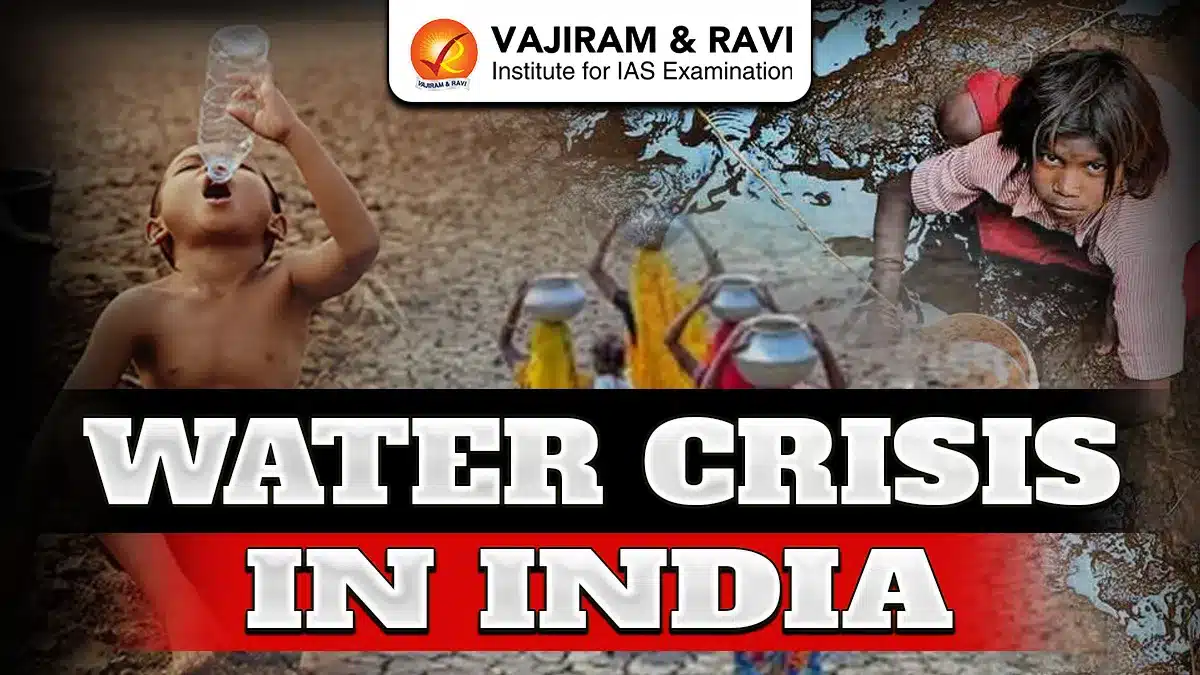
The Water Crisis in India has become a major issue in recent times. Water is essential for life, economic activity and ecological balance, yet it is a limited natural resource. Although water covers about 70% of the Earth, only around 1% is readily available for human use. India, with a rapidly growing population and increasing climate stress, is facing an acute water scarcity that threatens public health, food security and long term development of the country.
Water Crisis in India
India supports nearly 18% of the world’s population but has access to only about 4% of global freshwater resources. According to official assessments, around 600 million Indians experience high to extreme water stress. The per capita water availability has declined sharply to nearly 1,100 cubic metres, which is below the water stress threshold. Several major cities such as Delhi, Bengaluru, Chennai and Hyderabad are projected to face severe groundwater depletion by 2030, highlighting the seriousness of the water crisis in India.
Water Crisis in India Reasons
The Water Crisis in India is the result of multiple interlinked natural and human induced factors that have intensified over time. Major driving forces for the Water Scarcity in India are:
- Overdependence on Groundwater:
- About 65% of irrigation and 85% of drinking water relies on groundwater.
- Overuse has caused sharp water table decline in Punjab, Haryana, Rajasthan and Tamil Nadu.
- Nearly 256 out of 700 districts face critical or overexploited groundwater conditions.
- Inefficient Water Use Practices:
- Agriculture consumes nearly 85% of India’s freshwater resources.
- Flood irrigation leads to large scale water wastage in water stressed regions.
- Water intensive crops like paddy and sugarcane worsen scarcity in dry areas.
- Pollution and Contamination
- Over 70% of surface water is contaminated due to sewage and industrial discharge.
- Rivers such as the Ganga and Yamuna receive large volumes of untreated wastewater.
- Climate Change Impacts
- Declining and irregular rainfall affects groundwater recharge and river flows.
- Droughts and floods disrupt water availability and damage infrastructure.
- Urbanisation and PPopulation Growth
- Expanding cities increase water demand beyond supply capacity.
- India’s population of 1.4 billion strains limited freshwater availability.


Water Crisis in India NITI Aayog Report
The NITI Aayog’s Composite Water Management Index Report was released in June 2018. It highlights that India is facing the worst water crisis in its history, with nearly 600 million people experiencing high to extreme water stress. The report also ranks India 120th out of 122 countries on the water quality index, noting that around 70% of available water is contaminated. Further, the 5th Minor Irrigation Census (2013-14) records 20.52 million wells nationwide, reflecting heavy dependence on groundwater.
Water Crisis in India Impacts
The Water Crisis in India has serious consequences for health, economy, agriculture, environment and social stability as detailed below:
- Public Health Impacts
- Unsafe water access: Around 342 million people lack access to safe drinking water.
- Sanitation gaps: Nearly 539 million people do not have access to safe toilets.
- Mortality burden: About 200,000 deaths annually are linked to inadequate water supply.
- Agricultural and Food Security Impacts
- Crop losses: Water scarcity reduces agricultural productivity and farmer incomes.
- Food insecurity: Reduced yields threaten national food supply and price stability.
- Economic Impacts
- GDP loss risk: Water shortages could reduce India’s GDP by nearly 6% by 2050.
- Industrial stress: Water intensive industries face rising costs and production disruptions.
- Environmental Impacts
- Ecosystem damage: Rivers, wetlands and biodiversity suffer due to water depletion.
- Human wildlife conflict: Animals enter settlements searching for water, increasing conflict.
- Social and Political Impacts
- Water conflicts: Scarcity fuels disputes between states, farmers and urban users.
Reforms to Address Water Crisis in India
Addressing the Water Crisis in India requires a mix of conservation, governance reform, technology and community participation as highlighted below:
- Improving Water Efficiency
- Micro irrigation: Drip and sprinkler systems can save nearly 50% water and raise yields.
- Infrastructure repair: Fixing leaks reduces water loss in urban and rural supply systems.
- Reducing Overconsumption
- Demand management: Efficient pricing and monitoring discourage excessive water use.
- Technology use: AI, IoT and satellite data improve irrigation planning and monitoring.
- Sustainable Agriculture Practices
- Crop diversification: Shifting from water intensive to drought resistant crops conserves water.
- MSP reforms: Incentives for less water intensive crops reduce groundwater stress.
- Strengthening Governance
- Decentralised management: Gram Panchayat led water planning improves local accountability.
- Data systems: Real time monitoring strengthens evidence based water policymaking.
- Ecosystem Restoration
- Wetland revival: Restored wetlands improve groundwater recharge and water quality.
- Forest protection: Healthy forests regulate rainfall and reduce runoff losses.
Water Crisis in India Government Initiatives
The Government of India has launched several large scale programmes to address Water Scarcity in India and ensure long term water security.
- Jal Jeevan Mission (JJM)
- Household connections: Aims to provide tap water to every rural household by 2024.
- Coverage progress: Around 60% of rural households have received tap water connections.
- Jal Shakti Abhiyan (JSA)
- Conservation focus: Emphasises rainwater harvesting and water body restoration.
- National coverage: Expanded from 256 districts to all 740 districts nationwide.
- Atal Bhujal Yojana (ABY)
- Groundwater management: Promotes community led sustainable groundwater use.
- Targeted states: Focuses on seven major states facing critical groundwater depletion.
- Namami Gange Programme
- River rejuvenation: Targets pollution reduction and continuous river flow.
- Sewage treatment: Expands treatment infrastructure to reduce river contamination.
- National Water Policy (2012)
- Integrated management: Prioritises drinking water, sanitation and conservation.
- Rainwater harvesting: Encourages revival of traditional water conservation systems.

 Last updated on Sep, 2026
→ UPSC 2027 Notification will be released on 13 January 2027 at upsconline.nic.in.
→ Asian Games 2026 are being held in Aichi-Nagoya, Japan, from 19 September to 4 October.
→ Check out the latest UPSC Syllabus here.
→ Download UPSC Model Answers for Mains 2026
→ UPSC Mains Question Paper 2026 is out now for Essay & GS Paper 1, 2, 3 & 4.
→ UPSC Calendar 2027 has been released.
→ Enroll in Vajiram & Ravi’s UPSC Mains Test Series 2027 for structured answer writing practice, expert evaluation, and exam-oriented feedback.
→ Join Vajiram & Ravi’s UPSC Mentorship Program 2027 for personalized guidance, strategy planning, and one-to-one support from experienced mentors.
→ Go through the UPSC Mains Previous Year Papers to enhance your preparation.
→ UPSC has released UPSC Toppers List 2025 with the Civil Services final result on its official website.
→ Also check Best UPSC Coaching in India
Water Crisis in India FAQs
Q1. What is meant by the Water Crisis in India?+
Q2. Why is India facing a severe Water Crisis?+
Q3. How serious is Groundwater Depletion in India?+
Q4. What are the major impacts of the Water Crisis in India?+
Q5. What steps has the government taken to address the Water Crisis in India?+
Tags: india water crisis water crisis in india