Datacentres Latest News
- Technology firms and space agencies are exploring space-based datacentres to address the rapidly rising energy demand of artificial intelligence workloads.
Rising Energy Demand from Artificial Intelligence
- Datacentres are becoming one of the fastest-growing consumers of electricity worldwide, and artificial intelligence is significantly accelerating this trend.
- Modern AI systems rely on large clusters of graphics processing units (GPUs) and specialised accelerators to train and deploy machine learning models.
- These systems require continuous, high-density computing, leading to enormous power consumption.
- Unlike traditional datacentres that primarily support content delivery and cloud services, AI datacentres consume large amounts of energy internally.
- High-speed data exchange between servers within the same facility or across nearby facilities is essential for training large language models.
- As the adoption of generative AI expands across sectors, concerns over sustainability, carbon emissions, and grid stress are becoming increasingly prominent.


Concept of Space-Based Datacentres
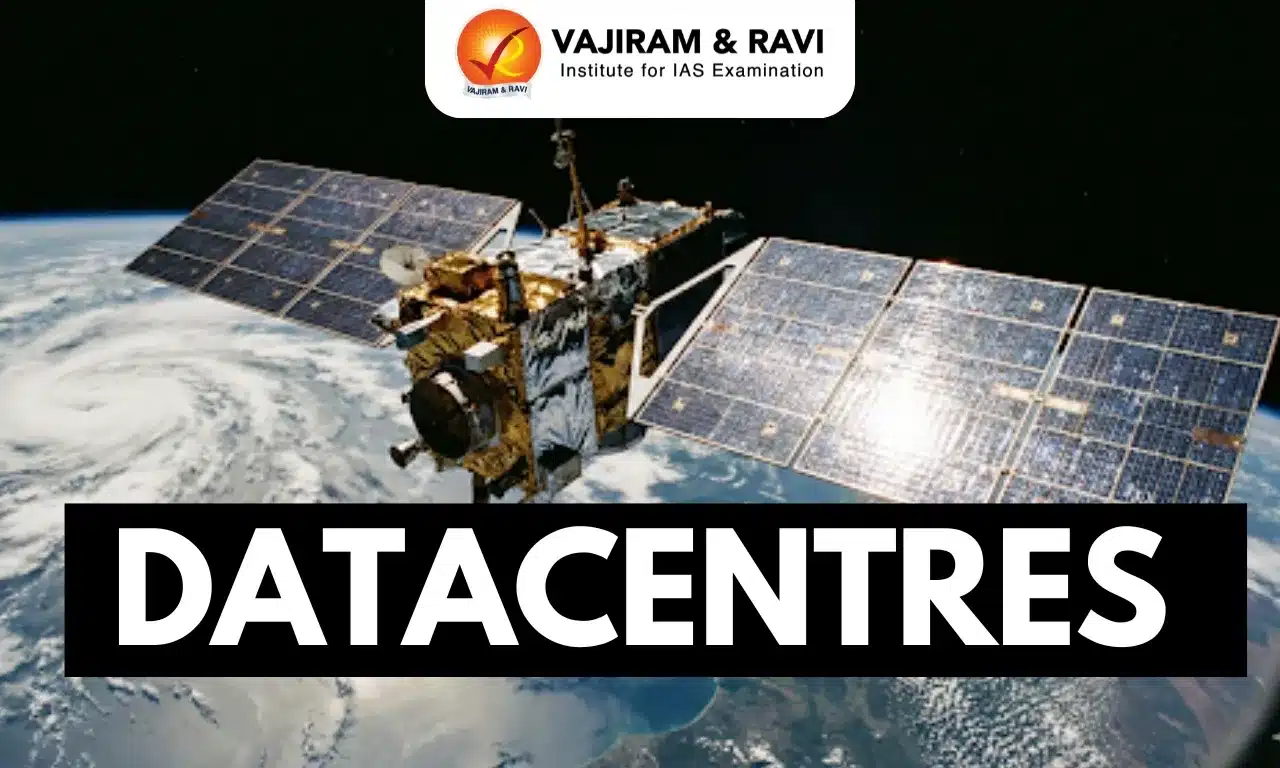
- To address these challenges, researchers are exploring the idea of placing datacentres in low-Earth orbit.
- The central idea is to power datacentres entirely using solar energy available in space, where sunlight is uninterrupted and more intense than on Earth.
- This approach aims to bypass terrestrial constraints such as land availability, cooling limitations, and dependence on fossil fuel-based electricity grids.
- Google Research’s Project Suncatcher proposes deploying clusters of satellites equipped with computing hardware that can process AI workloads in space.
- These satellites would operate in carefully choreographed orbits that maintain constant exposure to sunlight, ensuring an uninterrupted power supply through solar panels.
Technical Architecture and Design Principles
- A key feature of orbital datacentres is their reliance on dense inter-satellite communication rather than high-speed connections with Earth.
- AI workloads require extremely high internal bandwidth to allow different processors to work in parallel.
- In space-based systems, this would be achieved through closely spaced satellites communicating with one another using advanced multiplexing and high-frequency links.
- Since most data movement occurs within the system itself, the bandwidth required to communicate with ground stations is relatively modest.
- This mirrors terrestrial AI systems, where user queries require limited bandwidth compared to internal data transfers during model training.
Engineering Challenges in Space Deployment
- Despite the conceptual promise, several technical challenges remain. One major concern is exposure to solar and cosmic radiation.
- Long-term radiation can degrade semiconductor components, affecting performance and reliability.
- Initial tests conducted by Google indicate that some specialised AI chips can tolerate higher radiation levels than expected, but long-duration missions still pose risks.
- Thermal management presents another major challenge. On Earth, datacentres rely on air or liquid cooling systems.
- In space, where there is no atmosphere, dissipating heat becomes significantly more complex.
- Datacentres in orbit would continuously absorb solar radiation while lacking conventional cooling mechanisms, requiring advanced heat dissipation technologies.
- Maintenance is also a critical issue. Unlike terrestrial facilities, repairing or replacing faulty hardware in space is expensive and logistically difficult.
- This raises concerns about system resilience and long-term operational reliability.
Economic Viability and Cost Considerations
- The economic feasibility of space-based datacentres depends heavily on launch costs and hardware durability.
- Currently, launching equipment into orbit is expensive, but projections suggest that satellite launch costs may decline substantially in the coming decades.
- Google estimates that costs could fall to around $200 per kilogram by the mid-2030s, potentially improving the commercial viability of orbital datacentres.
- However, space-based solutions must remain competitive with rapidly advancing ground-based technologies.
- Improvements in renewable energy integration, cooling efficiency, and energy storage on Earth could reduce the relative advantage of orbital systems.
- Past experiments, such as underwater datacentres, demonstrated technical promise but were eventually discontinued due to economic constraints.
India’s Interest in Space-Based Datacentres
- India is also showing interest in this emerging domain.
- The Indian Space Research Organisation (ISRO) is reportedly studying space-based data centre technologies as part of broader efforts to explore commercial and strategic uses of space infrastructure.
- Given India’s growing AI ecosystem and renewable energy ambitions, space-based computing could become a long-term area of research and collaboration.
- This aligns with India’s broader push towards leveraging space technology for civilian, scientific, and commercial applications, while also addressing sustainability challenges associated with digital expansion.
Source: TH

 Last updated on Oct, 2026
→ UPSC 2027 Notification will be released on 13 January 2027 at upsconline.nic.in.
→ Check Nobel Prize 2026 Winners List here.
→ Download PIB PRiSM Monthly Magazine 2026 here.
→ Check UPSC Monthly Current Affairs Magazine The Recitals here.
→ Check out the latest UPSC Syllabus here.
→ Download UPSC Model Answers for Mains 2026
→ UPSC Mains Question Paper 2026 is out now for Essay & GS Paper 1, 2, 3 & 4.
→ UPSC Calendar 2027 has been released.
→ Enroll in Vajiram & Ravi’s UPSC Mains Test Series 2027 for structured answer writing practice, expert evaluation, and exam-oriented feedback.
→ Join Vajiram & Ravi’s UPSC Mentorship Program 2027 for personalized guidance, strategy planning, and one-to-one support from experienced mentors.
→ Go through the UPSC Mains Previous Year Papers to enhance your preparation.
→ UPSC has released UPSC Toppers List 2025 with the Civil Services final result on its official website.
→ Also check Best UPSC Coaching in India
Datacentres FAQs
Q1. Why are datacentres consuming more energy today?+
Q2. What is a space-based datacentre?+
Q3. Why is internal bandwidth more important than ground connectivity for AI datacentres?+
Q4. What are the major challenges of datacentres in space?+
Q5. Is India exploring space-based datacentres?+
Tags: datacentres mains articles upsc current affairs upsc mains current affairs