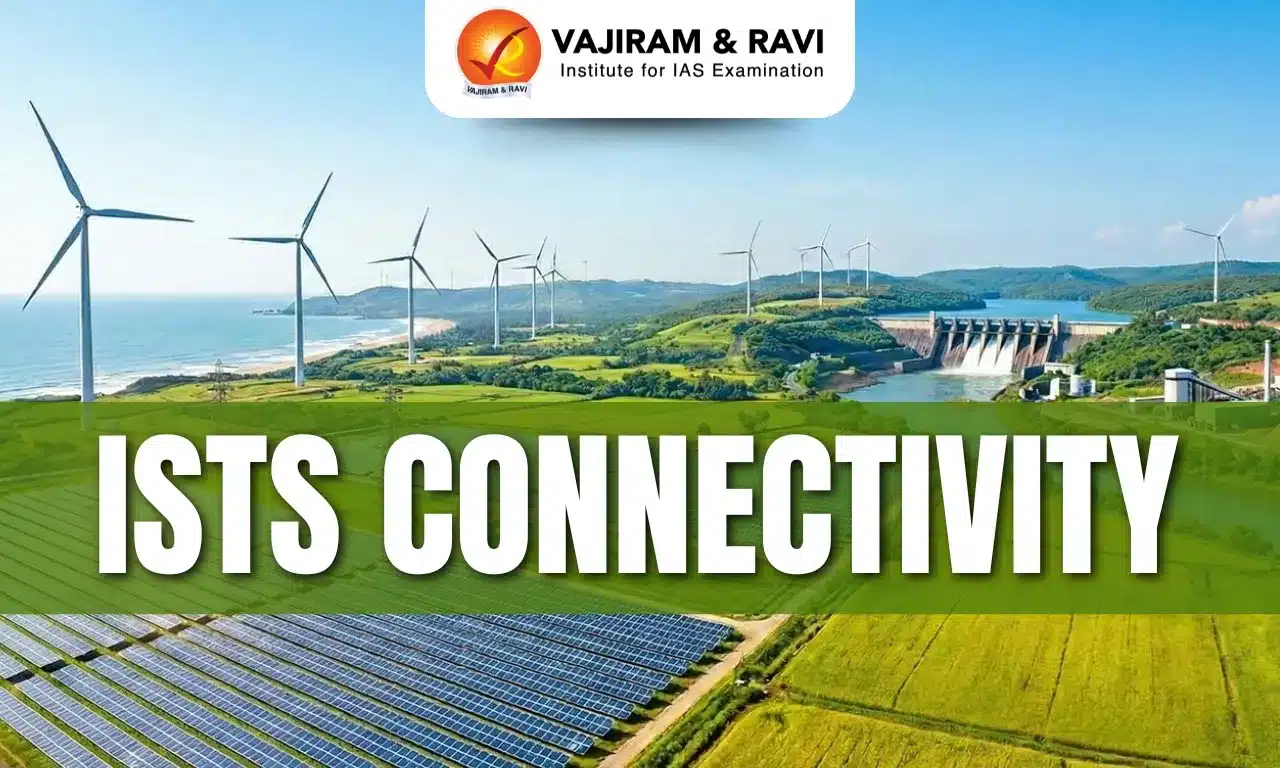
ISTS Connectivity Latest News
- India’s renewable energy sector (private developers, Renewable Energy Implementing Agencies (REIAs), industry bodies) has raised strong objections to a proposed regulatory framework by the Central Electricity Regulatory Commission (CERC).
- The proposed framework could lead to the forfeiture of Inter-State Transmission System (ISTS) connectivity if developers fail to execute long-term Power Purchase Agreements (PPAs) within a stipulated time.
- The issue is significant in the context of India’s ambitious target of 500 GW of non-fossil fuel capacity by 2030 and ongoing challenges of grid congestion, transmission bottlenecks, and delays in project execution.
Background
- Existing framework:
- Under General Network Access (GNA) regulations, renewable projects can secure connectivity through Letters of Award (LoAs), signed PPAs, partial land acquisition, bank guarantees in lieu of land documents.
- This flexibility aimed to facilitate early-stage project development.
- How the current model works:
- REIAs like SECI, NTPC, NHPC, and SJVN act as intermediary procurers – buy power from developers via PPAs, sell to discoms through Power Sale Agreements (PSAs).
- Typically, PPAs are signed only after PSAs, making early PPA linkage difficult.
- CERC’s proposal:
- PPA-linked connectivity: Grant future transmission connectivity only against signed PPAs, not LoAs.
- Auction-based allocation: Introduce auctions for allocating connectivity, along with firm commissioning timelines.
- Rationale behind these proposals:
- Address underutilisation of transmission infrastructure.
- Nearly 31.8 GW of renewable capacity already has connectivity but lacks PPAs.
- Around 42 GW of RE capacity remains without PPAs, making PPA delays a systemic bottleneck (ICRA).


Key Concerns Raised by the Renewable Energy Sector
- Penalising developers for factors beyond control:
- Industry associations argue that PPA delays are largely due to procedural inefficiencies and slow tariff approvals by state-owned DISCOMs, not developer inaction.
- Penalising developers undermines the principle of regulatory certainty.
- Impact on India’s clean energy targets:
- The proposed measures could slow capacity addition, threatening the 2030 non-fossil energy target.
- Despite rapid renewable growth, transmission infrastructure (495,000 circuit-km grid) has struggled to keep pace.
- Risk of higher tariffs and market concentration:
- The National Solar Energy Federation of India (NSEFI) opposed auctioning grid connectivity at a premium, warning it would –
- Increase renewable energy tariffs.
- Favour large, cash-rich players, marginalising smaller developers.
- Grid connectivity, they argued, should not become a tradable asset.
- The National Solar Energy Federation of India (NSEFI) opposed auctioning grid connectivity at a premium, warning it would –
Sector-Specific Issues
- Solar energy sector: Emphasised that delays stem from state-level regulatory and approval bottlenecks. Warned against market distortion through premium-based auctions.
- Wind energy sector:
- Wind associations termed proposed timelines unrealistic, citing long manufacturing cycles, import dependence for turbines and key components.
- Opposed the 18-month project completion deadline, seeking a 24–30 month timeframe.
SECI’s (Solar Energy Corporation of India) Position
- Warned that auctioning connectivity would push up future tariffs.
- Recommended reallocation based on project readiness, such as land acquisition, financial closure, and equipment procurement.
- This approach prioritises execution capability over bidding power.
Challenges and Way Ahead
- Transmission bottlenecks and idle capacity: Accelerated transmission infrastructure development – Proactive expansion of ISTS to match renewable ambitions.
- Delayed PPAs: Due to DISCOM inefficiencies. Reform DISCOM processes – Time-bound tariff approvals and PPA execution, strengthening financial health of DISCOMs.
- Mismatch between generation growth and grid expansion: Flexible, technology-specific timelines – Differentiated norms for solar, wind, and hybrid projects.
- Risk of policy uncertainty and investor confidence erosion: Integrated policy coordination – Closer coordination between CERC, Ministry of Power, and MNRE, align transmission planning with renewable capacity addition.
- Potential monopolisation of grid access: Non-market-based allocation of connectivity – Prioritise project readiness and execution milestones, avoid auctioning connectivity as a revenue-maximising tool.
Conclusion
- The controversy over ISTS connectivity rules highlights the broader tension between grid efficiency and renewable energy expansion.
- While addressing idle transmission capacity is necessary, punitive measures risk undermining investor confidence and slowing India’s clean energy transition.
- A coordinated, flexible, and developer-sensitive regulatory approach, focused on structural reforms rather than penalties, is essential to achieve India’s renewable energy and climate commitments.
Source: IE

 Last updated on Oct, 2026
→ UPSC 2027 Notification will be released on 13 January 2027 at upsconline.nic.in.
→ Check Nobel Prize 2026 Winners List here.
→ Download PIB PRiSM Monthly Magazine 2026 here.
→ Check UPSC Monthly Current Affairs Magazine The Recitals here.
→ Check out the latest UPSC Syllabus here.
→ Download UPSC Model Answers for Mains 2026
→ UPSC Mains Question Paper 2026 is out now for Essay & GS Paper 1, 2, 3 & 4.
→ UPSC Calendar 2027 has been released.
→ Enroll in Vajiram & Ravi’s UPSC Mains Test Series 2027 for structured answer writing practice, expert evaluation, and exam-oriented feedback.
→ Join Vajiram & Ravi’s UPSC Mentorship Program 2027 for personalized guidance, strategy planning, and one-to-one support from experienced mentors.
→ Go through the UPSC Mains Previous Year Papers to enhance your preparation.
→ UPSC has released UPSC Toppers List 2025 with the Civil Services final result on its official website.
→ Also check Best UPSC Coaching in India
ISTS Connectivity FAQs
Q1. What is the rationale behind CERC’s proposal to lapse ISTS connectivity for renewable projects without PPAs?+
Q2. How could CERC’s proposed ISTS connectivity rules impact India’s renewable energy goals?+
Q3. Why do renewable energy developers oppose auctioning of vacated ISTS connectivity?+
Q4. What role do state DISCOMs play in delaying renewable energy projects?+
Q5. Why does the wind energy sector seek longer project completion timelines?+
Tags: ists connectivity mains articles upsc current affairs upsc mains current affairs