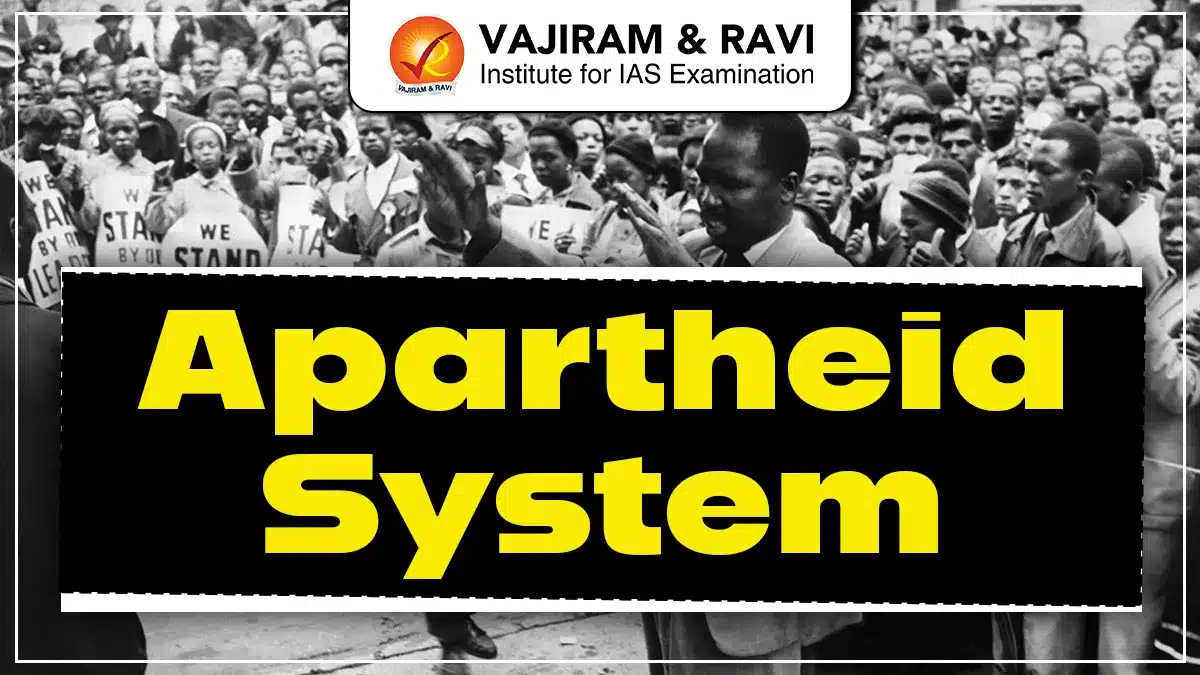
The Apartheid System was a legally enforced structure of racial segregation and discrimination in South Africa. It was imposed by white minority governments to maintain political, economic and social dominance over non-white populations, mainly Black Africans, Coloureds and Indians. Apartheid classified people by race, restricted movement, denied political rights, segregated education and housing and enforced inequality through law. Though abolished legally in the 1990s, its social and economic consequences continue to shape South Africa’s racial and economic divides even today.
Apartheid System
The Apartheid System functioned through a rigid legal framework that institutionalised racial hierarchy, enforced separation in daily life and denied non-whites basic civil, political and economic rights. Laws controlled residence, marriage, education, employment, voting and movement, ensuring white supremacy across all sectors. The system was divided into petty apartheid, affecting everyday social interactions and grand apartheid, reshaping land ownership, citizenship and economic participation. These features collectively reduced the Black majority to cheap labour while concentrating wealth, land and power in white hands.
Apartheid System Historical Background
Apartheid emerged from colonial racial practices, formalised in 1948 and enforced through legislation to sustain white minority rule in South Africa.
- Colonial Roots: Racial discrimination began with European colonisation from 1652, where land dispossession, slavery and pass laws restricted Black movement and economic freedom.
- Pre 1948 Pass Laws: Nineteenth and early twentieth century governments introduced pass systems limiting Black access to white areas, laying foundations for apartheid control mechanisms.
- Institutionalisation in 1948: The National Party formalised apartheid after winning elections, turning informal racial practices into binding national law.
- Population Registration Act 1950: This law classified all citizens as White, Black, Coloured, or Indian, determining rights, residence and access to services.
- Group Areas Act 1950: It segregated residential and business areas by race, leading to forced removals of nearly 3.5 million Black Africans between 1960 and 1983.
- Prohibition of Mixed Marriages Act 1949: It criminalised interracial marriages, reinforcing racial purity ideologies within the legal system.
- Bantu Education Act 1953: This law created a separate education system designed to prepare Black students only for manual labour roles.


Anti Apartheid Movement
The Anti Apartheid Movement was a global and domestic struggle aimed at dismantling racial segregation and ending minority rule in South Africa. It became the first successful transnational social movement of the twentieth century, linking internal resistance with global solidarity. The movement sought to overthrow apartheid internally and impose international political, economic and cultural sanctions externally.
- First Phase (Pre 1960s): Nonviolent resistance led by the African National Congress and South African Communist Party used protests, boycotts and civil disobedience.
- Second Phase (Post 1960s): The struggle internationalised, gaining support from the United Nations, African states, India and global civil society. The UN adopted the International Convention on the Suppression and Punishment of the Crime of Apartheid, framing apartheid as a crime against humanity.
- Third Phase (Post 1980s): Mass strikes, demonstrations and sabotage aimed to make South Africa ungovernable under apartheid rule. By 1990, bans on political organisations were lifted and major apartheid laws were repealed under mounting internal and external pressure.
Apartheid System Impact on Indians
Apartheid imposed systematic discrimination on Indians, restricting their rights, mobility and economic participation while placing them below whites in racial hierarchy.
- Racial Classification: Indians were legally categorised as non-white, divided into indentured labourers on plantations, merchant traders in urban markets and ex-indentured settlers
- Land Restrictions: The Asiatic Land Tenure and Ownership laws limited Indian property ownership and segregated Indian communities spatially.
- Economic Marginalisation: Indian traders faced licensing restrictions and exclusion from white commercial zones, limiting business growth opportunities.
- Social Segregation: Indians were barred from white public facilities, schools, hospitals and recreational spaces under petty apartheid regulations.
- Community Divisions: Indians were divided into indentured labourers, merchants and settled families, each facing distinct but interconnected forms of discrimination.
Apartheid System Role of India
India played a pioneering international role in opposing apartheid through diplomacy, sanctions and moral leadership.
- Gandhi’s Early Influence: Mahatma Gandhi’s experiences in South Africa inspired early resistance through nonviolent protest and political organisation.
- Natal Indian Congress: Founded in 1894, it became the leading Indian political organisation opposing racial discrimination and apartheid policies.
- Trade Sanctions: India became the first country to sever trade relations with South Africa in 1946, later imposing a complete embargo.
- UN Initiative: India brought apartheid to the United Nations in 1946, internationalising the issue before many newly independent states emerged.
- Support to ANC: The African National Congress maintained a representative office in New Delhi from the 1960s, reflecting India’s sustained support.
- Non Aligned Movement: Apartheid remained on the agenda from the first NAM conference in 1961, with India actively shaping collective opposition.
- AFRICA Fund: India contributed to financial and diplomatic efforts sustaining the global Anti Apartheid Movement.
Apartheid System Role of UN
The United Nations played a decisive role in delegitimising apartheid and mobilising international pressure against South Africa.
- Initial Complaints: The UN first addressed apartheid after South Africa passed discriminatory laws against Indian land ownership in 1946.
- Condemnation: In 1971, the UN declared apartheid a crime against humanity, marking a major moral and legal shift.
- Sanctions: Diplomatic, economic and cultural sanctions were imposed, including a mandatory arms embargo in 1977.
- Special Committees: The UN established the Special Committee against Apartheid in 1963 and the Centre against Apartheid in 1976.
- International Convention: In 1973, the UN adopted the Convention on the Suppression and Punishment of the Crime of Apartheid.
- Suspension: South Africa was suspended from the UN General Assembly in 1974 and readmitted only after democratic transition in 1994.
Anti Apartheid Leaders
Anti Apartheid leaders symbolised moral courage, resistance and reconciliation in the struggle against institutional racism.
- Nelson Mandela: A founding figure of resistance, he spent 27 years in prison before leading South Africa as its first Black President in 1994. Influenced by Gandhian principles, he emphasised reconciliation, justice and peaceful coexistence after apartheid’s collapse. He received the Nobel Peace Prize in 1993, symbolising international endorsement of the Anti Apartheid Struggle.
- Yusuf Dadoo: An Indian origin leader, he played a key role in underground resistance and global mobilisation against apartheid.
- ANC Leadership: Leaders like Oliver Tambo strengthened international alliances and sustained resistance during years of political repression.
Black Economic Empowerment Policy
The Black Economic Empowerment policy aimed to correct Apartheid Era economic exclusion but remains politically contested in its outcomes.
- Policy Objective: BEE seeks to increase Black ownership, management control and workforce representation in South Africa’s economy.
- Legal Framework: The Broad Based Black Economic Empowerment Act was enacted in 2003 to institutionalise economic transformation.
- Ownership Gaps: No Johannesburg Stock Exchange listed company is fully Black owned, reflecting limited success in wealth redistribution.
- Management Control: In 2022, whites, only 8 percent of the population, held 65.9 percent of top management roles, while Blacks held 13.8 percent.
- Employment Inequality: Blacks constitute 82.8 percent of unskilled labour but remain underrepresented in senior and skilled positions.
- Unemployment Disparities: In April–June 2024, Black unemployment stood at 37.6 percent, compared to 7.9 percent among whites.
- Political Debate: Critics argue BEE benefits a small Black elite, while supporters see it as essential for dismantling apartheid’s economic legacy.

 Last updated on Oct, 2026
→ UPSC 2027 Notification will be released on 13 January 2027 at upsconline.nic.in.
→ Check Nobel Prize 2026 Winners List here.
→ Download PIB PRiSM Monthly Magazine 2026 here.
→ Check UPSC Monthly Current Affairs Magazine The Recitals here.
→ Check out the latest UPSC Syllabus here.
→ Download UPSC Model Answers for Mains 2026
→ UPSC Mains Question Paper 2026 is out now for Essay & GS Paper 1, 2, 3 & 4.
→ UPSC Calendar 2027 has been released.
→ Enroll in Vajiram & Ravi’s UPSC Mains Test Series 2027 for structured answer writing practice, expert evaluation, and exam-oriented feedback.
→ Join Vajiram & Ravi’s UPSC Mentorship Program 2027 for personalized guidance, strategy planning, and one-to-one support from experienced mentors.
→ Go through the UPSC Mains Previous Year Papers to enhance your preparation.
→ UPSC has released UPSC Toppers List 2025 with the Civil Services final result on its official website.
→ Also check Best UPSC Coaching in India
Apartheid System FAQs
Q1. What was the Apartheid System?+
Q2. Who implemented Apartheid System in South Africa?+
Q3. How did the Anti Apartheid Movement succeed?+
Q4. What role did India play against Apartheid System?+
Q5. Is the impact of Apartheid System still visible today?+
Tags: apartheid system