Himachal Apple Import Duty Latest News
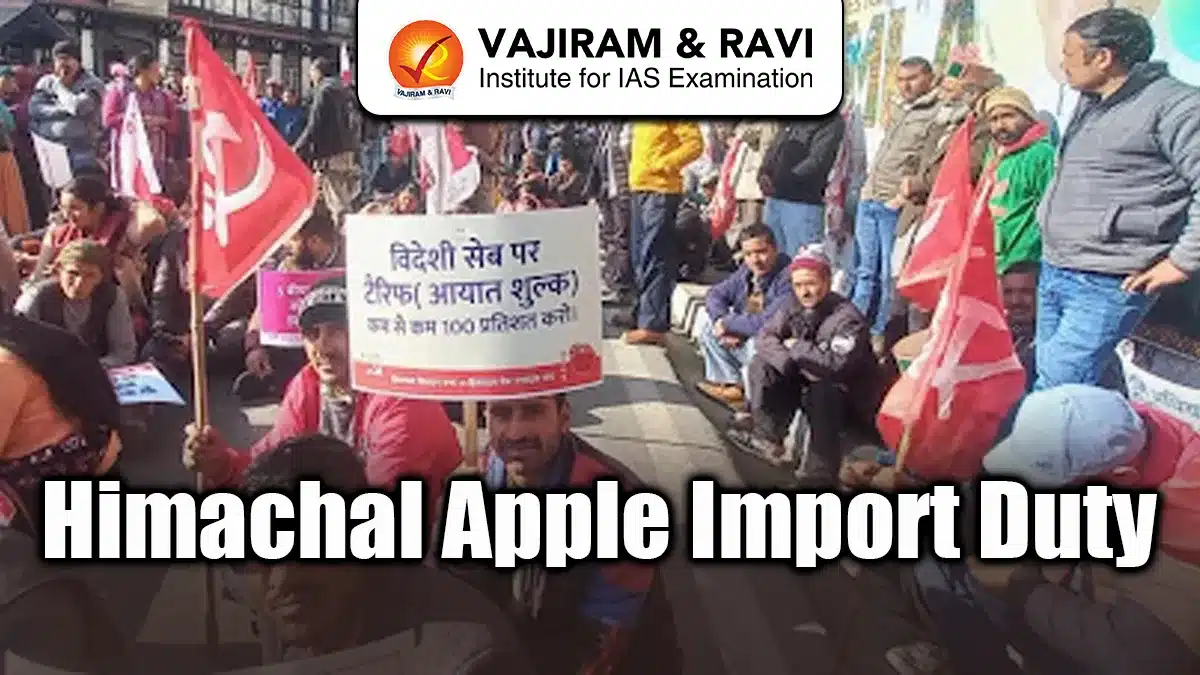
- Himachal Pradesh Chief Minister has urged the Centre to raise import duty on foreign apples from 50% to 100% and impose a seasonal ban on imports from July to November to protect about 2.5 lakh apple farmers. Apples account for nearly 80% of the state’s fruit output.
- The demand follows the Centre’s decision to cut import duty on New Zealand apples to 25% for April–August under the India–New Zealand FTA.
- Jammu and Kashmir has echoed similar concerns, warning that rising imports add to existing challenges faced by domestic apple growers.
India Cuts Import Duty on New Zealand Apples Under FTA
- Under the India–New Zealand Free Trade Agreement, India has reduced import duty on New Zealand apples from 50% to 25% under a quota system.
- The quota starts at 32,500 tonnes in the first year and rises to 45,000 MT by the sixth year.
- Imports must meet a minimum import price of $1.25 (₹113.6) per kg, while shipments beyond the quota will continue to attract the higher 50% duty.


Apple Production in India: J&K and Himachal at the Core
- India produces around 28 lakh metric tonnes (LMT) of apples annually.
- Jammu & Kashmir dominates output with about 20 LMT, followed by Himachal Pradesh at 5–6 LMT.
- The remaining production comes from Uttarakhand and a few north-eastern states, where cultivation is still nascent.
- The apple economy is valued at roughly ₹12,000 crore in J&K and ₹4,500 crore in Himachal Pradesh, making growers in these two states the most vulnerable to increased imports and tariff concessions.
Farmers’ Concerns Over Cheaper Imports
- Apple growers are worried about the overlap between New Zealand’s export window and India’s off-season market.
- In India, apples are harvested between July and November, while off-season sales depend on cold storage and Controlled Atmosphere (CA) facilities.
- New Zealand, however, harvests apples between January/February and May, allowing it to supply fresh apples when Indian farmers sell stored produce.
Impact on Domestic Prices and Sales
- Farmers warn that lower import duties will make foreign apples cheaper than domestic produce, directly affecting sales.
- In Jammu & Kashmir, high-density varieties like Gala arrive in June, while Royal Delicious reaches markets by September.
- Since the duty cut applies from April to August, growers fear significant losses during peak marketing periods.
Threat to Market Share
- Orchardists from Himachal Pradesh and Jammu & Kashmir argue that cheaper imports will depress domestic prices, reduce market share.
- It will hit farmers hardest during the off-season, undermining incomes in India’s key apple-producing regions.
Challenges Beyond Import Competition
- Climate Stress and Falling Yields – Apple production in HP and J&K has been hit hard by climate change, erratic weather, reduced snowfall, prolonged dry spells, floods, cloudbursts and landslides.
- These factors have weakened orchards and lowered productivity.
- Rising Disease Burden – Changing climatic conditions have led to a surge in plant diseases such as fire blight, apple scab, powdery mildew, sooty blotch and bitter rot.
- Reduced snowfall and higher temperatures have worsened water scarcity, increasing disease vulnerability during dry seasons.
- Production Losses and Quality Decline – In 2023, Himachal’s apple output fell to 4.84 LMT, nearly 28% lower than 2022, following devastating floods.
- Although production recovered to 6.87 LMT in 2025, excessive rainfall and disasters caused quality deterioration, with nearly 1 LMT rejected for poor size and quality.
- Infrastructure and Transport Bottlenecks – Logistical disruptions have compounded farmers’ problems.
- The prolonged closure of the Jammu–Srinagar National Highway (NH-44) due to landslides last year stranded hundreds of trucks during peak harvest, delaying market access and causing losses.
Farmers’ Demands for Protection
- Given these cumulative pressures, farmers’ groups have demanded 100% import duty on foreign apples, a July–November import ban, special category protection, and higher subsidies.
- They argue that unlike countries such as New Zealand, where apple farming is heavily subsidised and insured, Indian growers receive limited direct support.
- Farmer leaders stress that instead of increasing exposure to foreign competition, the government should focus on targeted support, productivity enhancement, and resilience-building for domestic apple growers.
Source: IE

 Last updated on August, 2026
→ UPSC Mains 2026 commenced on 21st August 2026 and will continue through 30th August 2026, as per the official examination schedule.
→ UPSC Mains Question Paper 2026 is out now for Essay & GS Paper 1, 2, 3 & 4.
→ UPSC Mains GS Paper 1 2026 is out now.
→ UPSC Mains GS Paper 2 2026 is out now.
→ UPSC Mains GS Paper 3 2026 is out now.
→ UPSC Mains GS Paper 4 2026 is out now.
→ Check out the latest UPSC Syllabus 2026 here.
→ UPSC Mains Admit Card 2026 is now out.
→ Enroll in Vajiram & Ravi’s UPSC Mains Test Series 2027 for structured answer writing practice, expert evaluation, and exam-oriented feedback.
→ Join Vajiram & Ravi’s UPSC Mentorship Program 2027 for personalized guidance, strategy planning, and one-to-one support from experienced mentors.
→ Go through the UPSC Mains Previous Year Papers to enhance your preparation.
→ Download UPSC Mains Essay Paper 2025, UPSC Mains GS Paper-I 2025, UPSC Mains GS Paper-II 2025, UPSC Mains GS Paper-III 2025, UPSC Mains GS Paper-IV 2025, UPSC Mains English (Compulsory) Paper 2025, UPSC Mains Hindi (Qualifying) Paper 2025 here.
→ UPSC has released UPSC Toppers List 2025 with the Civil Services final result on its official website.
→ UPSC Calendar 2027 has been released.
→ Also check Best UPSC Coaching in India
Himachal Apple Import Duty FAQs
Q1. Why is the Himachal apple import duty in news?+
Q2. What triggered concerns over the Himachal apple import duty?+
Q3. How many farmers depend on the Himachal apple economy?+
Q4. Why are New Zealand apples a threat to Indian growers?+
Q5. What additional challenges do apple farmers face besides imports?+
Tags: Himachal apple import duty mains articles upsc current affairs upsc mains current affairs